


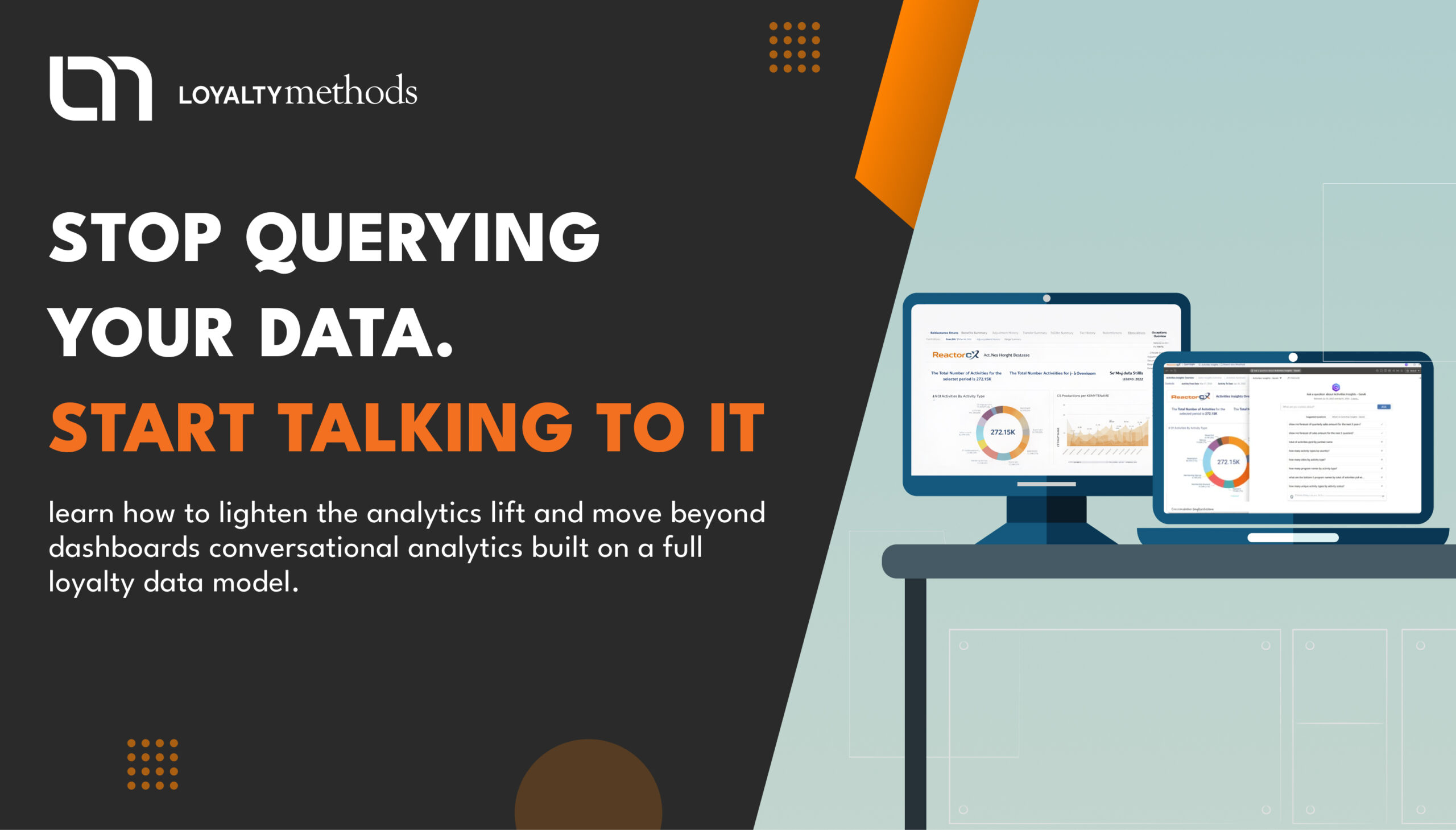
For enterprise loyalty teams managing multi-brand programs, the path from question to insight takes too long. Running a loyalty program across multiple brands, regions, or lines of business means answering questions that span those dimensions. Which segments drove redemption lift in Q3? How does tier progression compare across brands? What’s our liability exposure heading into Q4?
These are everyday questions. And in most enterprise loyalty environments, answering them takes longer than it should. The loyalty team knows what they want to learn. The data exists somewhere in the platform. But between the question and the answer sits a queue: an IT ticket, a SQL request, a spot on the analytics backlog. By the time the report arrives, the window to adjust the campaign has closed.
This is the dashboard trap.
Pre-Built Dashboards Solve the Wrong Problem
Every loyalty platform ships with dashboards. They show what the vendor anticipated you’d want to see: enrollment trends, point balances, redemption rates. The charts are polished. The data refreshes on schedule.
The problem is that the questions loyalty teams actually ask rarely match the questions dashboards were designed to answer.
A program director doesn’t want to know redemption rates in aggregate. She wants to know redemption rates for lapsed Gold members who received the Q3 win-back offer in the Southeast region. That query doesn’t exist in a pre-built dashboard. It never will, because the vendor couldn’t anticipate it.
What Conversational Analytics Actually Means
This isn’t a chatbot summarizing pre-built reports. The system generates an actual SQL query against the underlying data model. When a loyalty manager asks, “How many people moved up to the highest tier last month?” the platform generates a query, runs it against the data warehouse, and returns a table or chart. No IT ticket required.
The questions can be specific: “Show me promotion performance for campaigns launched in December.” They can be forward-looking: “Show me a model-driven forecast of quarterly sales for peak season next year.” They can span the dimensions that matter to multi-brand programs: “Total activities year-to-date by partner name.”
Role-based permissions, query limits, and row-level security ensure users only access data they’re authorized to see.
What makes this different from a business intelligence tool bolted onto a loyalty platform is that the natural language interface sits on top of a complete loyalty data model. The system understands tiers, promotions, members, transactions, and the relationships between them.
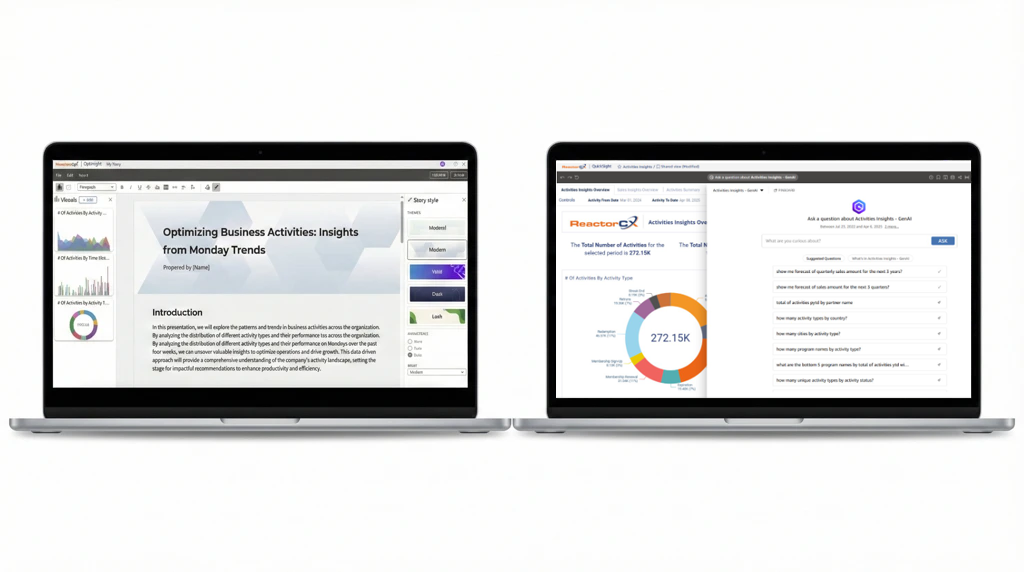
Four Layers of Access: Analyze, Ask, Anticipate, Act
Analyze: Pre-built dashboards covering the operational categories loyalty teams track daily: promotions, tiers, streaks, liability, accruals. These dashboards refresh in near real-time. Clients can copy them, modify them, or build their own. External data can be ingested for richer context.
Ask: Conversational analytics for business users who need answers to questions the dashboards don’t cover. Natural language questions generate SQL queries on demand. Tables and charts appear instantly, without requiring technical expertise.
Anticipate: AI-powered insights that surface what you should be asking, not just what you did ask. The system detects trends and anomalies automatically, generates executive summaries with a single click, and delivers them directly to leadership. It forecasts liability, redemption patterns, and member behavior so teams can anticipate cash flow needs rather than react to them.
Act: Unfettered SQL access for technical teams who want direct control. Power users can query the full loyalty data model directly, and BI tools like Tableau, Looker, or Power BI can connect straight to the data warehouse.
These layers aren’t mutually exclusive. A loyalty team might use pre-built dashboards for daily monitoring, conversational analytics for ad-hoc questions, and direct SQL access for custom models.
The Anti-Silo Philosophy: Loyalty Analytics Without Lock-In
ReactorCX takes the opposite approach.
Most enterprise clients already have a CDP or BI tool. They’ve invested in Tableau or Looker or Power BI. They have data teams who prefer their own tools. The goal isn’t to replace that infrastructure. The goal is to feed data into it.
This means syncing roughly 100 tables to the client’s data lake on a regular basis. It means providing direct SQL access so any BI tool can query the data warehouse. It means treating loyalty data as an asset the client owns, not a resource the vendor controls.
What We've Learned at 26 Billion Transactions
Real-time visibility changes behavior. When loyalty teams can see promotion performance as it happens, they iterate faster. Campaigns get adjusted mid-flight instead of analyzed after the fact.
Executive teams don’t log in to platforms. They read summaries. Automated insights that arrive in their inbox get attention. Dashboards requiring navigation don’t.
Technical teams value unfettered access because they’ve been burned by platforms that deliver rate limits, incomplete documentation, and proprietary data formats. Direct SQL access with no restrictions builds trust.
Speed to Insight Changes Everything
Program iteration cycles compress. Questions get answered while they’re still relevant. Data becomes a resource the whole organization can use, not a queue the business has to wait in.
Stop querying your data. Start talking to it. Your choice. Your data.