
9 Best Talon.One Alternatives You Should Know in 2026
Loyalty Methods · ReactorCX 2026
Talon.One unifies promotions and loyalty in one rules engine that's built for marketing to manage without engineering tickets. Your systems send it a cart or an event, and it returns what applies: a valid coupon, a discount, points earned, a tier change. But a cart is a clean object, and a lot of loyalty activity isn't.
When a member pulls up to the pump, the discount has to be there before they start fueling, and a guest who spends four nights at your hotel is earning across the spa and the steakhouse too, not just the room. The further your program sits from a shopping cart, the more of that logic your team maintains outside the platform.
Which alternative fits depends on the scale and complexity of your loyalty program. A DTC brand running targeted promotions on one storefront needs far less from its platform than a global program calculating earn, redemption, tier status, and point liability across markets. Getting that distinction right keeps you from paying for enterprise infrastructure you won't use, or choosing a lighter tool your program outgrows in two years.
Nine platforms follow, and they sit at different points on that spectrum. Each entry covers the kind of program it suits, where it stands out, and the tradeoffs to consider, so you can build a shortlist around what your program actually needs.
The Top Talon.One Alternatives at a Glance
| Product | Best For | Tier It Serves |
|---|---|---|
| Loyalty Methods (ReactorCX) | Complex enterprise loyalty setups and migrations | Enterprise, multi-brand, multi-region |
| Antavo | Gamified enterprise loyalty programs | Mid-market to enterprise |
| Voucherify | API-first promotion and incentive customization | Developer-led, any size |
| Open Loyalty | Self-hosted loyalty with data residency control | Regulated, data-residency constrained |
| Epsilon | Identity-led loyalty at enterprise scale | Enterprise, service-led |
| Salesforce Loyalty Management | Brands already in the Salesforce ecosystem | Enterprise Salesforce estates |
| Smile.io | Simple Shopify loyalty programs | Shopify SMB and DTC |
| Yotpo | Pairing loyalty with an existing reviews program | Shopify and mid-market ecommerce |
| LoyaltyLion | Loyalty analytics and Klaviyo-native segmentation | Shopify and Shopify Plus |
1. Loyalty Methods (ReactorCX): Best for Complex Enterprise Loyalty Setups and Migrations
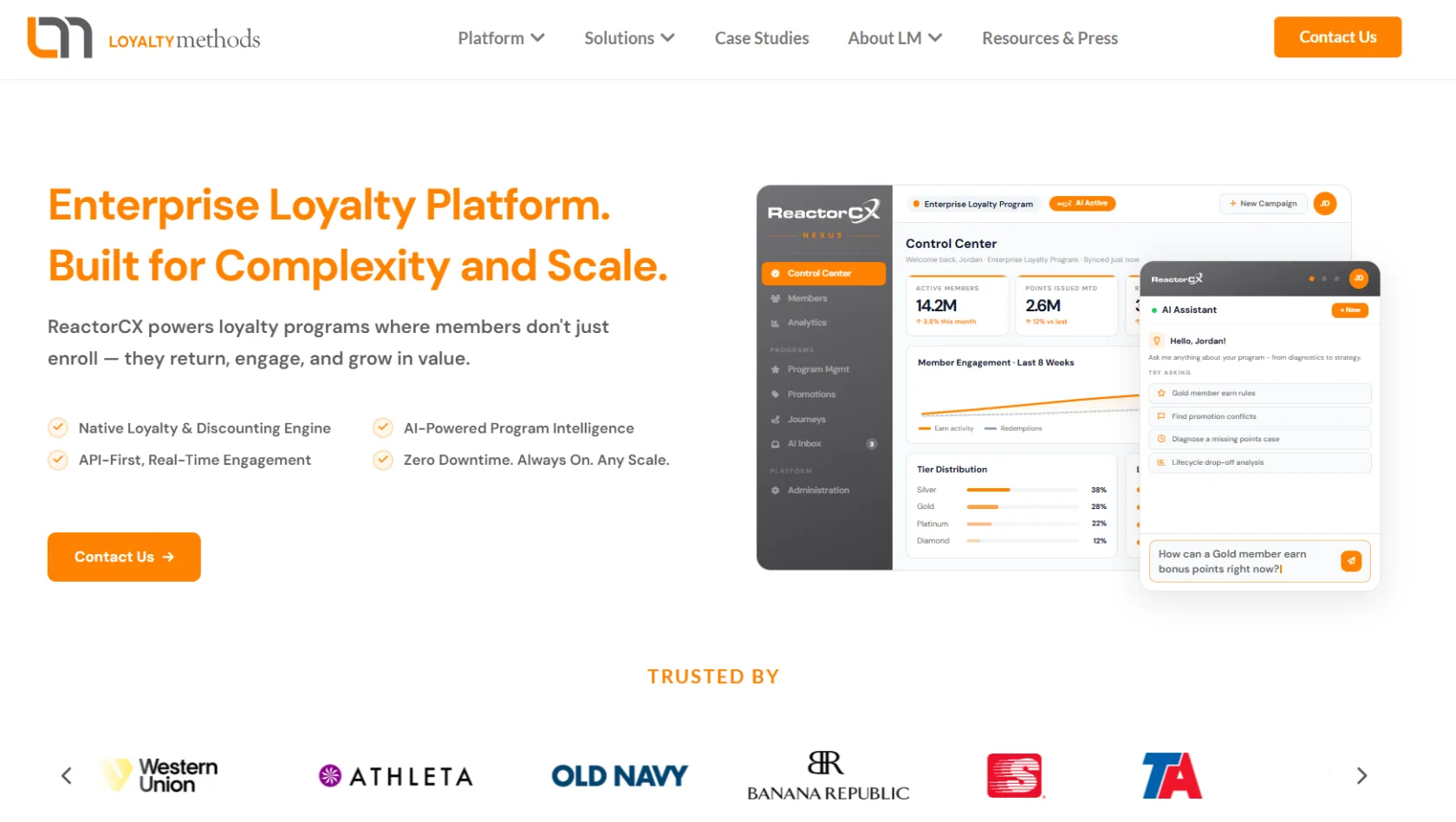
Loyalty Methods' ReactorCX sits beneath the customer-facing app, calculating earning and tier status while maintaining point liability. Its headless, API-first architecture lets existing point-of-sale, ecommerce, CRM, and marketing systems keep their current roles and call ReactorCX for loyalty decisions, with answers returned in sub-second time, inside the POS timeout window rather than as balance that catches up overnight. That includes the physical lane: ReactorCX prices the transaction at the pump and the register in real time, for the entire customer base, members or not. Last year alone that meant 4.2 billion transactions across 824 million member accounts.
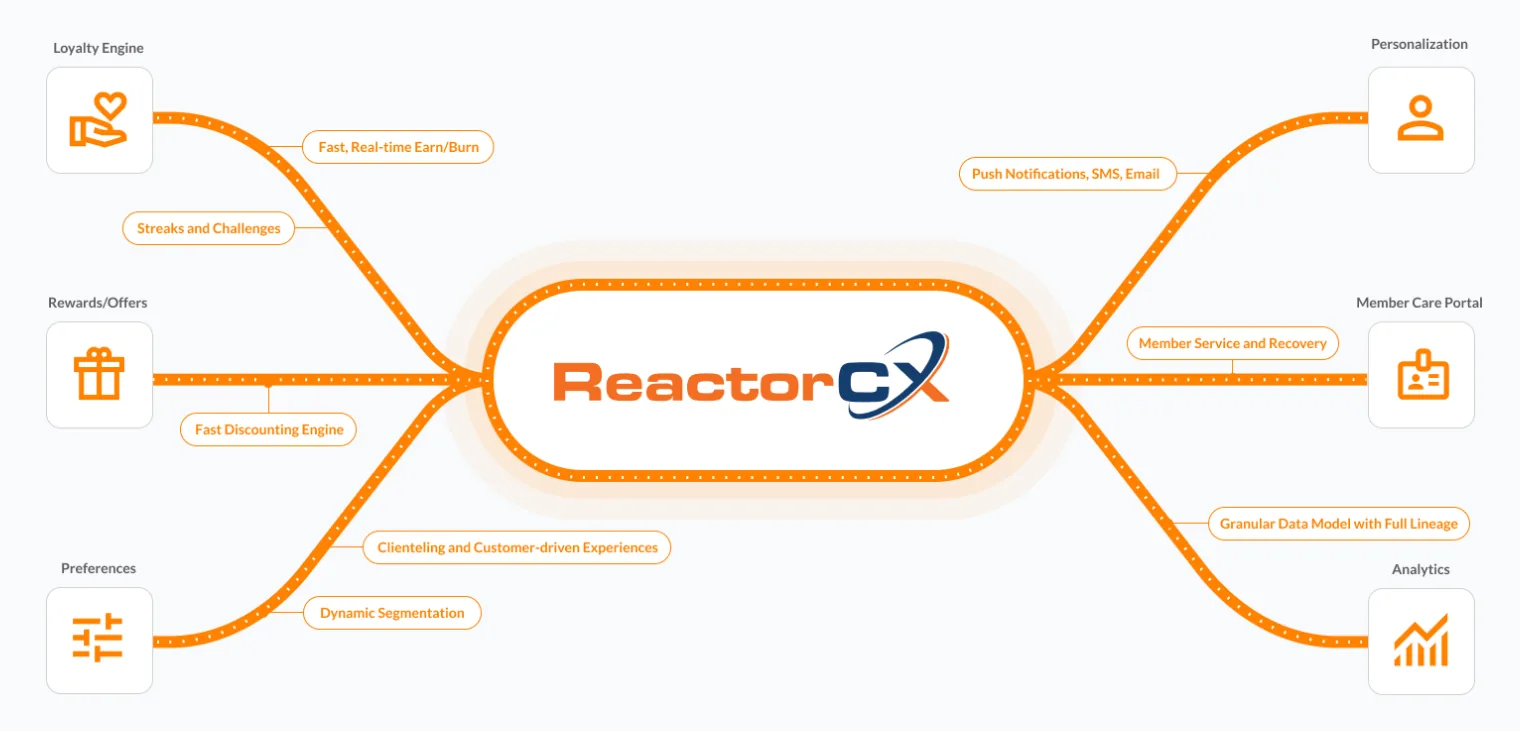
The deeper difference is that the platform itself is programmable. When a program needs a capability ReactorCX doesn't ship, it gets built inside the platform as configuration, real code with versioning and audit, instead of being filed as a vendor change request. Enterprises have added household-level tiers and custom recognition mechanics this way without waiting on a roadmap. Talon.One customers can compose new rules too, but only from the vocabulary its rule language provides; ReactorCX accepts logic the platform has never seen.
A single member balance can hold a holiday bonus, points earned on the co-brand card, and resort credit that only spends at one property. Multi-currency wallets keep those as separate purses inside one balance, and every point carries the rule that issued it, so burn order is set and any redemption traces back to the brand, partner, or promotion that funded it.
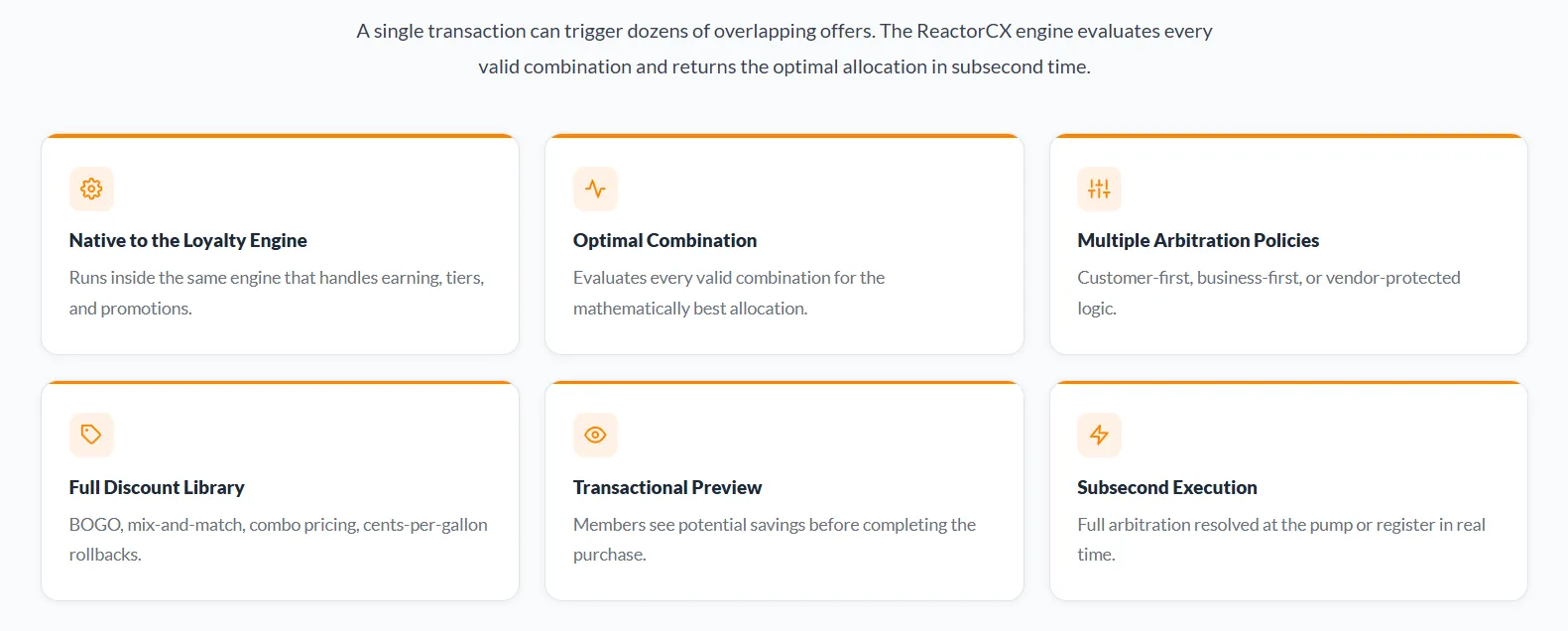
One checkout can put dozens of offers in play at once, including member deals, storewide promotions, or vendor-funded discounts, and something has to pick the winner before the receipt prints. ReactorCX arbitrates them in real time under a policy you set, favoring member savings, margin, or vendor-funded dollars first, and it prevents offers from stacking by accident, so the price on the ticket is always the one you intended. Budget ceilings pull an offer the moment its funding is spent, so a promotion that overperforms stops itself instead of running past its funding.
Enterprises replacing a legacy loyalty platform also need a safe way to bring the existing program across. That means preserving member records, outstanding point balances, tier state, and the qualification history behind each tier. SafeSwitch™, Loyalty Methods' four-gate process for zero-downtime migrations, runs the two platforms in parallel until they reconcile against live production traffic. Cutover waits until the new engine returns the same answers account by account, and the rollback stays armed after members move.
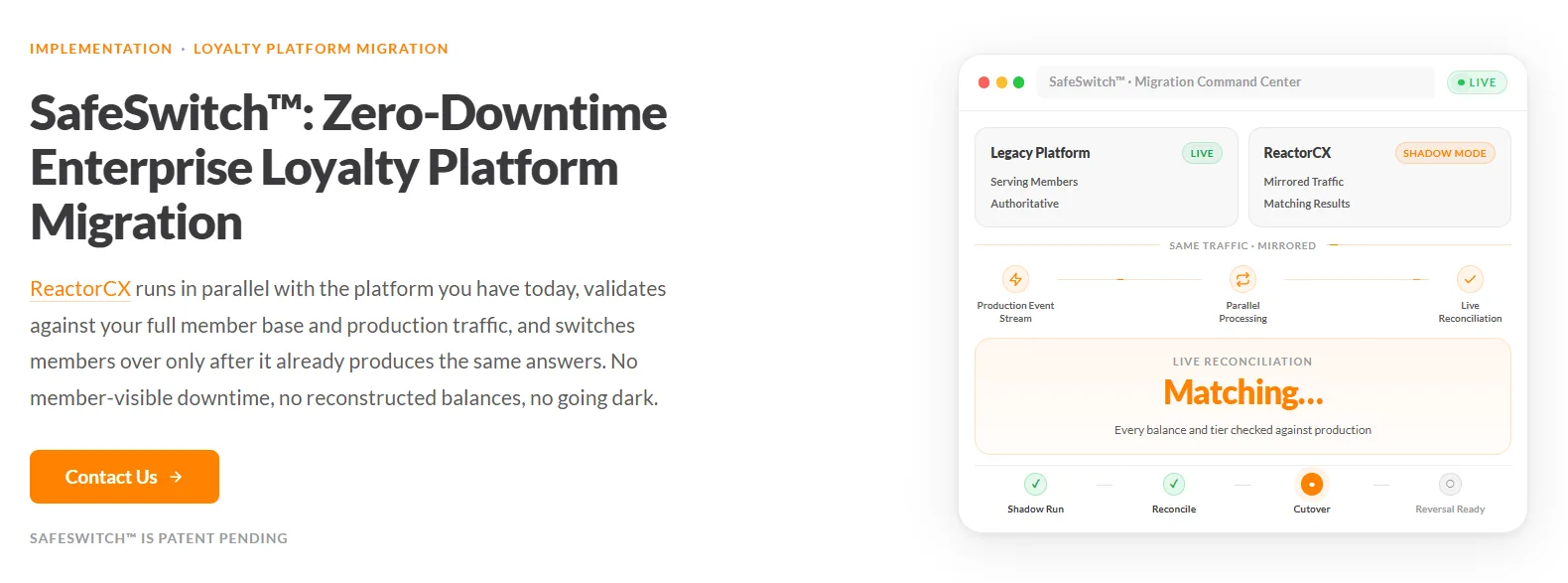
Every outstanding point is money the brand already owes, so a botched cutover is an accounting failure before it is a customer experience one. Loyalty Methods has moved more than 700 million member records between platforms this way, with full transactional history carried across rather than balances alone.
ReactorCX is best suited to enterprises above $1 billion in revenue whose loyalty programs span multiple lines of business and regions, often on a technology stack assembled over many years. It becomes especially relevant when a live program has to move platforms without going dark because it works alongside the CDP and marketing execution tools already in your stack. The CDP supplies the customer profile, while ReactorCX decides what each transaction earns.
Loyalty Methods’ Best Features
- Programmable core: New capabilities, household tiers, custom badges, bespoke earn logic, are built inside the platform as configuration, so the feature list is a floor rather than a ceiling.
- Discount arbitration: Dozens of overlapping offers on one checkout resolve in subsecond time under a policy you set, favoring member savings, margin, or vendor-funded dollars first, with accidental stacking prevented.
- SafeSwitch™ migration: Four gates run in sequence, shadowing full production load, reconciling every record against legacy, cutting over with named owners, and holding rollback until the new engine is stable.
- Rule audit: Built into migration, it compares what legacy is actually running against the program's published terms, catching expired promotions and drifted tier logic before they carry over.
- Multi-brand, multi-region structure: Brands, regions, and point types share one instance, with local-currency earn and redemption and mixed baskets resolved at line-item level so each brand's P&L gets the right revenue.
- Accrual lineage: Every point carries the rule that issued it, driving FIFO burn order across purses and giving finance a per-point audit trail instead of a breakage estimate.
- Bring-your-own-LLM access: The RCX AI Server exposes program configuration over Model Context Protocol, and the AI layer drafts changes for a human to approve.
Loyalty Methods’ Pricing
Loyalty Methods offers custom plans and pricing that reflect program footprint and scope, including:
- How many brands and currencies run in one instance
- Integration scope across point-of-sale systems and the existing CRM or marketing stack
- Whether you're moving from a legacy platform
What Are People Saying About Loyalty Methods
“Loyalty Methods has been a crucial partner, providing a flexible platform and bringing an experienced team that has partnered well with bp to deliver on our initiatives with excellence and dedication.”
Tarang Sethia, Chief Product Officer and General Manager, Digital Products, Mobility and Convenience Americas, bp
“They are experts in their space and provide excellent solutions, creativity and out of the box thinking.”
Steve Kinch, Innovation Leader, 7-Eleven
“LM's focus on innovation, agility, and successful, seamless delivery has made a massive difference in our efforts.”
Lucy Donaldson, Head of Loyalty, Martech and Consumer Ecosystems, Western Union
2. Antavo: Best for Gamified Enterprise Loyalty Programs
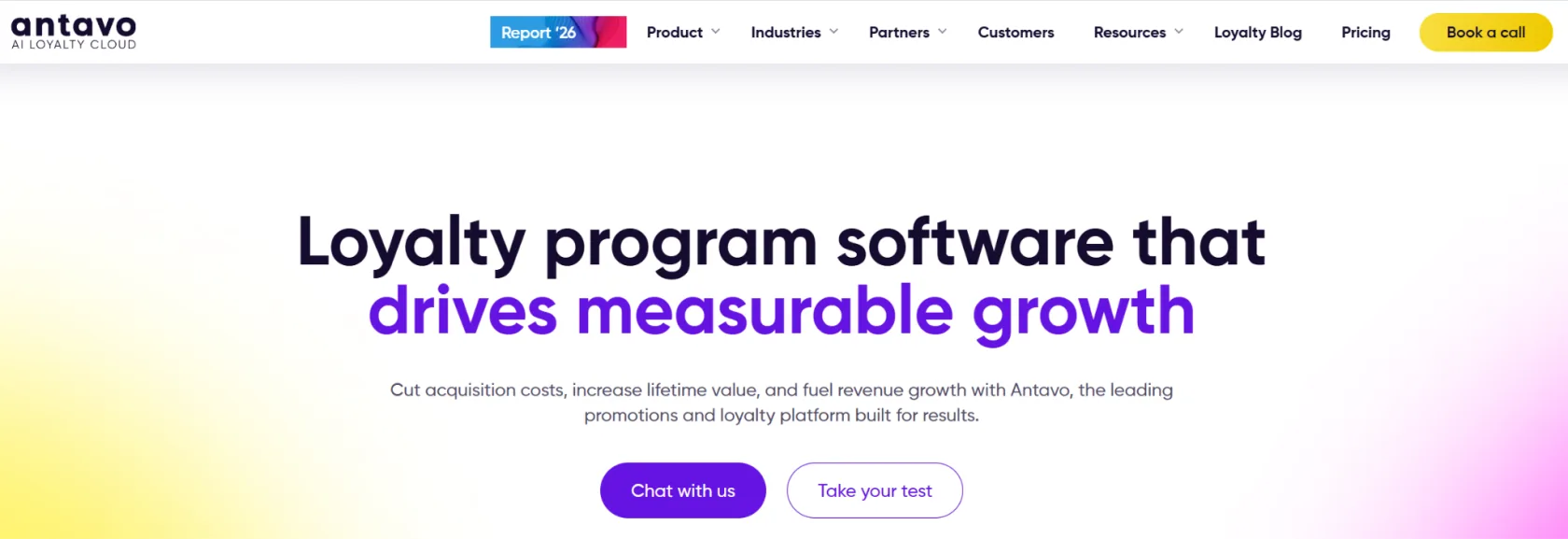
Antavo focuses heavily on gamification. Each mechanic carries its own configuration page with named fields, event names, and API endpoints. This depth is especially useful for fashion, beauty, travel, and hospitality brands, where months can pass between purchases and the program has to give members a reason to come back before they're ready to buy.
Running mechanics beyond points earning usually means adding a third-party gamification tool alongside the loyalty platform. But Antavo covers challenges, missions, badges, and streaks aimed at repeat visits, plus prize wheels, sweepstakes, and scratch cards. Gamified profiling extends that to zero-party data, with answers written straight into customer attributes.
For programs operating across markets, the Multi-accounts module gives each customer several point accounts, each with its own currency label, type, and earn, burn, and expiration rules. Tiers can be spend-based, point-based, or invitation-only, with reset cadences configured per program.
Antavo's historical transaction import doesn't carry point balances across, so someone on your team adjusts every member's balance by hand and checks the migrated data against the old system. If you're launching a new program, that never comes up. If you're moving a live one with millions of members holding balances they can see in the app, it's the part of the project to plan around first.
Antavo makes the most sense for brands using engagement mechanics to differentiate their loyalty programs, and is less suited where the hard part is transaction complexity.
Antavo’s Best Features
- Challenge rules on count or accumulating calculation methods, with unlimited criteria, repeat intervals down to an hour, and max-completion caps
- Gamified profiling across ten question types, from like-or-dislike cards to image picks, sliders, and date pickers
- Points, credits, and stamps as separate currencies, with per-customer multi-accounts and family accounts that pool balances
- POS redemption, receipt scanning for the transactions the POS does not reach, and Apple Wallet and Google Wallet passes
- No-code workflow editor and Loyalty Planner for program design, with Timi AI drafting campaign logic from a written brief
Antavo’s Pricing
Antavo offers Start, Grow, and Enterprise plans, but none have public pricing or specific plan details listed. You have to contact them for a quote.
Reviews and Ratings
- Capterra 4.4/5 (19 reviews)
- TrustRadius 8.5/10 (8 reviews)
- G2 4.2/5 (7 reviews)
- Gartner Peer Insights 4.0/5 (5 reviews)
3. Voucherify: Best for API-First Promotion and Incentive Customization
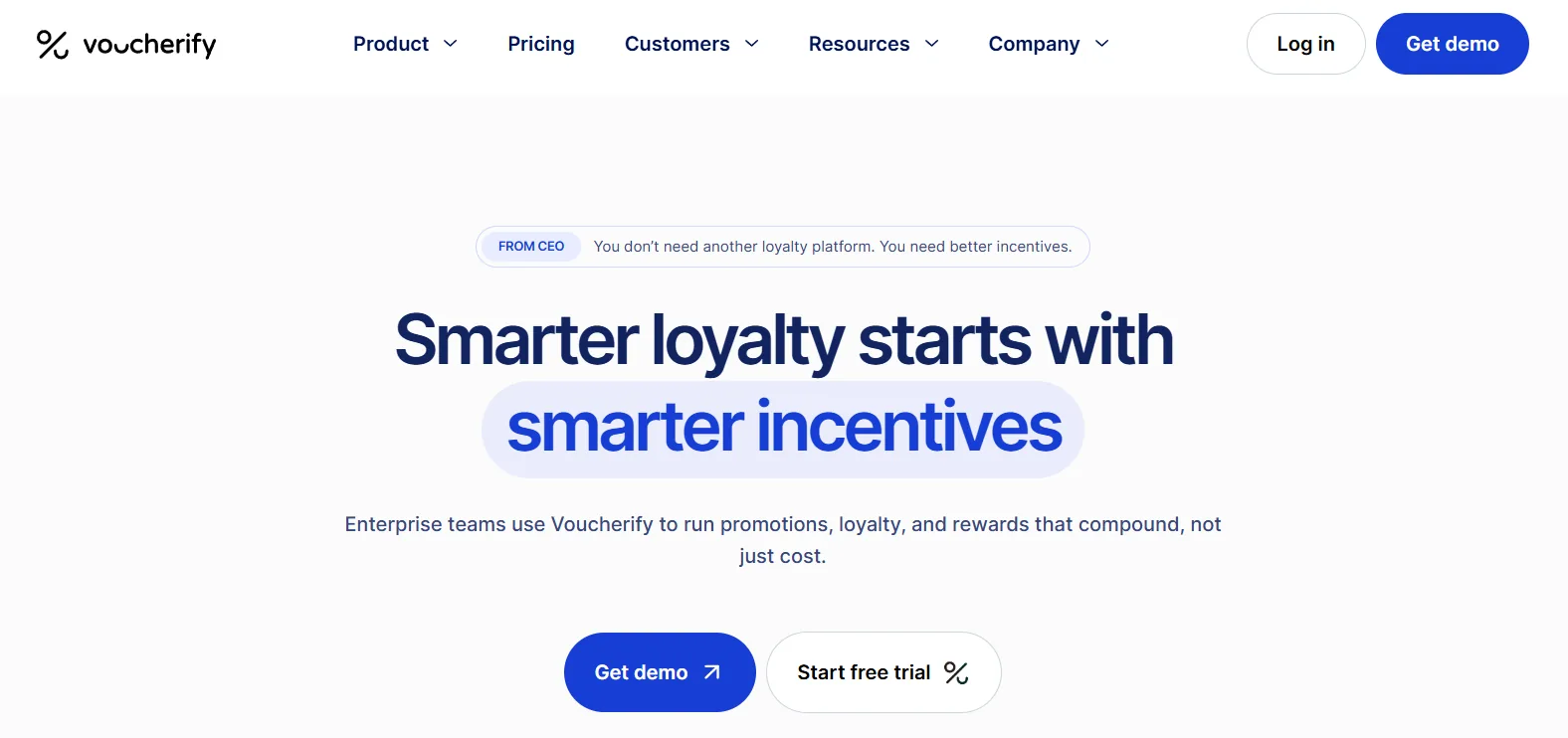
Voucherify puts promotion and loyalty logic behind APIs for product and engineering teams building a custom commerce experience, which makes it the closest architectural match to Talon.One on this list. What separates them is how much program you get versus how much you define.
Voucherify supplies the pieces, campaigns, vouchers, points, and referral mechanics, and expects your team to decide how they fit together. Talon.One arrives with more of that structure already made.
Voucherify's rule engine is reachable through three calls that cover the full lifecycle of an offer. Qualification returns the promotions a cart is already eligible for, validation prices a specific offer against that cart, and redemption commits it to the order. All three hit the same engine, so stacking, exclusions, and priority order resolve in one place instead of drifting between the checkout page and the fulfillment call.
Custom metadata lets Voucherify's rule engine evaluate fields specific to the business. Teams can attach any attribute to a customer, product, campaign, or redemption, then write rules against it. That way, a subscription company can gate an offer on plan tier and renewal date, or a marketplace on seller rating, without either field existing in a standard cart schema.
The tradeoff is that Voucherify stops at the API. Points balances, tier progress, the referral flow, and the screens a support agent uses to fix an account are all your build. That means a front-end workstream on top of the integration at launch, and engineering time for every later change a member would see. When someone calls about missing points, whether an agent can fix it depends on whether you built that tool.
Voucherify fits companies that want incentive logic to behave like part of their own product and have the engineering capacity to keep it there. It's the wrong fit for a marketing team that expects to launch a tier change without filing a ticket.
Voucherify’s Best Features
- Qualification, validation, and redemption APIs covering coupons, gift cards, referrals, loyalty, and bundles on one rule engine
- Extensible metadata on customers, products, campaigns, and redemptions, usable directly in promotion rules
- Referral programs with custom qualification rules, per-referral limits, velocity caps, and self-referral flagging
- Webhooks and Kafka event streaming into a data warehouse, with stacking rules and spend caps set by brand, market, and tier
- Free sandbox and published API reference, so a developer can prototype the rule model before a contract exists
Voucherify’s Pricing
Voucherify offers three primary plans based primarily on API calls and project count, each with a 60-day free trial.
- Business: $650 per month — 25,000 API calls per month, 100 per minute, 3 projects, unlimited users and campaigns, shared hosting.
- Organization: $1,300 per month — 50,000 API calls per month, 200 per minute, 5 projects, shared hosting.
- Enterprise: Custom quote — Custom limits, private data hosting, and the enterprise-only geofencing, management APIs, and areas and stores features.
Reviews and Ratings
- Capterra 4.8/5 (24 reviews)
- G2 4.6/5 (24 reviews)
4. Open Loyalty: Best for Self-Hosted Loyalty with Data Residency Control
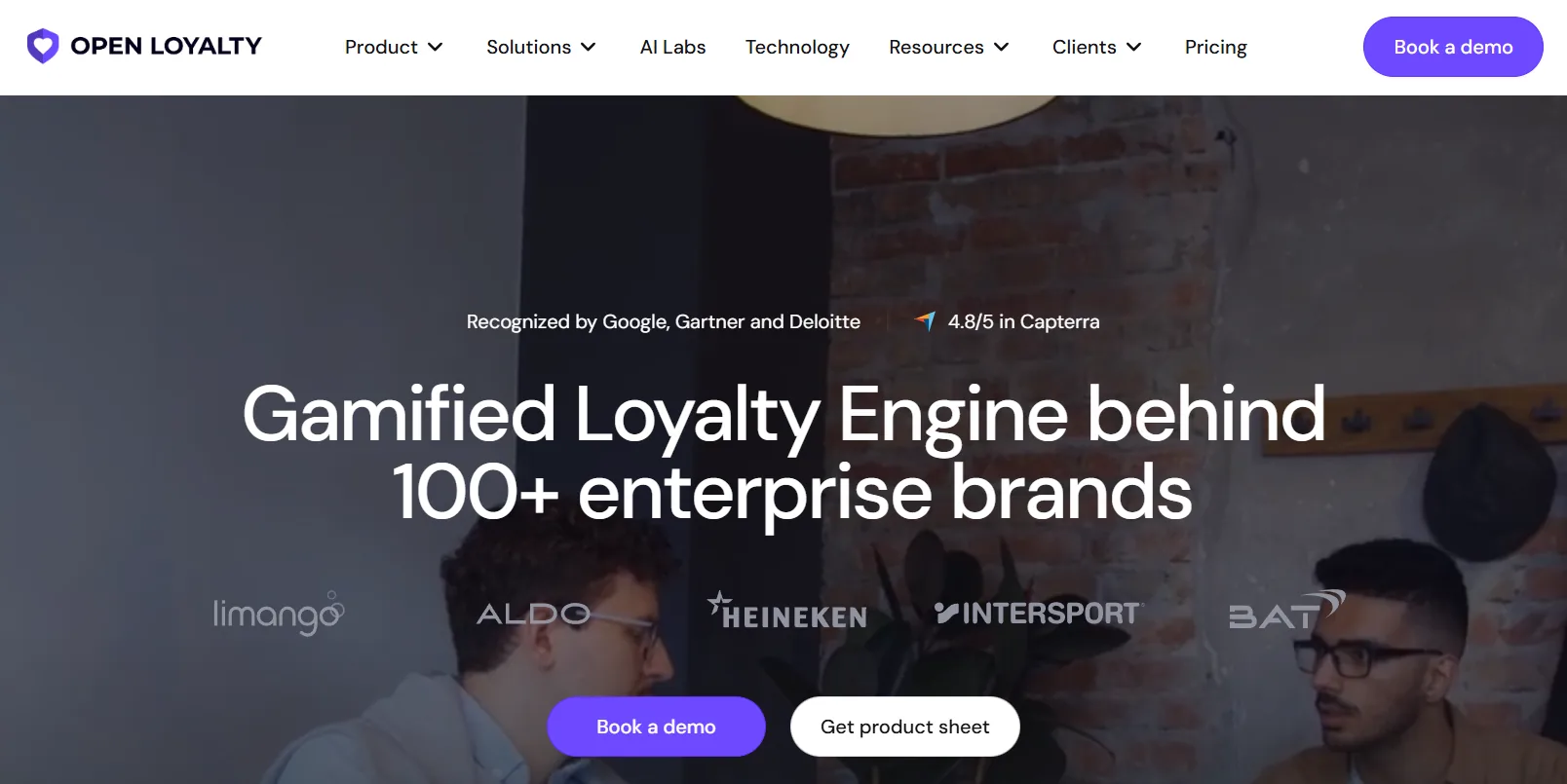
Open Loyalty is a headless loyalty engine that you run where you want it. Standard SaaS is available with regional storage in Europe, APAC, or North America, and enterprises that need the engine inside their own perimeter can deploy it to private cloud or on-premise infrastructure.
Every client instance runs on its own database and Kubernetes namespace, with a full audit log on every change to PII data. Certification covers ISO 27001 and ISO 9001, and enterprise identity connects through SAML and LDAP. Nightly incremental exports can also send loyalty data through AWS S3 to your own data lake.
Multitenancy lets a global program run separate configurations per market inside one deployment. Each tenant holds its own currency, rules, and member data, so a program in Germany can't read or write what a program in Singapore holds, and coalition brands stay separated the same way. Country teams and business units get their own scheme without anyone standing up a second installation to maintain.
Gamification is built in, with points, tiers, challenges, badges, and referrals available as engine primitives your developers compose. Every operation runs through the REST API, so a program change can be scripted, scheduled, or triggered from another system in your stack.
Open Loyalty hands your team building blocks to assemble. That puts a developer between a marketer and every promotion launch or tier threshold change. Migration works the same way, with bulk import covering members and points while redemption status, custom events, and webhook configuration come across through API work, and no documented parallel run before cutover.
Open Loyalty aligns with regulated or multinational programs where deployment location is a compliance requirement and markets have to stay separated at the data layer. Running it takes in-house engineering capacity, both to stand the platform up and to keep it current.
Open Loyalty’s Best Features
- Deployment to your own private cloud or on-premise infrastructure, or SaaS with customer-selected AWS region
- Gamification spanning challenges, streaks, badges, leaderboards, cashback, and games of chance including Spin the Wheel and Scratch & Win
- Trigger-condition-effect events engine reachable from any stack through REST, with earning rules, campaigns, tiers, and member profiles all exposed
- Per-tenant timezones, segments, member lists, and translations running from one installation
- Campaign builder for assembling tiers, referrals, and vouchers from configured components
Open Loyalty’s Pricing
Open Loyalty doesn't list their plans or pricing publicly, and doesn't include a free trial. All quotes require an estimate based on your project scope.
Reviews and Ratings
- Capterra 4.8/5 (15 reviews)
- G2 4.7/5 (16 reviews)
5. Epsilon: Best for Identity-Led Loyalty at Enterprise Scale
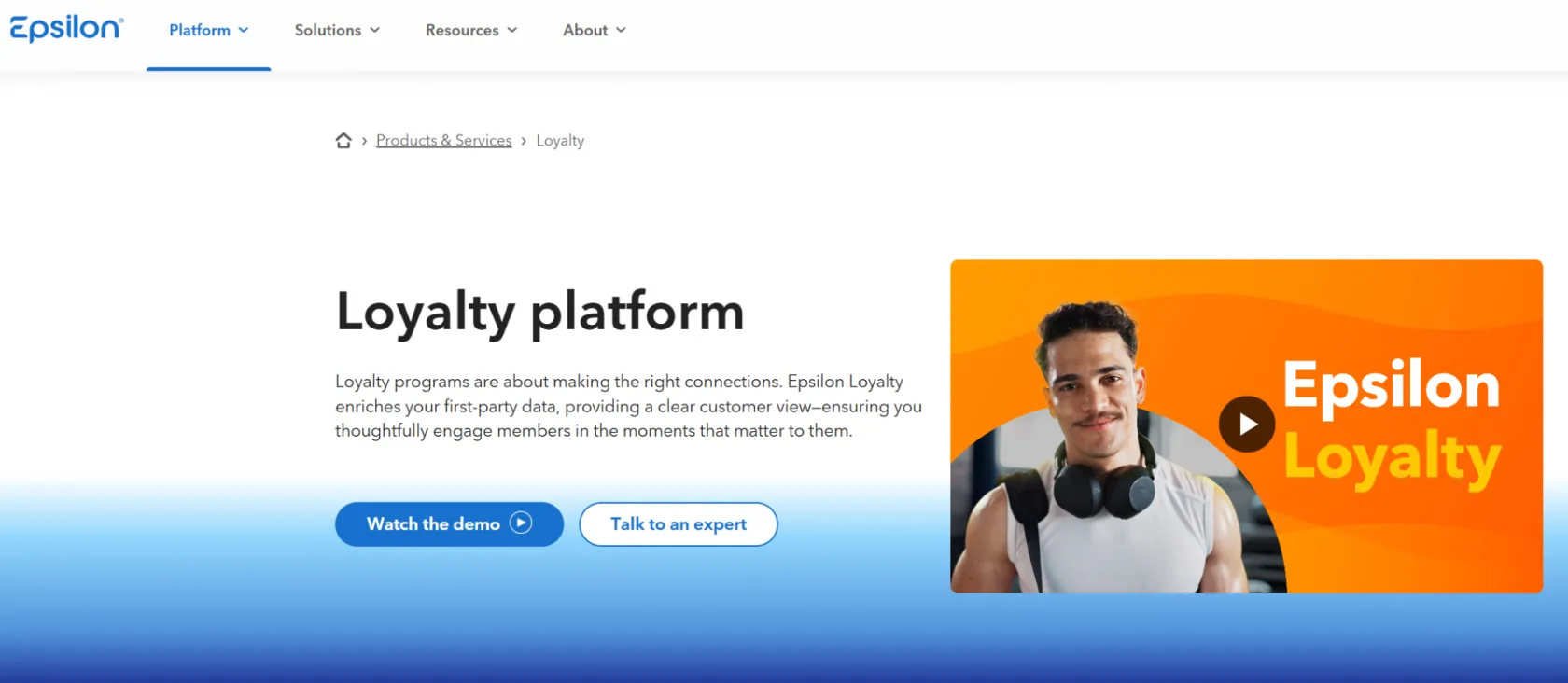
Epsilon uses identity resolution to connect loyalty activity to the same person across online and offline interactions. Its COREid links fragmented records to a pseudonymized individual profile anchored in a verified name and address. An in-store purchase and an app redemption can therefore contribute to the same customer view instead of being treated as unrelated interactions.
Once those records are connected, Epsilon layers demographic, psychographic, and purchase behavior attributes onto first-party loyalty data. Proprietary segmentation models score buying propensity at the member level, and teams can run their own models against the same profile. An offer decision can then account for what a member is likely to buy next rather than only what they've bought before.
Epsilon's real-time decision engine uses customer and loyalty signals to select personalized offers and rewards. Marketers can run A/B tests within the platform, while forecasting and holdout groups help determine whether an offer changed behavior or simply rewarded a purchase that would have happened anyway.
Epsilon's loyalty platform and its CDP are sold separately. Loyalty can enrich member records and push them into campaigns, but it isn't the place where customer data from across the business gets managed, so a company that needs both buys them as two products and connects them.
Epsilon also publishes no migration methodology, timeline, or points-liability conversion process, which leaves a live program's cutover plan undefined until an engagement begins.
Epsilon is appealing to enterprises where the core problem is recognizing the same customer across channels that don't currently talk to each other. Services come with the platform rather than as an option, which means a team wanting to run loyalty on its own, or keep it separate from Epsilon's data and media business, is paying for a model it won't use.
Epsilon’s Best Features
- COREid identity resolution built on a complete name and address rather than a device, cookie, or email
- Real-time marketing decision engine with offer management, A/B testing, forecasting, and holdout groups
- Localized Loyalty regional targeting that varies offers, notifications, and messaging by location inside one program
- Proprietary emotional loyalty scoring alongside transactional metrics
- Multilingual administration interface in seven languages, with secure hosting across five countries
Epsilon’s Pricing
Epsilon doesn't list prices publicly, but does provide some package details on its loyalty page.
- Starter: Includes shared hosting and self-serve admin, plus pre-configured options and limited configuration support.
- Standard: Includes dedicated hosted but self-serve administration, plus limited configuration help and more rewards options.
- Enterprise: Includes advanced hosting and admin options, custom feature scoping, more rewards, and integration assistance.
6. Salesforce Loyalty Management: Best for Brands Already in the Salesforce Ecosystem
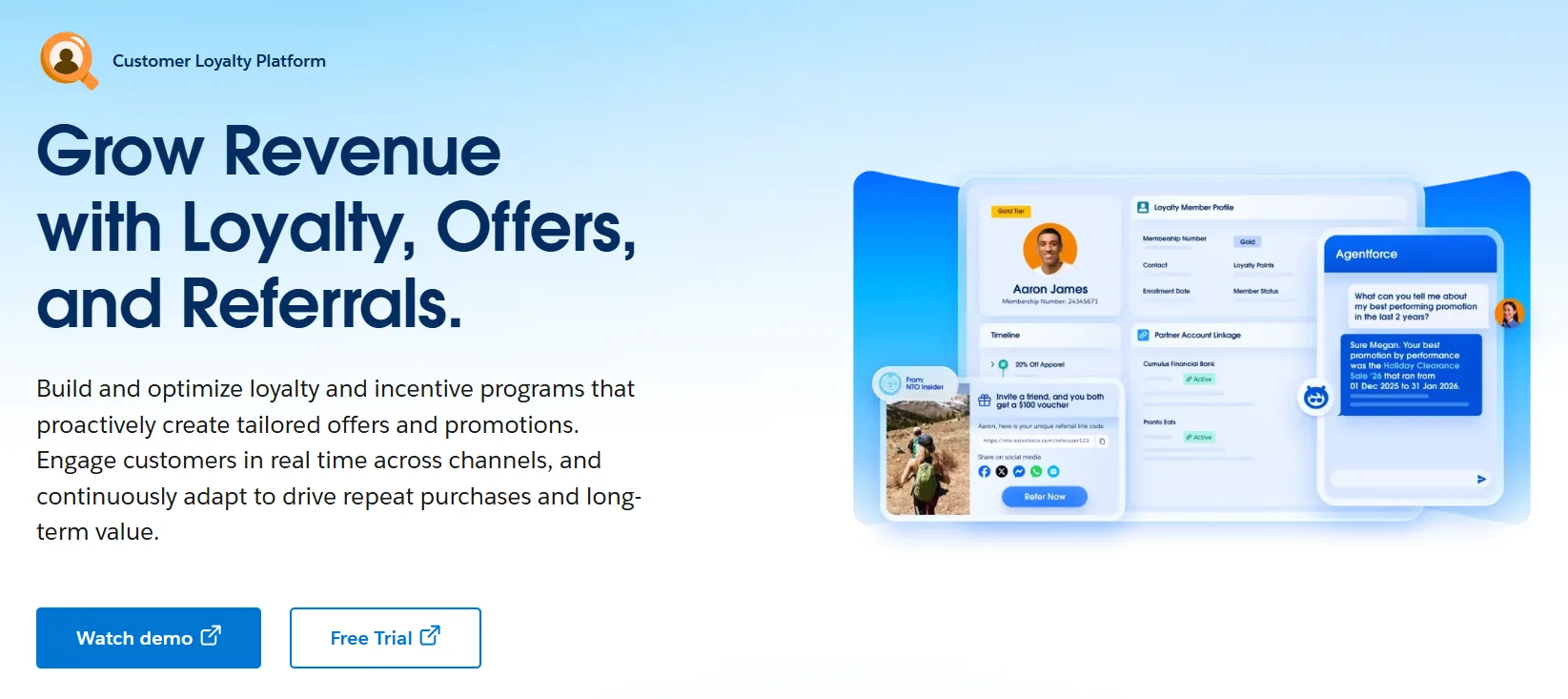
Salesforce Loyalty Management offers the clearest advantage when customer records already live in Salesforce. The loyalty program runs on the Salesforce Platform, allowing member profiles and loyalty activity to remain connected to the customer data already there. Service agents can view a member's tier and points balance alongside the CRM record, and marketers can use the same information in Salesforce workflows without first syncing it from a separate loyalty platform.
That native connection reduces one layer of integration, but it doesn't remove integration work altogether. Purchases and other eligible activities still have to reach Loyalty Management from the ecommerce or POS systems where transactions occur.
Points and tier status held in a separate system have to be reconciled with the customer record before anyone can act on them. Loyalty Management keeps that ledger in the Salesforce org, with qualifying currency determining tier status and non-qualifying points available for redemption. Promotion rules process accrual and redemption journals in real time or in batches.
Running any of this requires a qualifying Salesforce org. Loyalty Management is available in Enterprise, Performance, Developer, and Unlimited Editions with Loyalty Management enabled, not as a standalone product. Segment-based promotions add Data Cloud and a Growth or Advanced license. Member portals need separate Experience Cloud Site licenses, and Omnistudio has to be installed before any member engagement widget, regardless of edition.
Owning those licenses already makes this a straightforward decision. If you'd be buying into the ecosystem to get the loyalty engine, the cost and the scope of the implementation both grow well beyond the loyalty SKU. Multi-brand support requires the Advanced tier, and Salesforce publishes no loyalty migration methodology, only a template for validating member point balances after import.
The platform works for companies that already use Salesforce. But it's a big ask for any company that would have to build a Salesforce environment first.
Salesforce Loyalty Management’s Best Features
- Loyalty program engine with tiers, benefits, vouchers, and member management inside the Salesforce org
- Promotion setup with rule-based qualification, gated to Data Cloud for segment-based targeting
- Loyalty Service Excellence workflows that let service agents resolve member issues from the same console they use for cases
- Partner management for coalition and co-brand programs
- Currency-to-program master-detail structure supporting multiple currencies per program
Salesforce Loyalty Management’s Pricing
Salesforce Loyalty Management is priced per org and requires Salesforce Enterprise, Performance, Developer, or Unlimited Edition with Loyalty Management enabled.
- Starter: $20,000 per org per month, billed annually — One loyalty program, 1 million loyalty events per year, and 50,000 API calls per day.
- Growth: $35,000 per org per month, billed annually — 15 million loyalty events per year, 100,000 API calls per day, and the tier at which Data Cloud segment-based promotions unlock.
- Advanced: $45,000 per org per month, billed annually — 50 million loyalty events per year, 500,000 API calls per day, multi-brand support, and clubs.
Reviews and Ratings
- Gartner Peer Insights 4.3/5 (14 reviews)
7. Smile.io: Best for Simple Shopify Loyalty Programs
With Smile.io, ecommerce teams can launch a loyalty program without adding the work to an engineering backlog. Marketers install the app, configure earning rules in Smile Admin, and the program appears on the storefront, which suits single-brand merchants who want points and referrals running quickly on Shopify or BigCommerce.
Stores can reward purchases and account creation directly. Birthday points are configurable too, while product-review rewards work through supported review integrations.
The referral program gives members a shareable link and lets the store reward both the existing customer and the friend they refer. VIP tiers can track either spending or points earned. Marketers can adjust these mechanics without waiting for a storefront release.
Smile.io keeps the loyalty program visible while customers shop. The rewards launcher and on-site panel show the balance and what it unlocks while a customer browses, and Shopify POS and checkout extensions carry the same mechanics to physical stores. Smile.io also syncs points balances and VIP status into Klaviyo, allowing brands to use loyalty data in email and SMS campaigns.
Smile.io works with Shopify, Shopify Plus, Shopify POS, and BigCommerce. Wix support ended in February 2025 and Squarespace and WordPress stores can't use the platform, so a brand considering a headless build or a second storefront elsewhere will need to look at other options.
That's why Smile.io makes the strongest case for Shopify and BigCommerce merchants that want marketing to own the day-to-day loyalty program. It combines configurable rules with a ready-made storefront experience and connects to various ecommerce tools. That gives teams a faster route from program idea to launch.
Smile.io’s Best Features
- Points, referral, and VIP tier programs configured without developer involvement, redeemable for a percentage off, fixed-amount off, free shipping, or free product
- Rewards launcher, on-site panel, and embedded Loyalty Hub blocks, plus Nudges that show points balances and available rewards on-site
- Shopify POS and checkout extensions for in-store earning and redemption, plus Shopify Flow triggers for automation
- Integration catalog spanning Klaviyo, Gorgias, Recharge, and the major reviews apps, including Judge.me, Okendo, and Loox
- Industry benchmarks that compare your program's performance against comparable stores, alongside pre-built reporting on loyalty segments, ROI, and CLV
Smile.io’s Pricing
Smile.io offers plans based on your monthly order volume, what integrations you need, and reporting needs. There's a free plan available, plus a free trial for the three lowest tiers.
- Free: 200 monthly orders and 10 specialized reports, for a new store starting a program.
- Essential: $15 per month for 500 monthly orders — 1 integration and 15 reports.
- Standard: $79 per month for 1,000 monthly orders — 2 integrations and 20 reports.
- Growth: $199 per month for 2,500 monthly orders, then $20 per additional 100 — Unlimited integrations, and the tier where VIP tiers and the Loyalty Hub unlock.
- Plus: $999 per month billed annually for 7,500 monthly orders, then $5 per additional 100, plus API access.
- Enterprise: Custom quote billed annually — Unlimited orders, positioned for retailers above $40 million in annual revenue.
Reviews and Ratings
- Shopify App Store 4.9/5 (4,152 reviews)
- G2 4.6/5 (451 reviews)
8. Yotpo: Best for Pairing Loyalty with an Existing Reviews Program
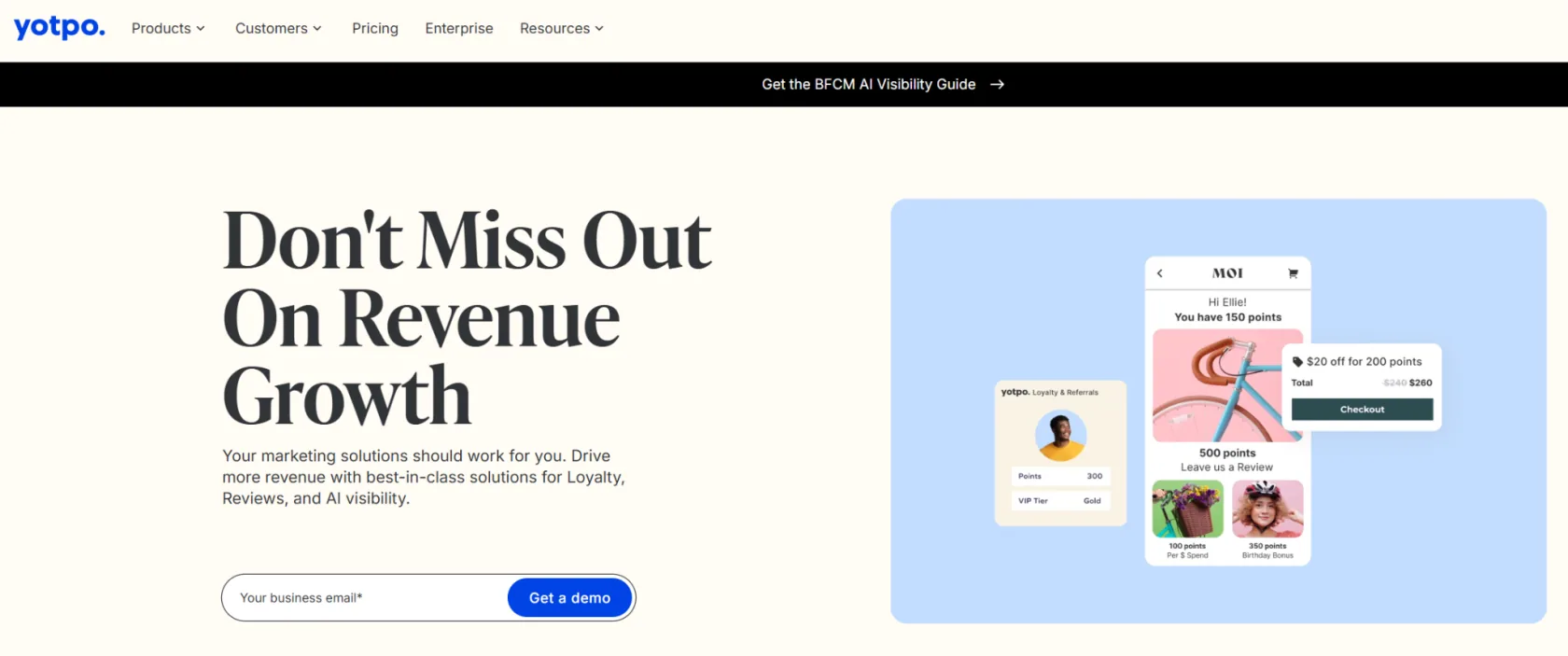
Yotpo connects review activity to the loyalty program, so both can use the same customer profile. That makes it a natural fit for ecommerce teams already using Yotpo Reviews, particularly on Shopify or Shopify Plus. Marketers can configure earning rules in the admin without requiring an engineer for every change.
Points come from account creation, spend milestones, and referrals into one balance, redeemable against discounts or free products. Loyalty Tiers progress on spending or points earned, with customer-tag criteria on supported platforms, and the program reaches physical retail through Shopify POS and receipt upload. Apple and Google Wallet passes run through Yotpo's Novel integration rather than natively.
The review connection starts at earning. Yotpo Review, Photo Review, and Video Review rules pay points or a discount coupon for a submitted review, and photo and video rewards stack on top of the base reward.
The stronger benefit is segmentation. Marketers can build audiences around whether someone submitted a review or how many reviews they've written. Average sentiment and star rating are available too, with filters for the product reviewed or the review source. Those conditions combine with loyalty data like points balance or current tier in the same builder.
The review connection comes with a workflow limitation. Yotpo only awards points when a product review is submitted through a review request email, including a request sent through Klaviyo. Reviews left directly through the on-site widget don't earn the reward, which means the incentive has to be promoted carefully to avoid customers earning nothing for a review they thought counted.
Yotpo makes sense when a brand already uses Yotpo Reviews and its review-request workflow. Review-based segments still require an active Reviews account and a Premium or Enterprise Loyalty plan. Brands choosing loyalty by itself can run points and referrals, with Loyalty Tiers available on higher plans, but they lose the shared review data that makes Yotpo distinct.
Yotpo’s Best Features
- Review behavior as a loyalty segment condition, with sentiment and star-rating filters combined using AND or OR
- Yotpo Review, Photo Review, and Video Review earning rules restrictable to specific VIP tiers
- Earning rules, rewards, and VIP tiers covering subscription-based, hidden, paid-membership, and invite-only program structures
- Referral programs with a unique per-customer link and built-in fraud prevention, plus loyalty data synced live into Klaviyo and Attentive
- Omnichannel support spanning Shopify POS checkout identification, Apple and Google Wallet passes, and receipt scanning for in-store and marketplace buyers
Yotpo’s Pricing
Yotpo offers a free plan plus three paid plans that scale with the number of monthly orders you receive. If you use other Yotpo products, you can also get up to 35% off the total cost.
- Free: $0 per month — With AI chatbot support only, no points for reviews, and no VIP tiers.
- Pro: $199 per month — Including 500 orders, then $0.20 per order to 1,000, $0.10 to 3,000, and $0.05 to 10,000, still without VIP tiers.
- Premium: From $799 per month, rising by monthly order volume to $1,499 at 10,000 orders — The tier at which review-based segments unlock.
- Enterprise: Custom quote — for brands above 10,000 monthly orders.
Reviews and Ratings
- Shopify App Store 4.8/5 (893 reviews)
9. LoyaltyLion: Best for Loyalty Analytics and Klaviyo-Native Segmentation
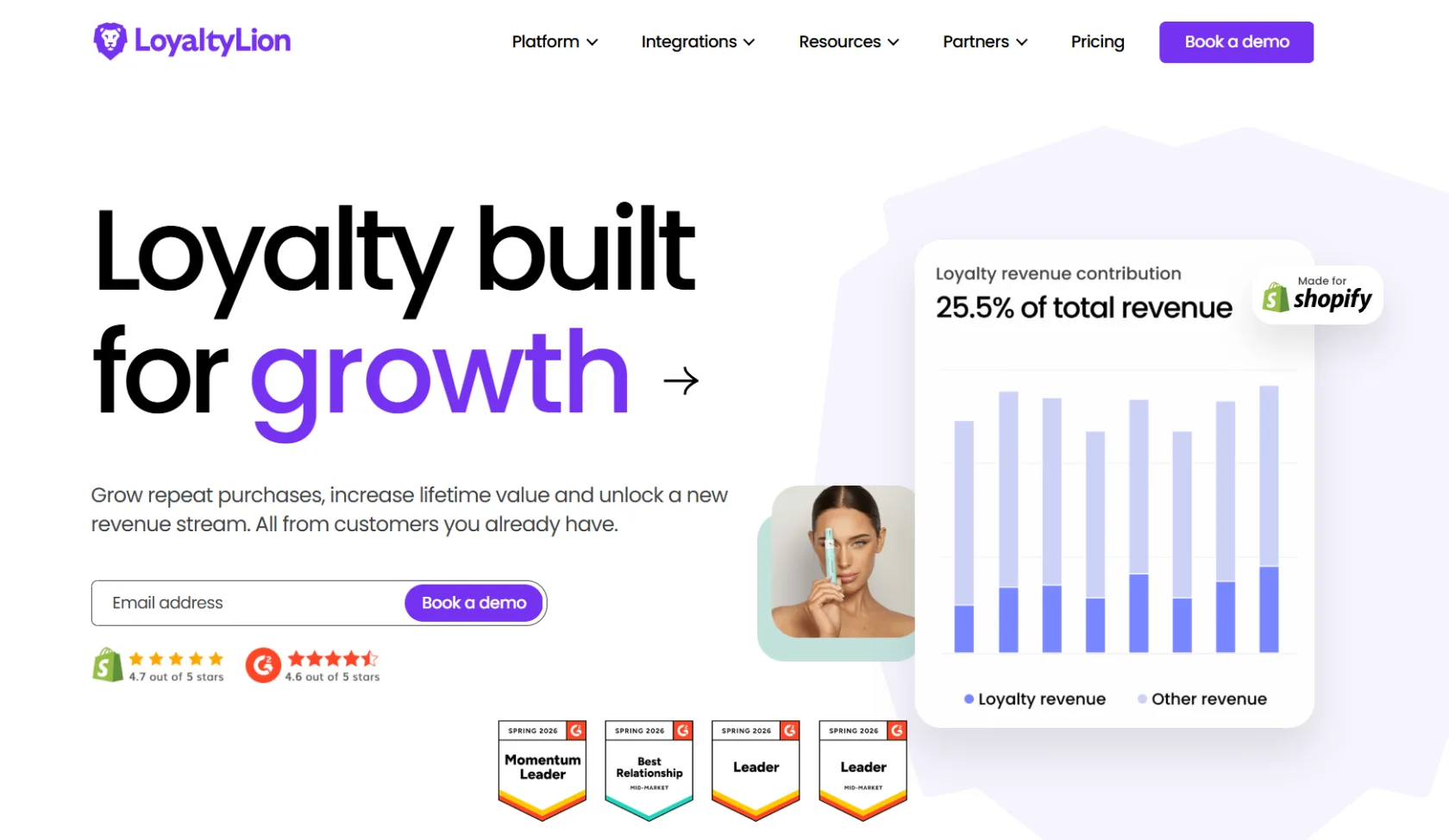
LoyaltyLion stands out for making its reporting unusually transparent. The loyalty dashboard defines what each metric includes and publishes the formulas behind measures such as attributed revenue and predictive customer lifetime value. That gives marketing teams a clearer basis for explaining program performance to finance.
Revenue is attributed across four mutually exclusive channels, so referrals, email, and repeat purchases can't each claim the same order, and it reports across six views. Eleven named CSV exports include a points accounting report showing opening and closing outstanding balances by day, which is what finance needs to carry unredeemed points as a liability.
LoyaltyLion sends loyalty data to Klaviyo as profile properties, so marketers use it directly in segments and flow conditions. The integration syncs five points values covering total, approved, pending, spent, and lifetime points, and adds current tier alongside advanced fields like progress toward renewal or upgrade and forecasted tier at expiration. Those properties update in real time after the initial sync, and Klaviyo Events extend it further by triggering messages the moment a customer completes a loyalty activity.
Migration leaves a gap in that analytics history. LoyaltyLion imports customer points and tiers, with birthdays handled separately, but historical orders don't come across, so a brand switching specifically for better retention analytics starts its order-based reporting at launch. Earlier performance stays in legacy reports or a warehouse, outside the dashboard doing the analysis.
LoyaltyLion fits Shopify and Shopify Plus brands running Klaviyo that want loyalty measurement they can defend to finance. Documentation covers BigCommerce, Magento, and custom commerce deployments, though platform support and feature parity aren't the same thing, since Shopify POS and checkout redemption stay Shopify-only.
LoyaltyLion’s Best Features
- Loyalty analytics dashboard with revenue attributed across four mutually exclusive channels: referrals, email and SMS, the loyalty component, and redeemer repeat purchases
- Published predictive customer lifetime value model with a documented dormancy multiplier, comparing members against non-members
- Per-field definitions, date-range filters, and saved presets on every CSV export
- Klaviyo-native profile properties covering points, tier status, and forecasted future tier, delivered through an Elite Master Partner integration
- Fully embedded loyalty page rather than a pop-up widget, extended by a loyalty panel, product-page points, and Shopify customer account components
LoyaltyLion’s Pricing
LoyaltyLion offers a free plan, plus a 14-day free trial for all paid plans. Monthly order count primarily determines which plan you'll need, but upgrading adds some additional features.
- Free: Up to 400 monthly orders — With on-site earning rules, real-time notifications, and a limited view of the loyalty dashboard.
- Classic: $199 per month — Includes 500 monthly orders, a branded loyalty page, and Klaviyo email flows built for you during onboarding.
- Advanced: Custom quote — Adds Recharge subscription integration, Shopify POS across multiple locations, and translations into 130+ languages.
- Plus: Custom quote — The tier at which real-time Klaviyo event triggers and automated loyalty flows unlock.
Reviews and Ratings
- G2 4.6/5 (608 reviews)
- Shopify App Store 4.6/5 (469 reviews)
ReactorCX: The Best Talon.One Alternative for Complex Enterprise Loyalty Programs
Talon.One built a strong engine for commerce, and the cart is where it does its clearest work. ReactorCX was built for programs where the transaction is harder to define.
Stays, play, bookings, fuel volume, referrals, reversals, and partner-attributed activity all run through the same model as purchases, so a reversal thirty days after the fact pulls back the points, the tier credit, and the vendor-funded discount together. Several funding parties settle inside a single call. Every point carries the rule that issued it, which gives finance a liability position it can count rather than estimate.
Between the breadth, the lineage, and a core you can extend yourself, ReactorCX ends up being the ledger the business runs on rather than a service it calls at checkout. And a ledger that size moves once, which is what SafeSwitch™ is built for, holding cutover until every account reconciles against the legacy system.
See ReactorCX Against Your Own Program
If your program has grown past what your current engine covers, reach out to the Loyalty Methods team today.
Contact Us