
Salesforce Loyalty Management makes sense for companies already standardized on Salesforce. It reads from the same customer record as Sales Cloud and Marketing Cloud, inherits the permissions model and the reporting layer, and for a program that lives inside that stack, a good deal of the integration work is already done. That advantage is why the product lands on most shortlists.
Companies start looking for a Salesforce Loyalty alternative when they need an answer at the register. Balance calculation, point expiration, and escrow rollover run as scheduled processing definitions, so a member checking the app after a purchase can be reading a number from the last run rather than the one their basket just produced.
Loyalty objects are also Salesforce objects, which means a fuel dispenser authorization, a casino session, or a hotel stay has to be modeled as a record on a data model built for customers and their purchases, and carries the platform limits that govern everything else in the org.
Even then, replacing the loyalty engine doesn't have to mean replacing Salesforce. A separate platform can own membership, balances, and eligibility while Sales Cloud and Service Cloud keep the customer record and Marketing Cloud keeps the messaging, connected through the API. That decision sets the terms for everything after it, including how much of the member record the new platform holds, what still has to reach it from the systems where transactions happen, and what moving a live program costs you in the meantime.
The eight platforms below take different positions on how much of the program they own. Each entry covers the shape of program it fits, where it does its best work, and what to validate before it reaches your shortlist.
The Top Salesforce Loyalty Management Alternatives at a Glance
| Product | Best For |
|---|---|
| 1. Loyalty Methods (ReactorCX) | Deciding earn and discount at the register and tracing every point afterward |
| 2. Talon.One | Evaluating promotion and loyalty rules against member history as well as the cart |
| 3. Antavo | Changing earning rules and tier logic without booking an engineering sprint |
| 4. Capillary Technologies | Reworking a program's economics and configuring the result with one vendor |
| 5. Epsilon | Pairing loyalty decisioning with third-party data and identity resolution |
| 6. Comarch Loyalty Management | Programs under a data-residency mandate and coalition partner settlement |
| 7. Open Loyalty | Building the member experience yourself on loyalty primitives |
| 8. Annex Cloud | Running loyalty and referral off one member record |
1. Loyalty Methods (ReactorCX): Best for Enterprise Programs That Decide Earn, Discount, and Settlement at the Moment of the Transaction
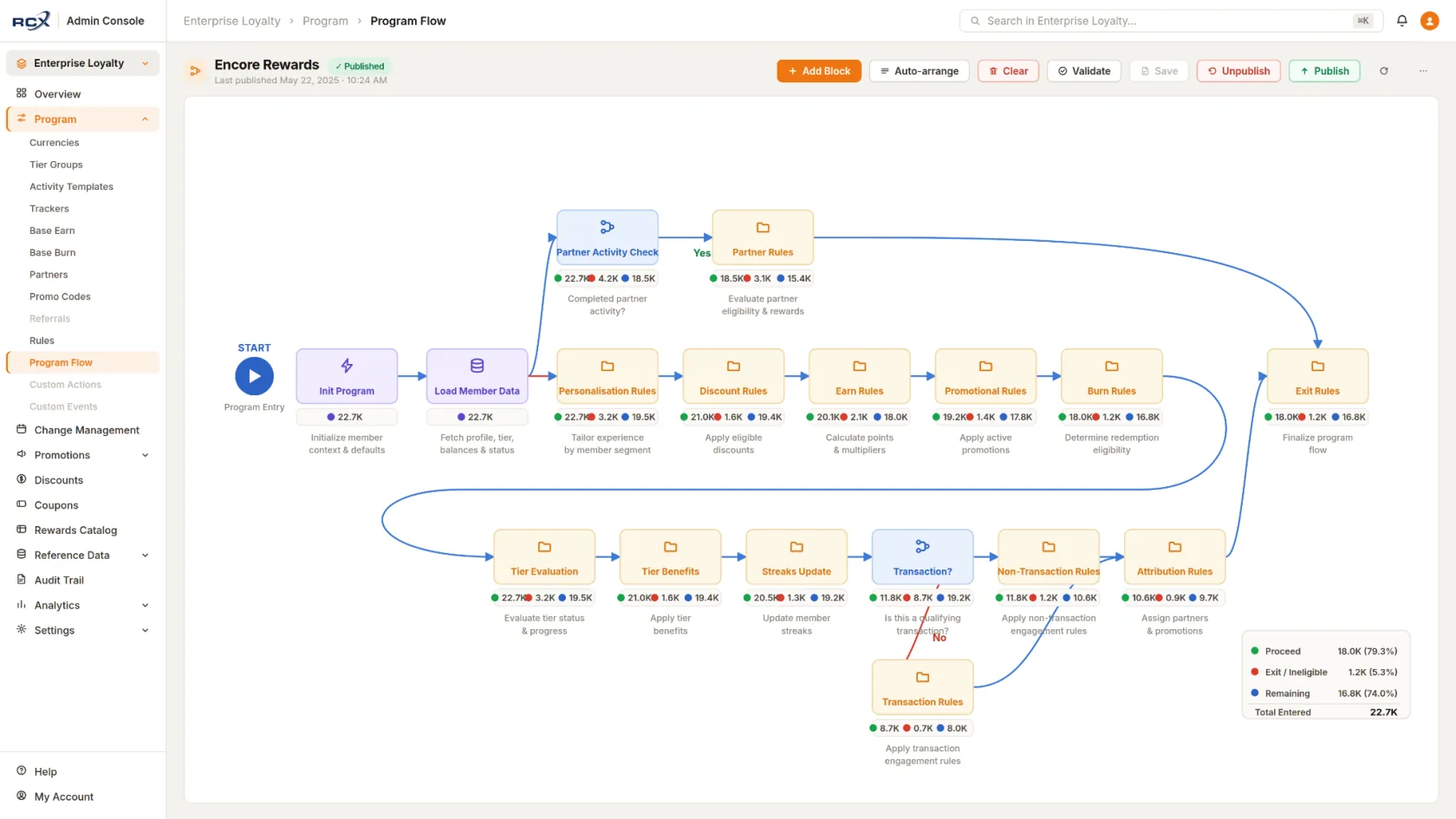
ReactorCX is Loyalty Methods' loyalty engine and ledger. It holds member balances and the activity behind them, and it applies the rules that decide what each member earns and can redeem. The apps, sites, and marketing systems already delivering the member experience keep doing that, connecting through real-time REST APIs, event streams, and FeedXChange for batch partner feeds. ReactorCX's own screens run on those same APIs, so anything the platform can do is available to the systems calling it.
When a member disputes a balance or an auditor asks where an outstanding points number came from, someone has to trace it back to the activity that created it. Every point carries the rule that issued it along with its currency and tags, so a service agent can follow a single earn or redemption end to end in the Member Care Portal.
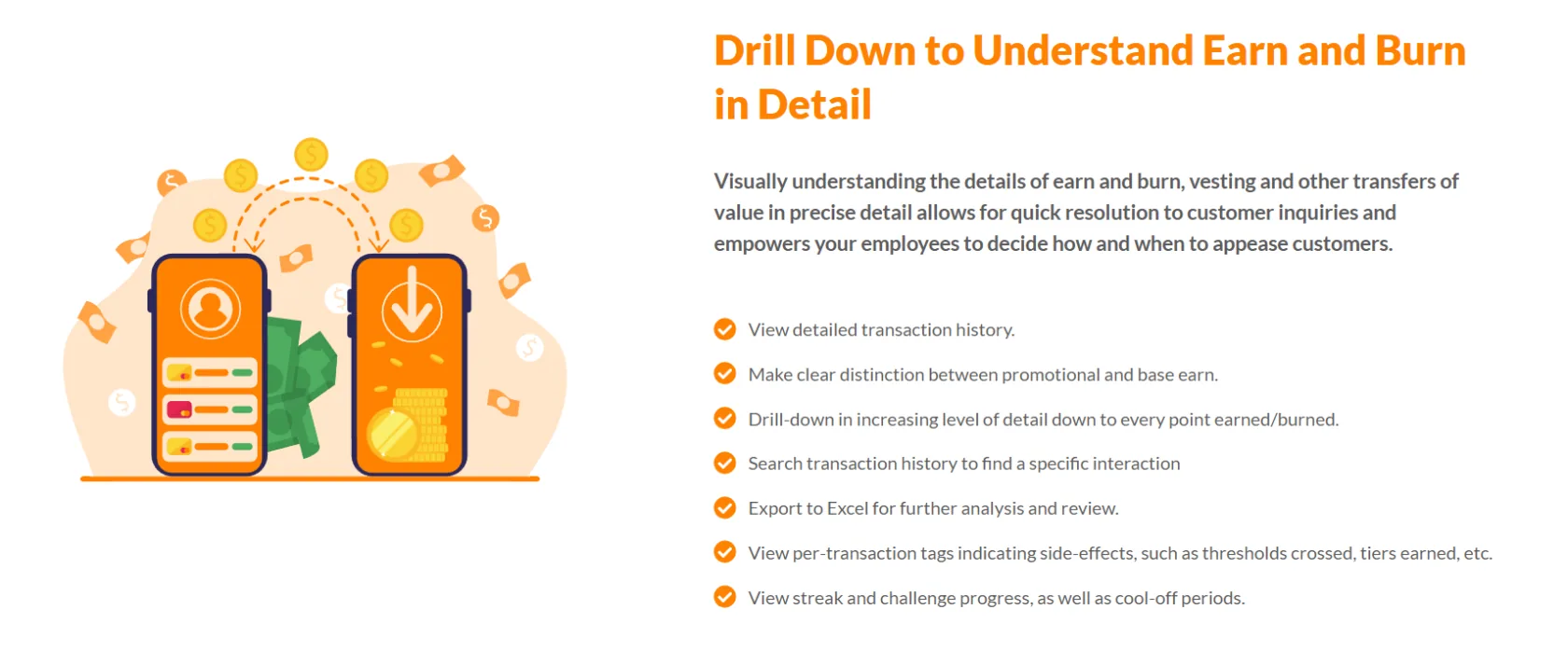
Those records export at the transaction level with lineage attached, so finance journals them into its own accounting systems and reconciles against the individual accruals behind the balance. The same reporting covers breakage, expiration, and partner settlement outputs.
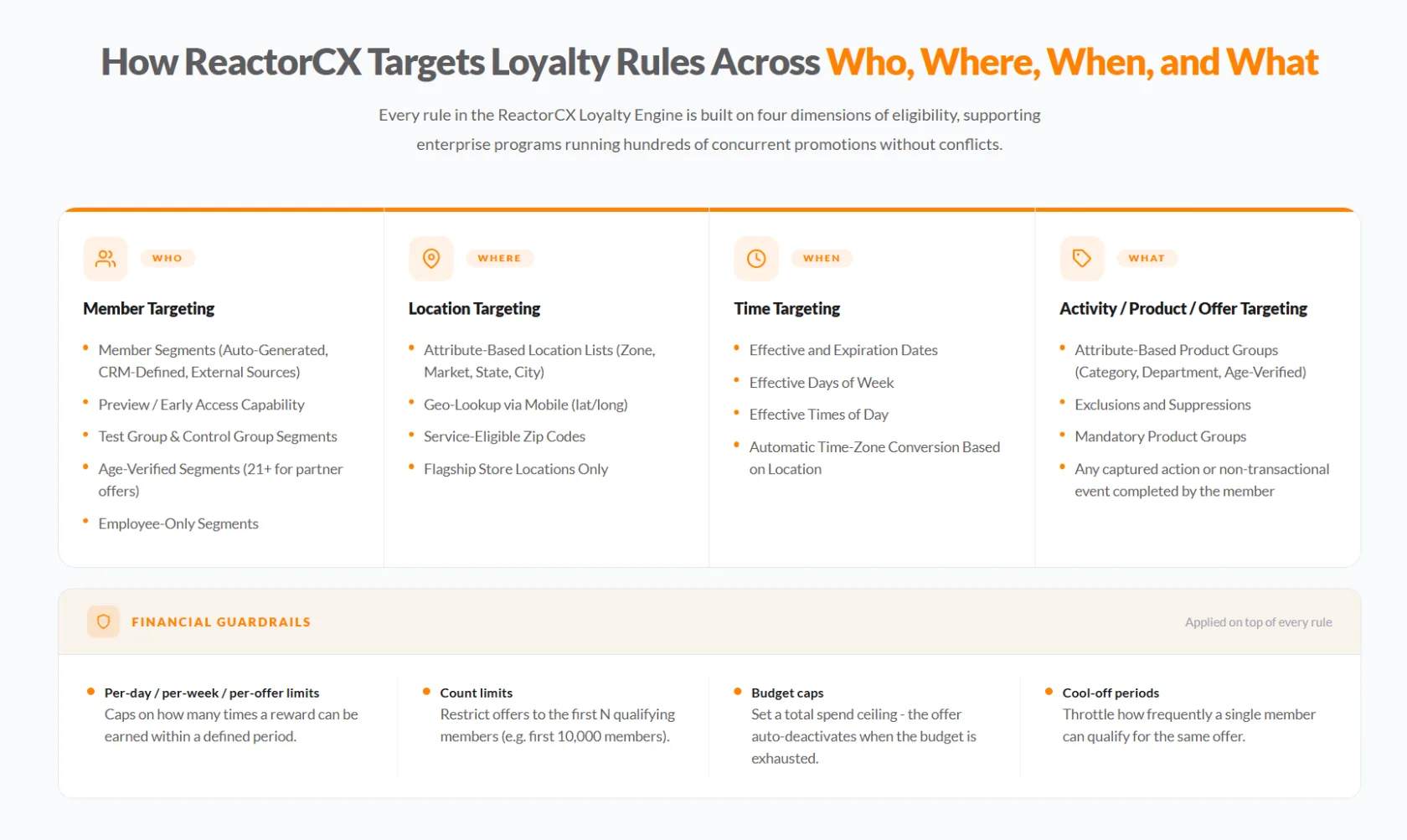
A large program can have hundreds of promotions live at once, and one rule that overspends its budget comes straight out of margin. Earn, burn, tiers, and promotions run on the same engine, and every rule is written against the same four dimensions of eligibility, covering who qualifies, where, when, and on what activity. Budget caps deactivate an offer once its ceiling is reached, count limits cap uses per day or week, and cool-off periods control how often one member can requalify. When a basket triggers several overlapping offers, arbitration resolves the allocation inside the transaction at the register or the pump, so earning and discounting settle in one call.
During a multi-brand purchase, the program has to credit one member while keeping each brand's accounting separate. ReactorCX evaluates each line item against the rules of the brand it belongs to, so one mixed transaction produces several accruals tagged to their brand divisions, all crediting the same member balance. The same pass resolves who funded what, splitting a vendor-funded promotion, a store discount, and a card-issuer bonus across the parties that owe them. Each brand produces its own liability rollforward from the same engine, with no downstream allocation step and no allocation of partner cost after the fact.
Every enterprise program eventually needs something the configuration UI doesn't cover, and household-level tiers or a custom recognition mechanic get built inside ReactorCX as configuration that is genuine code, versioned and audited like the rest of the program. Extending the core data model with a new field carries it into the rules that reference it and into the API in the same step, with no platform release, so an attribute added in the morning is queryable by integrated systems that afternoon.
A ledger gets its hardest test when a live program moves, because balances stay in motion the whole time. SafeSwitch™ runs cutover through four gates in order, Shadow Run, Reconcile, Cutover, and Reversal Ready, with no gate opening until the one before it passes. Reconciliation compares every balance and tier state against the legacy platform account by account, and legacy stays running with the rollback path armed until ReactorCX is confirmed correct in live production. ThreadSync™ is the parallel build that precedes it, splitting work into specialist threads that reconcile at shared checkpoints.
ReactorCX fits a company that already has the member experience it wants and needs the ledger underneath it to hold up to finance and to an audit. Used alongside an existing CRM, that system keeps the customer record and the service and marketing work built on top of it, while membership, balances, and eligibility move to a loyalty engine that decides them at the point of the transaction.
ReactorCX’s best features
- Fully extensible model: the self-service layer sits on a fully programmable core, and the AI layer can write the configuration for a person to approve, so when a client's requirement exceeds what the configuration UI or the AI knows how to build, custom code and net-new functionality can be built on the same platform.
- SafeSwitch™ cutover: shadow run on production traffic, account-by-account reconciliation against legacy, and a rollback path held open until the switch is confirmed.
- One activity model: purchases, fuel dispenser authorizations, hotel stays, gaming sessions, and non-purchase events all resolve against the same rules on the same event.
- Multi-currency wallets: points, credits, vouchers, and comp dollars run as separate purses per brand, tagged at source inside one member balance.
- Agent authority in the Member Care Portal: canceling a transaction reverts the points, tier change, and vendor-funded discount that came with it.
- Gamification in the same engine: streaks, challenges, and missions evaluate on the same transaction event as earn, burn, and tiers.
- Two privacy modes: PII held in-platform with full data-subject rights, or tokenized identifiers with PII in a client-controlled system.
ReactorCX’s pricing
ReactorCX is priced by engagement rather than per seat. Loyalty Methods scopes each quote around the deployment and integration complexity, with implementation included.
2. Talon.One: Best for Evaluating Promotion and Loyalty Rules Against Member History as Well as the Cart
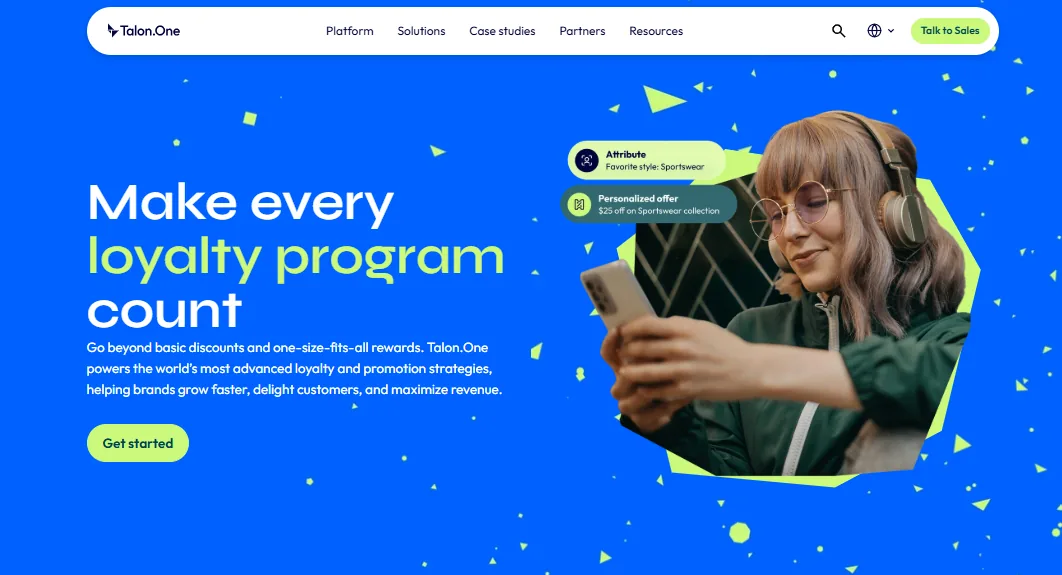
Talon.One brings loyalty and promotion logic into the same rules engine. Whenever it receives an event from a customer session or profile, the Rule Builder decides whether an incentive applies using the current transaction and the customer information available to it. Eligibility can reflect the member's tier, audience membership, achievement progress, and profile attributes instead of relying only on what's currently in the cart.
Rewarding a member for reaching a tier or completing a challenge requires conditions that read the profile, and four of the Rule Builder's condition groups do that: Attribute and audience conditions check profile values, whether an attribute is set, whether a date attribute's anniversary falls in a set window, and whether a customer belongs to, joined, or left an audience. Loyalty and achievement conditions check tier and loyalty card state, and whether a member has completed or is progressing through an achievement, both enabled per campaign.
Earn rules and discount rules are authored in the same Rule Builder, both following a WHEN this happens, THEN do this structure, so loyalty and promotion logic stay in one place. Advanced promotion rules can also combine cart item filters, bundles, loyalty programs, and custom effects, while strikethrough rules apply item pricing and labels with no conditions attached.
Because Talon.One evaluates a cart, or an event shaped like one, activity that arrives in a different shape gets mapped into that structure first. Whatever the mapping doesn't reach stays with your team to maintain. Earning that accumulates across several separate transactions under one visit, or partner activity that lands on a feed days after the member did anything, is where that work tends to collect.
Finance has a separate question. Subledgers, point validity, and activation delay all sit in the platform, which gives a controller the inputs a liability is built from. Producing the reported figure happens outside it, with Talon.One's own ROI guidance covering IFRS 15, material rights, and breakage before pointing to third-party actuarial certification.
Talon.One fits a program where the hard part is the rule logic itself, with dozens of overlapping campaigns live at once and eligibility turning on tier and achievement progress rather than on the contents of a basket.
Talon.One’s best features
- Loyalty program models on one engine: points, tiers, paid memberships, gamification, and multi-partner programs, in both card-based and profile-based structures.
- Out-of-the-box reward types, including discounts, gift cards, cashback, free items, loyalty points, and exclusive bonuses.
- Campaign governance at volume with budgets, fraud protection, and a Rule Builder condition that checks whether a budget has reached its limit.
- Talon.One Predict for Next Best Offer and propensity experimentation, with vendor-reported model accuracy of up to 90 percent.
- Named connectors across CEPs (Braze, Iterable, Twilio Segment), POS systems (Oracle Retail Xstore, NewStore), and ecommerce platforms (Shopify, Salesforce).
Talon.One’s pricing
- All three plans are quoted through sales with no published price and route to a contact form, and there's no self-serve signup.
Talon.One reviews and ratings
- G2 4.5/5 (63 reviews)
3. Antavo: Best for Changing Earning Rules and Tier Logic Without Booking an Engineering Sprint
Antavo gives loyalty teams direct control over earning rules and campaigns. Its Workflows module is a drag-and-drop visual editor where a loyalty manager builds earning rules and campaigns from triggers and nodes, then reviews per-member execution logs to confirm the path each member's journey took. A point ceiling caps spend for a whole campaign or for individual members, and a promotion calculator simulates purchases before launch to confirm discounts apply as intended, supporting promotion-heavy industries like retail and hospitality.
The platform's tier controls let teams define progression without hard-coding every exception. Programs can qualify members by points or spending, while invitation-only tiers cover statuses that aren't earned through a threshold. Teams can add as many levels as the program needs and choose from several expiration methods. Grace periods hold a member's status for a set window after they'd otherwise drop a level, and refund-after-reset handling keeps a returned purchase from clawing back tier points earned before the last reset.
Antavo also helps omnichannel brands capture purchases inside and outside their own stores. Members can earn and redeem through an integrated POS. When a brand can't connect to a third-party retailer's checkout, Klippa-powered receipt scanning converts uploaded receipts into structured purchase data that can trigger points or rewards in Workflows.
Antavo operates as the data processor, with the brand's CRM or CDP staying the system of record. Points are earned, burned, held pending, and expired inside the platform, while the accrual and breakage reporting a controller works from happens outside it, against JSON or CSV exports. Coming from an arrangement where loyalty sat on the customer record, you'll have to determine ahead of time which system answers when a member's tier and their profile disagree, and what has to be built to keep the two in step.
Antavo suits a program whose value comes from how often it changes. Adjusting a tier threshold mid-year or building next month's campaign against the promotional calendar happens in Workflows, run by the same people who own the program's results.
Antavo’s best features
- One or multiple custom currencies, from points to credits and stamps, with per-action earn values and configurable expiration.
- Multi-accounts module that gives a single member several point balances, plus family accounts that pool resources across grouped customers.
- Built-in gamification modules, including challenges, missions, badges, streaks, prize wheels, scratch cards, and treasure hunts, with no third-party add-ons.
- Zero-party data collection through gamified profiling using surveys, like-or-dislike cards, sliders, and image picks.
- Loyalty cards and rewards pushed to Apple Wallet and Google Wallet without a separate app download.
Antavo’s pricing
- Antavo publishes no prices for their three plans (Start, Grow, and Enterprise). There's also no free trial, no free version, and no self-serve signup.
Antavo reviews and ratings
- Capterra 4.4/5 (19 reviews)
- G2 4.2/5 (7 reviews)
- Gartner Peer Insights 4.0/5 (5 ratings)
4. Capillary Technologies: Best for Reworking a Program's Economics and Configuring the Result With One Vendor
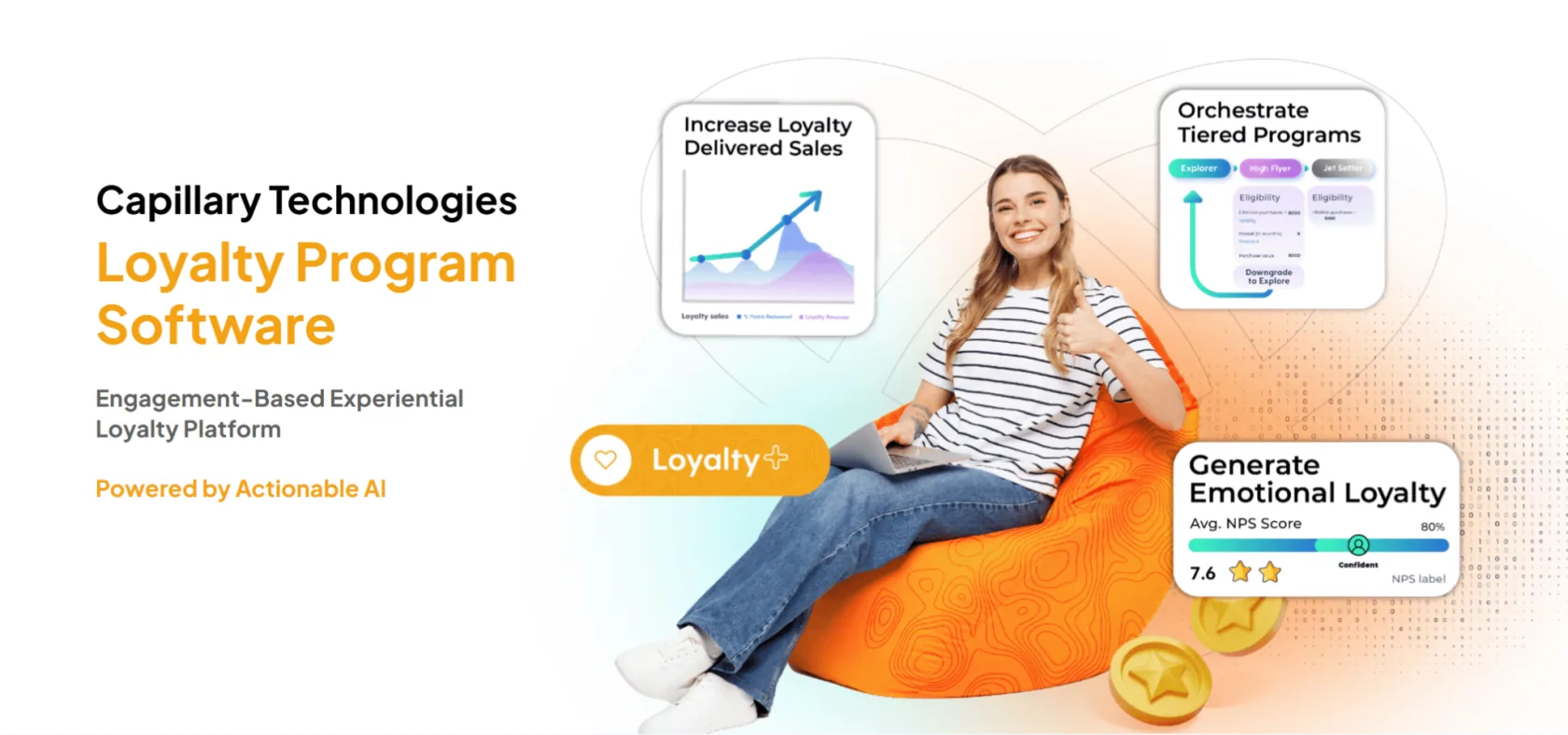
Capillary sells the loyalty platform and the program-strategy consulting on one contract, combining a member ledger (Loyalty+), cart promotion engine, engagement layer (Engage+), and consumer data platform (CDP+) into one tool.
It supports eight program models on one platform, from points and tiers to channel loyalty for distributors, coalition programs, and gamified engagement. That range fits multi-region enterprise retailers and consumer groups running several brands and program types at once.
Some enterprise teams need help designing or reworking the program itself, beyond configuring the software. Brierley's FAST Track catalog includes more than 20 focused engagements, such as Program Cost-Benefit Analysis, Proactive Churn Modeling, and Lifetime Value Modeling, plus its BLQ diagnostic for comparing emotional and behavioral loyalty. A churn model that identifies which segments are worth defending arrives with the configuration that acts on it, so the team that recommends a change to tier economics is the team that writes the rule.
Capillary's cart-promotion controls are useful when several offers qualify during the same checkout. Teams can enable stacking at the item or cart level, cap how many promotions apply, and calculate percentage discounts from either the original subtotal or the amount left after earlier discounts. When offers conflict, a drag-and-drop ranking determines which promotion type applies first, or the engine can prioritize the offer that expires soonest or produces the largest discount.
Brierley, Kognitiv, and SessionM each arrived through acquisition with their own platform and installed base, which is how the portfolio got this wide this fast. That range pays off if you need several of those pieces. If you only need the loyalty engine, you're buying past what your program uses. The services model works the same way, fitting a program that reshapes itself every few quarters better than one changing something every week.
Capillary earns its place when the program's economics need rethinking before its rules get rewritten. The same vendor can run the analysis and then configure what it recommends across brands and regions.
Capillary Technologies’ best features
- aiRA agentic co-pilot that builds audiences from plain-language prompts, predicts reward ROI by market, and holds every campaign for explicit human approval before launch.
- CDP+ consumer data platform that unifies online and offline customer data for cross-channel segmentation across brands.
- Loyalty promotions in single, milestone, and streak formats, with milestone cycles that reset on daily, weekly, monthly, yearly, or custom windows.
- Per-promotion ISO 8601 timezone tagging and a dedicated conglomerate solution for running multi-brand programs across regions.
- Insights+ reporting with a Liability ITD metric (points issued, returned, redeemed, and expired) broken out by tier and by month.
Capillary Technologies’ pricing
Capillary doesn't publicly list packages or pricing. You have to contact them for a quote.
Capillary Technologies reviews and ratings
- G2 4.8/5 (6 reviews)
5. Epsilon: Best for Pairing Loyalty Decisioning With Third-Party Data and Identity Resolution
Epsilon Loyalty sits inside the Epsilon PeopleCloud suite, layering third-party data and Epsilon's own segmentation models onto first-party member records. A program can then target on what a member buys across the category rather than only on its own purchase history. Existing apps, sites, and messaging keep delivering the experience, so the data work happens without a channel rebuild.
Knowing more about a member only pays off if the program acts on it. A decision engine picks which incentive and message each member gets, scoring the options against the behavior the program is trying to produce, so propensity scores turn into a specific offer at a specific moment. Program models cover points, tiers, experiential rewards, and coalition partnerships, and Localized Loyalty handles offers and communications by region, with the interface in seven languages and hosting in five countries.
Epsilon runs the program with you or for you, and the account team is how changes to it happen. Raising an earn rate for one segment, launching a promotion, or changing who qualifies for a tier all go in as requests against the engagement rather than configurations a loyalty manager makes directly. That works for a team with no loyalty operations function of its own, but not as well for a team changing things with less than a week's notice.
Integrations get confirmed the same way, through Epsilon's team during the engagement, and a brand that already owns its CDP, its messaging, and its loyalty strategy is paying for a layer it has built.
For a technical evaluator, the set of supported integrations is hard to assess up front. Epsilon's own FAQ states that the loyalty platform includes a wide range of native connectors but that it doesn't list them, so a team can't confirm specific integrations before engaging sales. The services wrapper adds a related dependency, since a guided engagement runs only as well as the team assigned to it, and that reliance grows as a brand shifts from self-serve administration toward having Epsilon operate the program.
Epsilon fits a program whose hardest problem is knowing who the member is across channels the brand doesn't own. A retailer seeing only its own purchase history gets propensity scoring built on data it has no way to collect, plus a team to run the program against it.
Epsilon’s best features
- In-platform A/B and split testing with forecasting and holdout groups.
- Predictive and agentic AI to identify behavioral shifts, suggest next-best offers, forecast performance, and flag potential growth opportunities.
- Insights and analytics with ROI forecasting mapped to program KPIs.
- Predictive insights that monitor fraud and bring suspicious program activity to the loyalty team's attention.
- Localized Loyalty for tailoring offers and member communications by region.
Epsilon’s pricing
Epsilon doesn't list prices publicly, but does provide some package details on its loyalty page.
- Starter: Includes shared hosting and self-serve admin, plus pre-configured options and limited configuration support.
- Standard: Includes dedicated hosted but self-serve administration, plus limited configuration help and more rewards options.
- Enterprise: Includes advanced hosting and admin options, custom feature scoping, more rewards, and integration assistance.
Epsilon reviews and ratings
- G2 4.3/5 (2 reviews)
6. Comarch Loyalty Management: Best for Programs Under a Data-Residency Mandate or Coalition Partner Settlement
Comarch still ships on-premise and hybrid deployment alongside managed cloud in 2026. Comarch Cloud is fully managed SaaS across 16 global data centers, External Cloud runs the platform in your own Azure, AWS, or GCP tenancy, and on-premise and hybrid installations cover organizations whose regulatory or internal infrastructure requirements rule out both.
A residency mandate extends past the hosting model to the data layer. Comarch Loyalty Management is database-agnostic, running on Oracle, PostgreSQL, Amazon RDS, Google Cloud SQL, or Azure Database, so a team can keep the platform on its existing Oracle estate or an open-source stack rather than a vendor-managed data store. Data anonymization and consent-based profiling cover the GDPR processes that come with operating under those mandates.
Coalition programs need to reconcile points earned across partners and settle their monetary value. Comarch's travel edition supports accrual and retro transactions in both directions. Billing OUT creates files from accrual transactions and includes the monetary value of the points. Billing IN processes files received from partners and returns an acceptance or rejection for each record.
The Data Hub handles the exchange itself, with six name-matching algorithms including Jaro-Winkler and transliteration for non-Roman characters, which resolves the passenger-name differences that otherwise break inter-partner accrual.
Self-hosting moves the operational work back toward the buyer. Database administration, security patching, monitoring, and disaster recovery for the loyalty platform become responsibilities someone owns internally or contracts for separately, and the division varies by deployment model. Comarch Cloud avoids the question, which is where a team without a residency requirement usually lands.
Comarch fits where the deployment target and the partner settlement are both fixed before the loyalty conversation starts. A regulated operator that cannot use public cloud and an airline settling point value with partner carriers are both solving problems most platforms treat as edge cases.
Comarch’s best features
- Multitenancy that hosts multiple B2B and B2C loyalty programs on one platform, with program proportions set per country or region.
- Travel edition built for airline programs, covering award booking, partner accrual, and passenger-name resolution across carriers.
- Flexible currency management supporting multiple point types, point transfers between accounts, and refunds.
- Loyalty Fraud Detection module that uses AI and machine learning to flag atypical accrual and redemption patterns against configurable fraud-score thresholds.
- Contact Center with a four-eyes approval step that requires a second sign-off on selected agent actions.
Comarch’s pricing
Comarch only provides pricing through a custom quote.
Comarch reviews and ratings
- G2 4.2/5 (10 reviews)
- Capterra 4.4/5 (9 reviews)
7. Open Loyalty: Best for Building the Member Experience Yourself on Loyalty Primitives
Open Loyalty provides the loyalty engine while the buyer controls how the program appears to members. More than 50 prebuilt loyalty and gamification mechanics sit behind one REST API, with the engine applying earning and redemption logic and maintaining the member ledger. Loyalty teams manage the program through an Admin UI. Your web and mobile interfaces, POS systems, and other member touchpoints connect to that same backend.
Program rules can also run on behavior unique to the business. A team defines a custom event schema, adds typed attributes describing the activity, and your system sends the event in real time, where those attributes become campaign conditions. A completed action in your own product changes a points balance or issues a reward through configured rules instead of one-off code.
Each client installation is separated at the infrastructure level, with a dedicated database and Kubernetes namespace in the standard SaaS setup and encryption at rest and in transit. Multiple tenants run inside one installation, one for each brand or country, sharing that isolation boundary. AWS hosting spans Europe and APAC with North America available, and the platform holds ISO/IEC 27001 certification alongside controls for GDPR and CCPA.
The headless model moves a real share of implementation onto the buyer. Open Loyalty supplies the engine, the Admin UI, and the API. Everything a member touches gets built against them, from the balance display and the rewards catalog through the tier progress screen and the redemption flow, and that code stays yours to maintain as the program changes. Adding a new mechanic means a configuration change in Open Loyalty and a front-end release to expose it.
Open Loyalty fits a team that has engineers and wants them building the member experience rather than working around someone else's. The ledger, the mechanics, and the event model are exposed to compose against, and what members see is entirely a product decision.
Open Loyalty’s best features
- Prebuilt mechanic families spanning points and multi-wallet, tiers with progression, challenges and missions, badges, leaderboards, gamified referrals, coupons, and games of chance, each exposed through its own API.
- Public API reference, a Now/Next/Later product roadmap, and a year-by-year changelog, all readable without an account or a sales call.
- Nightly incremental delta CSV exports replicated into your own AWS, GCP, or Azure storage for a copy of loyalty data in your own infrastructure.
- Two-level View and Modify role-based ACL across roughly 30 resources, plus administrator single sign-on for Okta, Microsoft Entra ID, and Auth0.
- Built-in member anonymization and right-to-be-forgotten, backed by an exportable audit log that tracks PII changes.
Open Loyalty’s pricing
Open Loyalty doesn't list their plans or pricing publicly, and doesn't include a free trial. All quotes require an estimate based on your project scope.
Open Loyalty reviews and ratings
- G2 4.7/5 (16 reviews)
- Capterra 4.8/5 (15 reviews)
8. Annex Cloud: Best for Running Loyalty and Referral off One Member Record
Annex Cloud combines loyalty management, referrals, gamification, and customer data collection in one enterprise platform.
Brands use the same member profile and rules engine to reward purchases, referrals, social activity, survey responses, and other trackable actions. Refer a Friend sits alongside points, tiers, progressive profiling, and segmentation, so advocacy doesn't need a separate reward system.
For teams keeping Salesforce B2C Commerce, Annex Cloud offers a cartridge on AppExchange that requires B2C Commerce. Its Salesforce CRM connector syncs member data in real time, displays membership details, records loyalty activity and interactions, and lets service users manage points from Salesforce.
More than 125 connectors and integrated components cover commerce, payments, messaging, and customer-data systems, and the Adyen integration supports card-linked earning and redemption across commerce platforms. Replacing the loyalty layer doesn't force a change to the stack around it.
Annex Cloud owns the member ledger and the rules layer above it. The rules engine configures points, tiers, and reward logic, while the Incentive Engine generates, stores, and redeems reward codes, gift cards, and store credits. For consumer goods brands that don't own the point of sale, receipt scanning fills the transaction gap. Members submit receipts through the brand app, email, SMS, or WhatsApp, and the platform reads SKUs, descriptions, pricing, discounts, location, and store ID from each one.
Annex Cloud reports on financial, member, currency, engagement, and program performance in the product, and pushes the full loyalty dataset into a data lake or BI tool for anything beyond that. Where finance and operations ask questions that need the second path, answering them depends on a pipeline someone builds and maintains, and the answer arrives in whatever tool sits at the end of it.
Annex Cloud fits a company that wants a dedicated loyalty platform while keeping Salesforce B2C Commerce or CRM around it. Referrals, omnichannel rewards, receipt capture, and segmentation all run through the same member record, which is what makes advocacy and purchase behavior legible as one program rather than two.
Annex Cloud’s best features
- Multi-instance deployment that gives each regional instance its own member records and integrations to support data residency.
- RFM segmentation dashboard that flags best, biggest, new, and at-risk members to target with rules.
- Rewards catalog spanning store credits, discount codes, and gift cards from more than 350 brands in physical and virtual forms.
- Registration-as-a-Service microsites for enrolling sales reps, installers, and retailers who sit outside the brand's own website.
- Incentive Engine that generates, stores, and redeems reward codes, gift cards, and store credits from inside the platform.
Annex Cloud’s pricing
Annex Cloud doesn't publish pricing on its website. Pricing is only available by custom quote.
Annex Cloud reviews and ratings
- Capterra 4.2/5 (39 reviews)
Where ReactorCX Fits Among Salesforce Loyalty Management Alternatives
The replacement decision comes down to which part of the job you're actually moving.
Finance relying on it to explain an outstanding balance across brands or funding partners points to a traceable ledger with reporting built in. If the constraint is marketing waiting on developers, what matters is how much of the program a loyalty manager can change without opening a ticket. Teams building their own member experience are evaluating APIs and deployment control instead, and a program spanning several markets is weighing where its data sits and who operates it day to day.
Most of these platforms answer one of those well. Programs running several brands or channels at once tend to need more than one answered at the same time, where a single purchase has to price correctly at the counter, split between the businesses that funded it, and leave a record that holds up at close.
ReactorCX is built for that end of the range. It runs as the loyalty engine and ledger underneath whatever the business already has, so a company standardized on Salesforce keeps the customer record and the service and marketing work built on it, and a company with no CRM commitment gets a loyalty platform that doesn't come with one attached. The cutover comes with it, and so does a programmable core, which means the requirement your program has next gets built inside the platform instead of waiting for a release.
See ReactorCX Against Your Own Program
Contact us to discuss what starting or moving your loyalty program would involve.
Contact Us