
Quick summary
- Transaction-heavy programs: Loyalty Methods (ReactorCX) decides which offers apply and who pays for them in the same call that records the purchase, traces the points liability behind them, and proves the move on live transactions before members switch.
- Richer member engagement: Antavo lets your marketers build member games without engineers, Open Loyalty gives your developers ready-made mechanics for your own app, and Annex Cloud pays referrals and reviews like purchases.
- Promotions and loyalty on one cart: Talon.One settles which coupons, discounts, and loyalty bonuses apply through campaign rules, and Voucherify validates coupons, gift cards, and loyalty rewards together through one API.
- Loyalty beside your customer data or CRM: Capillary runs loyalty with its own customer data and campaign platforms, and Salesforce Loyalty Management puts each member on the record your sales and service teams already use.
- Programs in several markets: Comarch runs consumer, B2B, and coalition programs across countries and currencies from one platform.
Loyalty teams often start comparing Oracle CrowdTwist alternatives when a program outgrows the one brand and one stack it launched on. CrowdTwist runs loyalty inside Oracle’s stack, and many companies choose it for its built-in connectors to Oracle’s own registers and marketing tools.
Those connectors spare your team the integration work at the till and in member messaging. On a different POS or messaging platform, though, CrowdTwist takes the same API work to connect as any other engine.
Adding brands or countries brings a second limit. A brand with its own tiers or points economy, or a country program managed on its own, may need a separate CrowdTwist program instance to keep it apart. Each of those instances is set up, configured, and managed on its own, so with several banners and regions, your team has to run several programs side by side.
The ten platforms below handle those two limits in different ways, from engines that run behind whatever systems you already have to suites with their own customer data and platforms built for several countries at once.
Top Oracle CrowdTwist Alternatives Compared
| Platform | Who it's for | Key strengths | Architecture | Pricing |
|---|---|---|---|---|
| Loyalty Methods (ReactorCX) | Enterprises with stacked offers, partner-funded promotions, or several brands on one engine, including those moving off a live platform | Offers and partner costs settled at the till, liability traced to every sale, and SafeSwitch parallel migration | Headless, API-first loyalty engine | Custom quote by program scope, volume, and integrations |
| Antavo | Marketing teams that want to run and rework member games without developer help | A visual campaign editor, prize wheels and challenges, and campaigns saved as reusable blueprints | Headless, API-first loyalty platform | Custom quote based on active customers |
| Capillary | Brands ready to replace their separate customer data and messaging tools too | One customer profile behind every segment, reward, and real-time voucher | Loyalty suite with its own customer data and engagement platforms | 12-month contract from $100,000 (AWS Marketplace) |
| Comarch | Multinational groups with programs in several markets, some of them B2B or coalition | Country programs with their own promotions and currencies, plus partner billing for coalitions | Enterprise loyalty suite on cloud, on-premise, or hybrid | Custom quote, or per active member or transaction on Loyalty Cloud |
| Salesforce Loyalty Management | Brands already running sales and service in Salesforce | Members on the same record as sales and service, and journeys triggered by loyalty events | Loyalty module inside Salesforce | $20,000 to $45,000 per org per month |
| Talon.One | Retail and restaurant brands running busy coupon and discount calendars alongside loyalty | One rule builder for promotions and points, with stacking rules and spending caps per campaign or customer | API-first incentives engine | Custom quote based on data volume |
| Voucherify | Teams with in-house engineers whose rewards go well beyond points | Up to 30 coupons, gift cards, and rewards checked in one call, with a separate wallet for each reward type | API-first incentives platform | By API usage and projects ($650 to $1,300 a month) |
| Open Loyalty | Brands whose own engineers build and run the member app | A loyalty backend your developers build the member experience on, with a tenant per country | Headless, API-first loyalty engine | Platform fee plus an allowance set by monthly active members |
| Annex Cloud | Brands whose sales already lean on referrals and reviews | Referrals, reviews, and social actions that earn like purchases, plus receipt scanning | Enterprise loyalty and engagement platform | Custom quote for enterprises (typically $250M+ revenue) |
| Kobie | Enterprises that want the vendor's people working on the program with them | Strategy and program operations from the vendor, and a liability ledger per point | Loyalty platform with strategy and managed services | Custom quote |
1. Loyalty Methods (ReactorCX): Best for real-time offer decisions and points liability traced to every sale
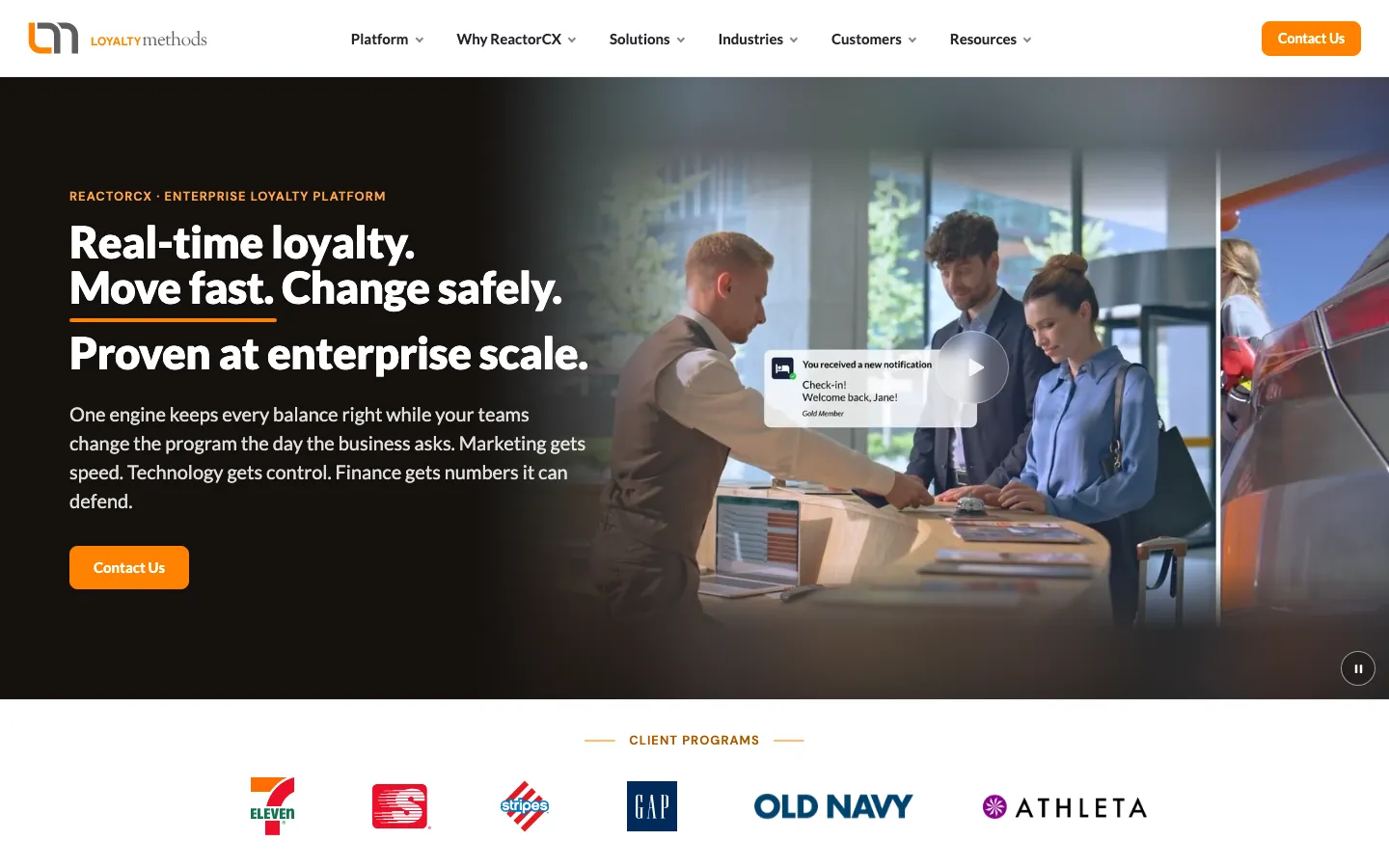
At checkout, ReactorCX works out what the member earns, which offers apply, and who funds each one before the receipt prints. Members get the rewards they qualify for on the spot, and every partner bill and points balance traces back to that sale.
Unlike CrowdTwist, ReactorCX works the same way whichever vendor's systems you run. Your registers and app call its APIs during the sale for the member's balance and rewards, then show the result at the till or on screen. Each transaction also streams out as an event to your messaging and customer data tools, so a purchase can trigger a follow-up message or update a segment right away.
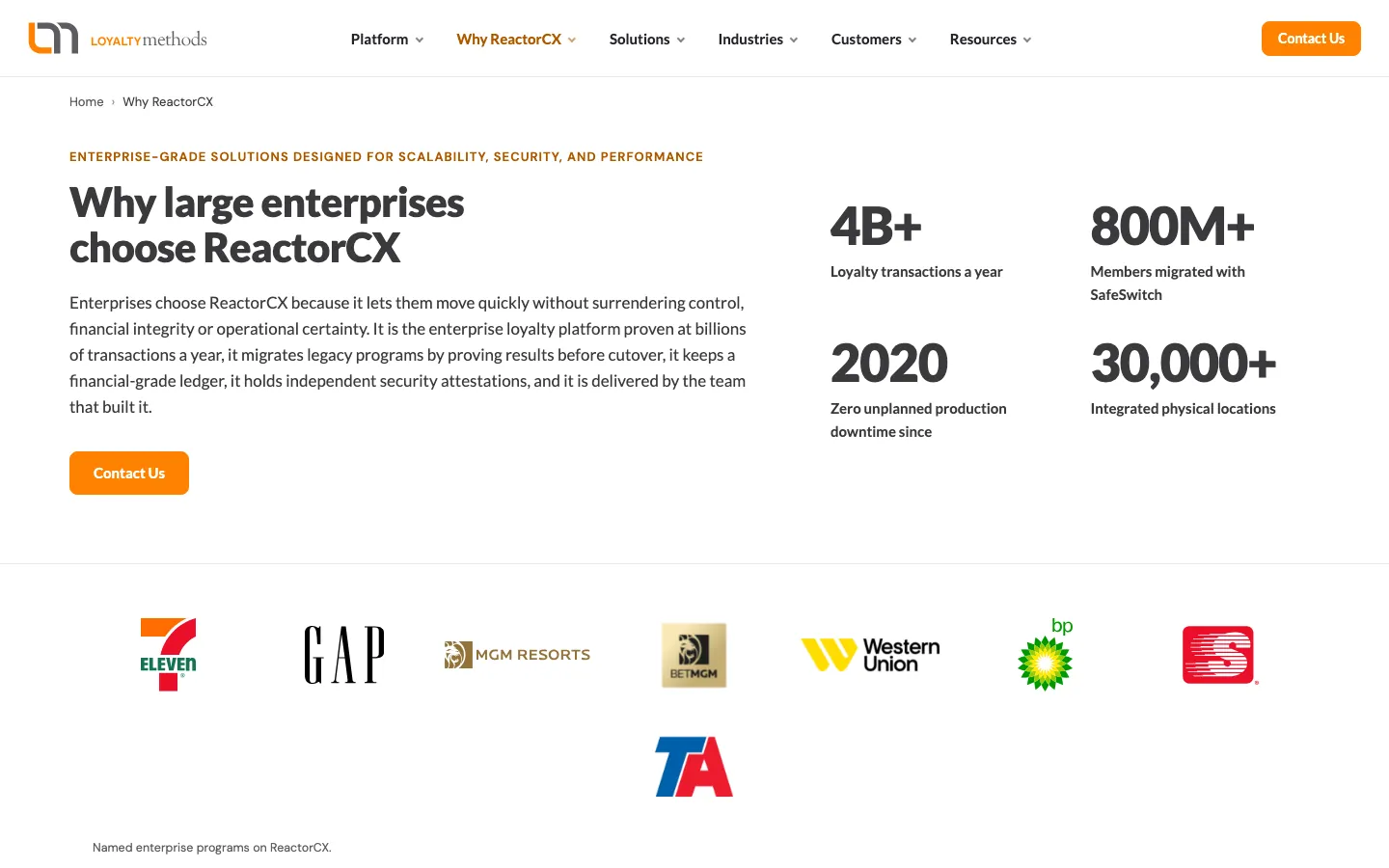
When several offers apply to one purchase, ReactorCX picks the combination by a rule you set, whether you want to give members the best deal, protect your margin, or save partner-funded promotions where you can. It also splits the cost of a partner-funded offer between you and the partner and records the partner's share so finance can bill it.
Finance gets the same trace for points liability. Each point carries the purchase or activity that earned it. When a member redeems, ReactorCX spends the oldest points first and tags the redemption by partner, location, or promotion, so any liability figure leads back to the purchases behind it.
That holds across brands, too. Where CrowdTwist can need a separate program instance for each brand with its own points economy, ReactorCX runs several programs, each with its own point currency, inside one instance. Finance can then follow any liability figure to the purchases behind it, no matter which brand issued the points.
Activity outside the purchase runs through the same real-time engine, so a finished survey or challenge can trigger an offer right away. Your marketers can change any of these rules from one admin console without waiting on a release. When a rule needs more than the settings offer, your engineers extend the same engine in code or with a reusable custom function, versioned and audited.
Moving off CrowdTwist means every balance and tier has to arrive intact, and SafeSwitch™ checks that on your real traffic before any member moves over. It runs ReactorCX beside CrowdTwist on live transactions and reconciles every balance and tier account by account. CrowdTwist keeps serving members until the two systems agree. Once traffic moves, CrowdTwist stays live and in sync with rollback ready until you sign off, so members can be switched back without data loss.
ReactorCX is built for a program that keeps adding brands, partners, or rule changes, especially one moving off CrowdTwist with live members to protect. A single-brand program with simple purchase points and no partner funding would use little of it.
ReactorCX’s key features
- Programmable rules with an audit trail: Your marketers and engineers build rules, test them in staging, and publish them as tracked versions, with any prior version restorable. Every transaction logs which rules applied to it.
- ReactorCX AI: AI agents read your program's rules, tier logic, and history through MCP to help your team diagnose issues and plan changes.
- Several programs in one instance: Each brand or region can run its own program and point purses, with members earning in local currency.
- Integration: REST APIs and real-time event streaming connect ReactorCX to POS, CRM, and CDP, with a separate warehouse sync for your data warehouse. Custom fields you add carry into rules, APIs, events, and reporting without a platform change.
- Member Care Portal: Service agents see a member's full activity history, correct transactions, adjust tiers, and credit missed purchases, within the limits set for their role.
- Enterprise security: ReactorCX holds SOC 2 Type II, SOC 1 Type 2, and SOC 3 attestations and supports single sign-on through OIDC or SAML 2.0.
ReactorCX’s pricing
Loyalty Methods offers custom enterprise pricing for each program with dedicated implementation, consulting, and ongoing support. The price depends on:
- How many brands and currencies run in one instance
- Integration scope across point-of-sale systems and the existing CRM or marketing stack
- Whether you're moving from a legacy platform
What customers are saying about ReactorCX
"We've done a really nice job, I think, in building the foundation, the foundational layer of what we want the program to be. And then we're now at a phase where we're turning the corner a little bit and getting into more of the gamification and personalization capabilities that the [Loyalty] Methods platform unlocks."
Anil Mansukhani, Vice President of Loyalty Marketing, MGM Resorts International
"They are experts in their space and provide excellent solutions, creativity and out of the box thinking."
Steve Kinch, Innovation Leader, 7-Eleven
2. Antavo: Best for marketer-built gamification and engagement campaigns
Antavo lets your marketers build gamified campaigns themselves, deciding what members do to earn, how rewards change with their behavior, and how much a campaign can pay out. A campaign can start from one member action, such as a purchase, a survey answer, or a barcode scanned in store. Once it works, your team saves it as a blueprint and runs it again next season.
A holiday campaign can give a bonus reward after five separate transactions and extra points for a post-purchase survey, all set up in Antavo’s no-code Workflows editor. On the member’s side, the campaign runs through Antavo’s gamification modules, such as a prize wheel with your own winning odds and prize limits, or a multi-step purchase challenge.
Your developers connect Antavo to your website, app, and registers through its APIs, and every transaction or action then runs through the Workflow engine to check your rules and issue the points, coupons, or partner rewards. If your registers stay on Oracle, that’s new integration work, since Antavo has no built-in connector for them.
For a multi-brand program, Antavo keeps the separation CrowdTwist’s instances create. Each Antavo program has its own customer database, so a shopper enrolled with two of your brands exists as two separate member records, and neither brand sees the purchases or points from the other. Rewarding combined spending across brands means planning your own way to link those records.
Antavo fits a team that wants marketers to build and rework gamified campaigns on their own. A program built mostly on purchase points, with little use for games or challenges, would use little of it.
Antavo’s key features
- Campaign run logs record every step a run passes through and the result of each check for 30 days
- The one-way Oracle Responsys integration syncs mapped customer fields to Responsys contact records
- Treasure hunts reward members for scanning barcodes on store shelves or visiting specific pages on your site
- Gamified profiling uses like-or-dislike cards, sliders, and image picks to build member segments
- Teams build Apple and Google Wallet passes in a drag-and-drop editor and restyle them as members move up tiers
Antavo’s pricing
Antavo’s costs scale depending on customer activity. You can choose from three plans, all of which require a custom quote:
- Start: Ecommerce brands launching a quick, simple, and scalable program
- Grow: Brands outgrowing tactical loyalty apps
- Enterprise: Complex programs running across markets, channels, or brands
Reviews and ratings
3. Capillary: Best for combining loyalty with customer data and engagement
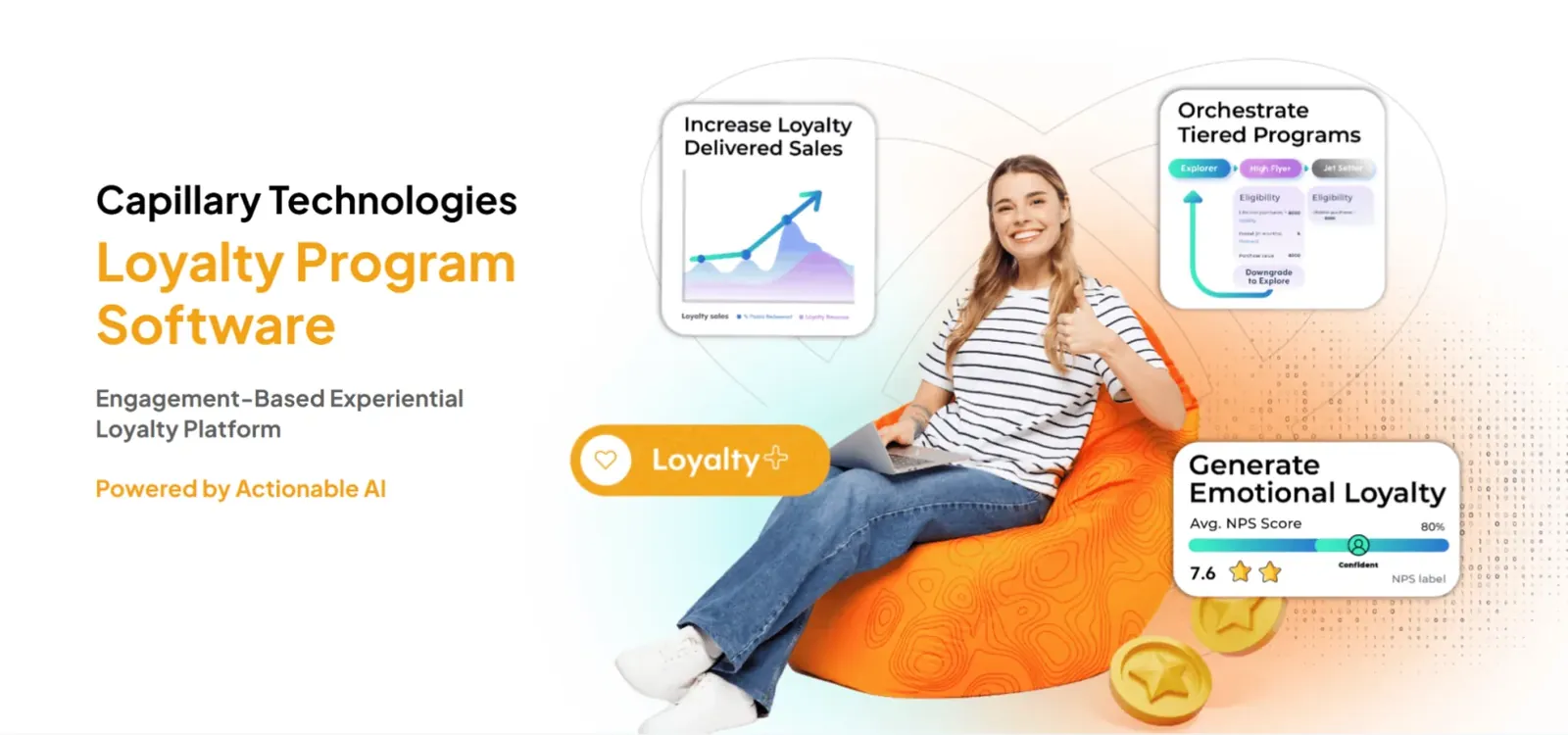
Capillary’s customer data platform, CDP+, comes with the loyalty engine and matches in-store transactions, online orders, and social activity to one customer ID. Your segments and loyalty rules run on that same record, so there’s no segment file to wait on, like the ones CrowdTwist receives from Oracle Unity. That means your marketers can trigger an offer or message from what a member did today.
The same record holds across brands, too. Capillary can run a separate program for each brand, zone, or country, with its own tiers and earn rules, on one customer database, where CrowdTwist may need a separate instance for each. Members can also redeem points from several of those programs in a single transaction.
Capillary’s campaign tool, Engage+, works from that record as well. It looks at each member’s online and in-store activity to choose the message they get and whether it goes out by email, SMS, push, or social. At the point of sale, its dynamic vouchers send a personalized offer to the member’s phone in real time or print it on the store receipt.
The downside shows up in cart promotions. Once one goes live, its per-customer limit and total redemption count are locked. If a promotion is more popular than expected and you want to allow more redemptions, you have to deactivate it and rebuild it with new limits, which means relaunching it just as it’s performing best.
Capillary may work for brand groups that want one customer view across its brands and channels, with offers and messages run from it. If you plan to keep Unity and Responsys, much of Capillary would overlap with them.
Capillary’s key features
- An AI assistant turns a plain-English campaign brief into an audience, rewards, and messages for approval
- In-app games, streaks, and challenges respond to points and tiers without an app release
- Run multiple loyalty programs with brand- or region-specific tiers and earn rules on one customer database
- Cart promotions for automatic member discounts, tier-only store offers, point-claimed rewards, and code-based offers
- Three redemption strategies for applying promotions before payment or reporting them after the sale, fuel pumps included
Capillary’s pricing
Capillary doesn't publish plans or a rate card on its own site. Its AWS Marketplace listing starts at $100,000 for a 12-month contract.
Reviews and ratings
4. Comarch: Best for loyalty programs across countries, currencies, and business models
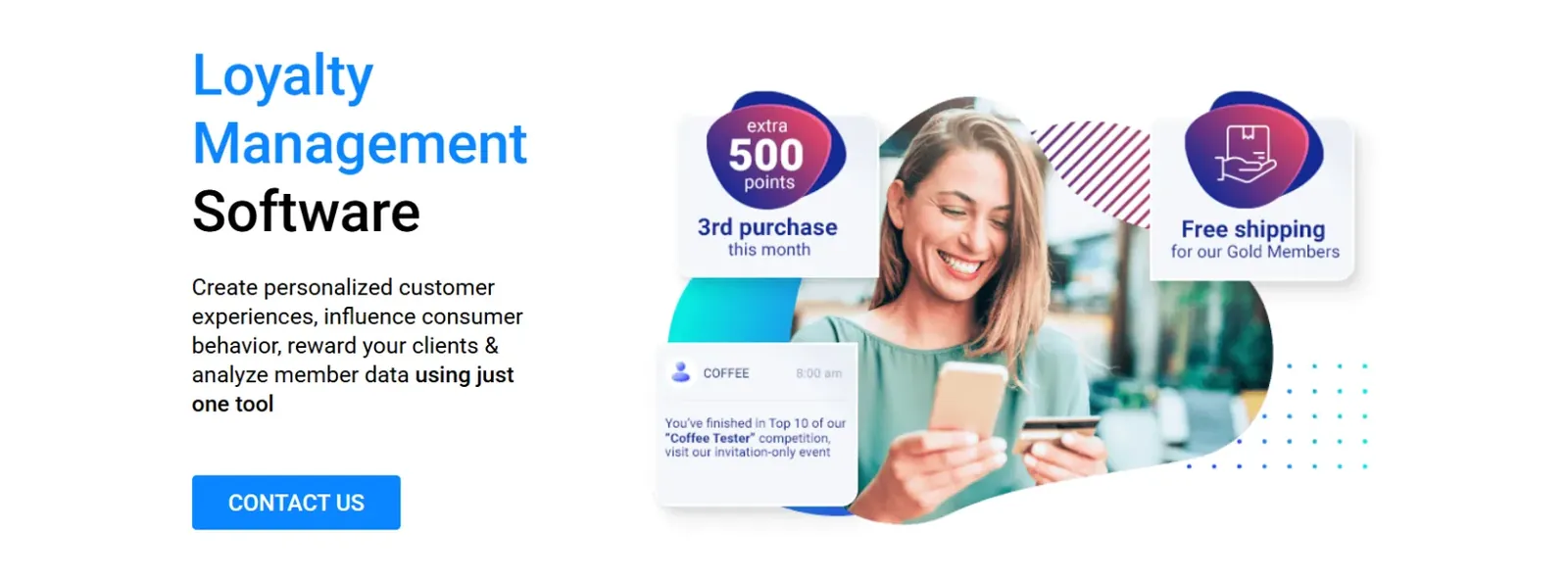
Comarch lets a multinational group run a separate loyalty program for each country on one platform. The core mechanics are shared across markets, and each country runs its own campaigns, points and redemption rules, and member communication in its own currency. Adding a market then means configuring another program on the platform you already run.
Each country program gets its own interface, partners, and member data, so a local team manages its market without touching anyone else’s. All of that sits inside one platform, with no separate instance per country, so your central team maintains the shared mechanics once for every market.
Comarch also runs B2B and coalition programs beside consumer ones. A fuel retailer, for example, can reward individual drivers and fleet customers on the same platform, and partner billing handles settlement with coalition and co-brand partners.
You also choose where it runs. Comarch can host it in its 16 data centers, run it on your own Azure, AWS, or Google Cloud tenant, or install it on-premises or in a hybrid setup if regulations or your IT policies require it.
But when you choose Comarch, you end up depending on their team for most customizations. When a market needs something the standard platform doesn’t do, Comarch customizes its tools or builds a dedicated component, so those changes wait on Comarch’s developers instead of being something your local loyalty team configures.
Comarch suits a group running loyalty in several countries, or running consumer, B2B, and coalition programs side by side. For a single-country, single-brand program, most of that structure goes unused.
Comarch’s key features
- Partner billing for settlements with co-branded partners and coalition members
- Vendor program managers for day-to-day campaign configuration, accrual-rule updates, and partner settlement reporting
- A promotion engine rewarding any-channel activity, like reviews or app downloads, with points, discounts, or coupons
- Badges, progress bars, and leaderboards where members compete for extra points and special prizes
- AI models flagging early signs of disengagement and automating next-best offers across channels
Comarch’s pricing
Comarch doesn't list prices for either of its tiers.
Reviews and ratings
5. Salesforce Loyalty Management: Best for loyalty on the same customer record as sales and service
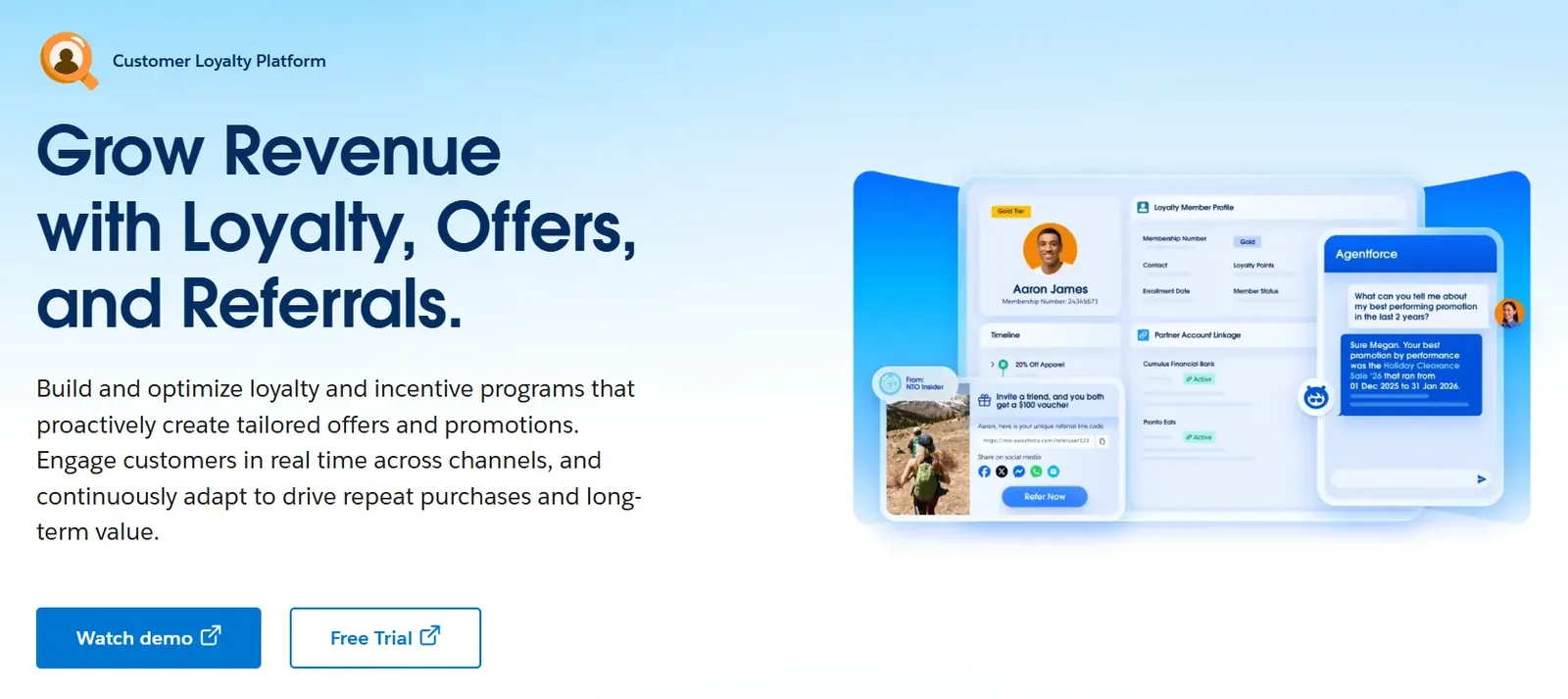
Salesforce Loyalty Management is built on the Salesforce platform, so each loyalty member is the same customer record your sales, service, and marketing teams already work from. Points, tiers, and loyalty activity show up wherever those teams look, without a separate loyalty system connected to your CRM.
In a service case, the agent sees the member’s points balance and tier on the same screen as the complaint. They can correct points or issue a voucher on the spot, without switching to another tool.
With Marketing Cloud in your stack, the same record drives member messaging. A tier upgrade, a points milestone, an expiring reward, or a new enrollment can start a Journey Builder journey as it happens, and the email or SMS carries the member’s current tier and balance.
The same record works for business customers. Salesforce runs B2B programs beside consumer ones, and a B2B member is the company account your sales team already manages, with its contacts linked to it. That insight lets a rep going into a renewal see what the account has earned and what its tier entitles it to, without asking the loyalty team.
Similar to CrowdTwist, if you want to use Loyalty Management, you have to buy into the whole Salesforce stack. It runs only inside a Salesforce org on the Enterprise edition or above, and the triggered journeys need Marketing Cloud, sold as a separate product. Running each brand as its own program adds another step, since that takes the top Loyalty Management edition.
Salesforce Loyalty Management fits a brand whose sales, service, and marketing already run in Salesforce, especially one that rewards business customers as well as consumers. If you’re building your own stack, it’s not a likely fit.
Salesforce Loyalty Management’s key features
- A POS API for enrolling members, looking up tiers and vouchers, and recording accrual and redemption orders
- Games like spin-the-wheel as rewards for orders or non-purchase activity such as surveys
- Partner liability billing on prepaid or postpaid terms along with a ledger for each partner
- Calculate liability from the points balance multiplied by cost per unit, plus issued vouchers multiplied by their cost
- Simulations that show how new or changed loyalty processes run, without changing any data in the org
Salesforce Loyalty Management’s pricing
Salesforce Loyalty Management is priced per org per month (free trial available). It requires Salesforce Enterprise, Performance, Developer, or Unlimited Edition with Loyalty Management enabled.
- Starter: $20,000 per org per month, billed annually, one loyalty program with Quick Promotions (1 million loyalty events a year, 50,000 API calls a day)
- Growth: $35,000 per org per month, billed annually, adds the Loyalty Rules Designer, simulation, escrow points, member badges, and simple partner management (15 million loyalty events a year, 100,000 API calls a day)
- Advanced: $45,000 per org per month, billed annually, adds multiple loyalty programs in one org, clubs, and advanced partner management (50 million loyalty events a year, 500,000 API calls a day)
Reviews and ratings
- Gartner Peer Insights 4.4/5 (14 ratings)
6. Talon.One: Best for promotions and loyalty managed by one rules engine
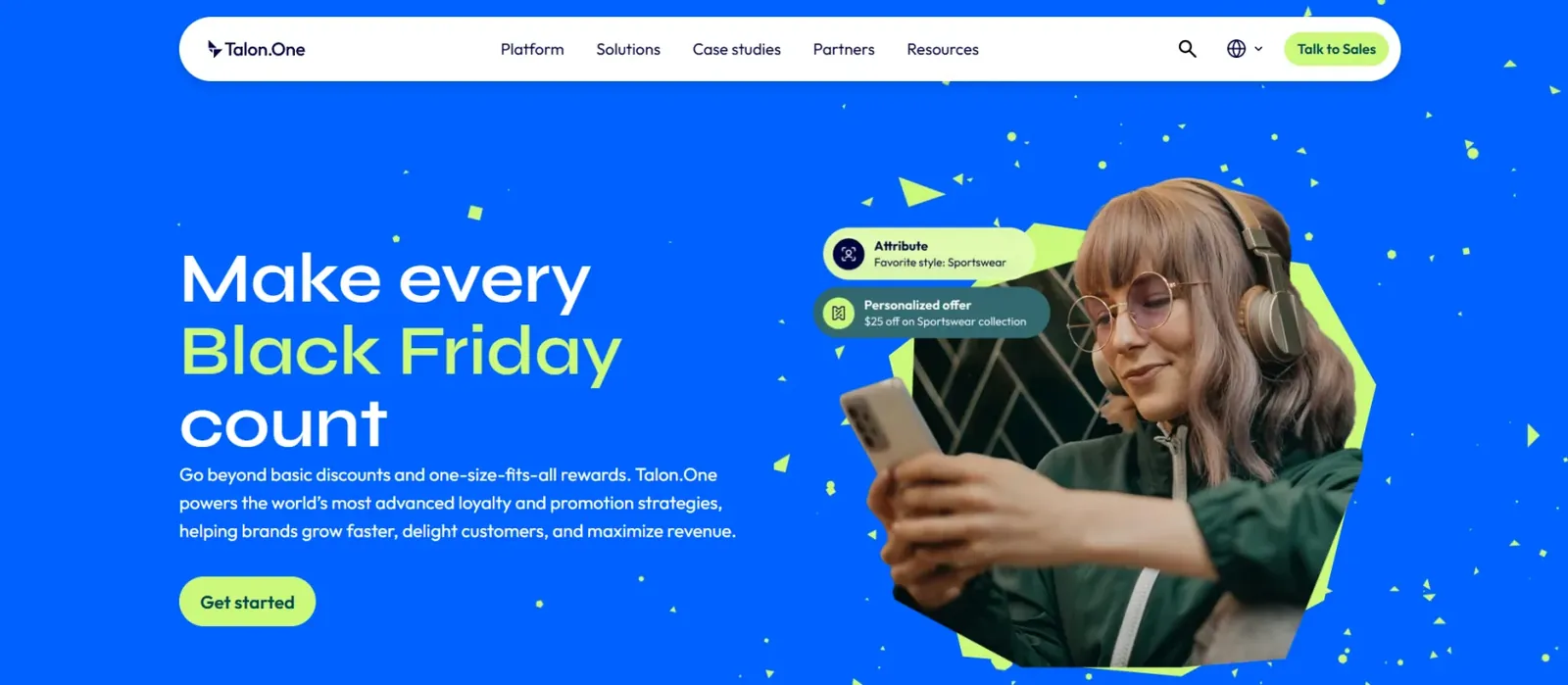
Talon.One runs your promotions, coupons, discounts, and loyalty points from one rule builder, so a single set of rules decides what a customer gets at checkout. You set each offer’s conditions and how it interacts with the others, and your checkout calls Talon.One to work out which offers apply to the cart.
When several offers apply to one order, evaluation groups decide which ones combine. Each group follows one rule: every offer stacks, only the first eligible offer applies, or only the highest discount does. Groups can be nested, too, so a customer can get the better of two competing coupons on top of a sitewide holiday sale.
Budgets cap what a campaign can give away, in total or per customer, coupon, store, or session. A cap can also sit on an identifier such as an IP address, which makes it harder for one shopper to collect extra discounts through several profiles. When an offer hits its limit or a customer stops qualifying, Talon.One drops it and checks the other eligible promotions, so the customer still gets the offers that remain valid.
Because Talon.One can only apply your rules to the carts it receives, every register, website, and app has to send the cart to it before the customer pays. Your engineers build that connection for each channel, which can include Oracle Retail Xstore through Talon.One’s API, so you can keep Xstore when you move off CrowdTwist. Then once a channel is connected, your marketers change promotion rules in the rule builder without a code release.
The trade-off comes with a busy promotion calendar. Each evaluation group applies one stacking rule to every offer in it, so a deal that needs different treatment has to go in a group of its own. As offers launch, change, and expire, your marketing team spends more time building and maintaining those groups.
Talon.One makes the most sense when most of your loyalty happens in the cart, alongside frequent discounts and coupons. If your members mostly earn through the surveys, sweepstakes, and social activity CrowdTwist is built around, Talon.One has less to offer.
Talon.One’s key features
- POS connections through its APIs, including Oracle Retail Xstore and Newstore, for in-store earning and redemption
- Recurring budgets resetting daily, weekly, monthly, or yearly, such as a weekly coupon cap per customer
- Subledgers for separate point balances inside one program, such as points redeemable only where they were earned
- Automatic rollback of pending points on returns and cancellations, with an option to deduct active points
- Up to 20 tiers in profile-based programs, with immediate or scheduled downgrades
Talon.One’s pricing
Talon.One doesn't publish its prices. Each plan depends on the data volume.
Reviews and ratings
7. Voucherify: Best for running coupons, gift cards, and loyalty from one API
Voucherify runs coupons, automatic promotions, loyalty points, referrals, and gift cards through one API, so every kind of incentive you offer follows the same rules. Once the integration is in place, your marketers launch each campaign through its own wizard, whether it’s a loyalty reward, a referral link for an influencer, or a gift card sent by email.
At checkout, Voucherify can check up to 30 coupons, gift cards, and rewards in one request. It then applies your stacking rules to decide which ones combine, how many a customer can use, and which takes priority. Campaigns sit in exclusive categories, where only one can apply, or joint ones, where several can, so a customer can’t double up on discounts you meant to keep apart.
Because Voucherify treats loyalty as one part of a wider reward setup, a single program can run several wallets at once. One customer can hold separate balances for standard points, cashback, and bonus points, each with its own rules and expiration dates, so you manage several reward types under one program.
But Voucherify does not provide pre-built connections for any point-of-sale system, Oracle Simphony and Xstore included. Your engineers must manually write custom connections for every website, mobile app, or physical register channel you operate, and your team must maintain those connections over time.
For example, if you use standard retail registers alongside restaurant checkout systems, your engineers will have to build and maintain completely separate connections for each one. This creates a high upfront cost in developer hours, slows down how fast you can launch new features, and forces your IT team to permanently maintain those custom connections over time.
Voucherify works well for marketing teams that want to run a wide mix of gift cards, referral links, and coupons, with developers ready to build the connections. If you don’t have engineers to maintain the integrations, or your program is mostly standard loyalty points, other platforms may work better.
Voucherify’s key features
- Reusable validation rules nesting audience, product, budget, and metadata conditions in AND/OR brackets
- An eligibility check showing the discounts and promotions a customer qualifies for on the current order
- Campaign moves between projects in one cluster, for copying a region's or brand's setup without rebuilding
- Control over the member data you send, often just a customer ID and rule fields
- Tiers based on points earned, spend, or event count, with grace periods before a downgrade
Voucherify’s pricing
Voucherify offers three pricing plans, primarily based on API usage and the project count.
- Business: $650/month. Get 25,000 API calls per month (up to 100 per minute), three projects, and standard support
- Organization: $1,300/month. Access 50,000 API calls per month (200 per minute) and five projects, and shared hosting
- Enterprise: Custom quote. Use custom limits, private data hosting, and the enterprise-only geofencing, management APIs, and areas and stores features
Reviews and ratings
8. Open Loyalty: Best for developer-built loyalty experiences
Open Loyalty gives your developers a ready-made loyalty engine and leaves the member experience to them. Points, tiers, challenges, leaderboards, and other mechanics all come as API calls. Your team builds them into your own app or site, such as a challenge that pays out when a member logs in, writes a review, or completes their profile.
The engine connects to the rest of your stack the same way. Open Loyalty sits behind your CRM, CDP, and commerce platform, and webhooks send events like a finished challenge or a won prize to your other systems, so the member’s profile stays current everywhere. One installation can also run a separate tenant for each country or business unit, with its own currency, timezone, and segments.
The member experience is yours to build, though. Open Loyalty has no member-facing screens, so your developers build every screen, progress bar, and reward button members see, or you license its separate white-label app. CrowdTwist gives marketers preloaded experiences and widgets they configure and launch, so moving off it means rebuilding what members see along with the program behind it.
Open Loyalty fits a brand whose developers already own the app or website and have time to build the rewards experience into it. If you need member experiences your marketers can launch without engineers building them first, it’ll slow you down.
Open Loyalty’s key features
- Separate tenants for each country or business unit, with their own currency and timezone
- Budget limits on points issued overall or per member, per day, week, month, year, or lifetime
- Automatic reclaiming of points when an order is returned or canceled
- Product-based campaigns rewarding chosen SKUs, categories, brands, or bundles at different point values per tier
- Daily CSV exports of member, transaction, and points changes to AWS, Google Cloud, or Azure storage
Open Loyalty’s pricing
Open Loyalty doesn't publish its rates. It charges a platform fee plus an allowance fee set by your monthly active members, that is registered members who complete at least one loyalty event in a calendar month.
Reviews and ratings
9. Annex Cloud: Best for rewarding referrals and reviews on the same loyalty platform as purchases
Annex Cloud lets members earn loyalty rewards for promoting your brand as well as for buying from it. Points and tier credit come from purchases and also from following the brand, sharing content, writing reviews, and referring friends. Because all of it is recorded on one member record, a customer who mostly reviews and shares can move up tiers the same way a big spender does.
Refer-a-Friend rewards both the member and the friend they bring in, with fraud controls built in. The friend joins the program already attributed to whoever referred them, so you can see which advocates drive sign-ups and reward them for it.
Your marketers run these campaigns from the same promotion engine as purchase rewards, without a development request. That lets them reward advocacy as precisely as spending, for example with extra points only when a review includes a photo or video, and test the campaign on real orders before it goes live.
The same setup carries across brands. Several brands, franchises, or regions can share one instance, with templates that give each its own program settings, so a new banner doesn’t become another program to run. A brand that needs its data kept apart for residency or security reasons can still run on its own instance.
Support, though, starts with your team. Under Annex Cloud’s support terms, your staff handle first-line support and diagnose user-reported problems themselves, and its engineers step in only once your technical contact can reproduce the issue. You’ll need trained people in-house for that, and during a busy sales period a problem waits on them first.
Annex Cloud has a clear role when customer advocacy is a major part of how your business acquires and retains customers. Without that emphasis, there are other platforms more suited to traditional loyalty programs.
Annex Cloud’s key features
- A Bazaarvoice API integration linking loyalty data and members to ratings and reviews, Q&A, and social content
- Multi-point buckets that let one member action earn in more than one points currency
- Multi-variant templates giving each brand, franchise, or region its own settings on one instance
- A OneView Commerce POS integration showing store associates real-time loyalty data at the register
- Receipt scanning for purchases at retailers and marketplaces you don't own, with approve, flag, or reject rules
Annex Cloud’s pricing
Annex Cloud works primarily with enterprises with over $250M annual revenue. However, it doesn't provide public plan specifications or pricing details. You can request a quote directly from their team.
Reviews and ratings
- TrustRadius 6.4/10 (5 reviews)
- Capterra 4.2/5 (39 reviews)
10. Kobie: Best for pairing loyalty technology with strategy and program operations
Kobie sells its loyalty platform together with the people to plan and run the program. Its strategy team starts with Emotional Loyalty Scoring, which measures how much of your members’ loyalty comes from habit, reciprocity, or status, and uses the results to shape the program design and partner strategy. An AI-assisted financial model then gives marketing and finance one set of numbers on upfront cost, expected return, and program economics.
Oracle’s consulting covers strategy and financial models for CrowdTwist too, so Kobie’s difference shows up after launch. Its operations team plans your CRM activation, coordinates member journeys across channels, and writes lifecycle messaging playbooks for each market. Its loyalty-trained contact center agents can also answer members’ questions about points and rewards on your behalf, which you’d otherwise have to staff yourself.
Even though Kobie sets up the structure and strategy behind your loyalty program, your own team still handles campaign execution in each market. Kobie’s operations team trains and equips your employees and partners to follow the agreed playbooks, while your marketers use the Loyalty Experience Engine to configure tiers, offers, rewards, and customer audiences without code.
Kobie is an option if you want outside loyalty expertise and day-to-day operating support alongside the software, whether you take the full platform or connect individual components to its existing marketing systems. If you already have loyalty strategists, regional marketers, and member support staff, much of what its services cover would duplicate their work.
Kobie’s key features
- A program health monitor tracking 22 business metrics and 17 customer-value drivers with causal lift analysis
- A plug-and-play gamification suite with challenges, badges, streaks, and surveys
- A liability ledger recording each point's cost and attribution from earn to redemption
- A built-in AI assistant for program configuration, liability modeling, and campaign optimization
- A rewards marketplace with gift cards, merchandise, travel, exclusive perks, or inventory you supply
Kobie’s pricing
Kobie doesn't publish pricing or plans for its platform or its services. You’ll need to contact them for a quote.
Reviews and ratings
- G2 4.8/5 (10 reviews)
Why companies look for an Oracle CrowdTwist alternative
Teams usually leave CrowdTwist because their program has grown in a direction the Oracle setup doesn’t follow easily: onto systems outside Oracle’s stack, across more brands and countries, or into partner-funded offers that finance has to track.
Systems outside Oracle’s stack
CrowdTwist’s built-in connectors cover Oracle’s registers, Responsys, and Unity, and much of what it does at the till and in member messaging depends on them. When a register or messaging tool moves off Oracle, connecting CrowdTwist becomes the same API project as connecting any other engine, so the main reason to keep it weakens.
Some teams also want their loyalty engine independent of any one vendor’s suite, holding rules and balances behind their own apps and channels.
Several brands or countries in one program
A brand with its own tiers or points economy, or a country run as its own program, may need a separate CrowdTwist instance. As a group adds banners and markets, that means more programs to run. Anything meant to span brands, such as a shared rule, a combined reward, or one view of points liability, then has to work across those separate programs.
Lower-risk loyalty migration
For a team already on CrowdTwist, the move itself becomes a priority. CrowdTwist’s exports and developer API get the data out, but every member balance, tier, and historical record still has to match the moment the new system takes over, and a mismatch reaches members before your team can correct it. That’s why a platform migration process that checks balances, tiers, transactions, and integrations against the live program before cutover matters as much as the platform you choose.
Deeper financial and partner controls
CrowdTwist bills partners a flat cost for each point they award. That covers a simple partner program. It stops covering yours once partners co-fund promotions and expect their share split out, or once brands that share a currency need their liability reported separately. When finance has to trace partner charges and liability back to the transactions behind them, a flat per-point charge doesn’t give enough detail.
Loyalty and promotions in one decision
When promotions and loyalty run in separate systems, the promotions engine decides the discount and the loyalty engine decides the reward, and neither one owns the final combination at checkout. As your promotion calendar gets busier, offers start combining in ways you didn’t plan, and the team wants both decided by the same set of rules.
More or less vendor support
CrowdTwist’s professional services can cover setup, configuration, and ongoing program management. Teams that want their own marketers and engineers running the program may prefer a product they direct themselves. Others want more from the vendor than that, including strategy, financial planning, and member care.
How to choose the right Oracle CrowdTwist alternative
The right alternative fixes the reason you’re leaving CrowdTwist without creating a new problem for your team. Each test below uses your own rules, systems, and plans, so every candidate is judged on your program.
Start with the problem you need to solve
Name the problem the new platform has to solve first. A team dealing with competing offers at checkout has a different priority from a group running five brands as separate CrowdTwist programs. Write down what already works, too, so you know what the replacement has to keep.
Find out who controls program changes
Take a change your team made recently, such as a new earning rule, and trace how each platform would handle it. On one platform, a marketer configures, tests, and publishes it from the admin. On another, the same change needs engineering work or the vendor.
Test a more complex change as well. A platform may let marketers adjust routine rules but need technical work for new data sources, integrations, or custom logic. Note which changes your business team can make directly and which wait on developers or the vendor.
Map the integration work end-to-end
Start with the systems that will stay in place, then trace how a member’s activity moves through them. With CrowdTwist, an Xstore register looks up the member, shows the rewards they can use, sends the sale for points, and adds points or rewards to settle a complaint. Simphony handles enrollment and redemption at the till.
Then follow the data past the transaction. Responsys receives member activity in real time, and Unity sends segments back by file. Build the same map for each candidate and mark whether each connection is a native integration, an API your team builds against, or a batch feed. The finished map shows how much integration work it takes to keep the whole loyalty workflow running.
Test the financials and member records
Check how each platform handles transactions that touch points, partner payments, and financial reporting. A return should reverse points against the brand that issued them, and a partner-funded offer should create the records finance needs to settle with the partner. When one loyalty program runs across multiple retail brands, each brand still needs its own sales, returns, and partner offers recorded against it.
Member records need the same scrutiny. Your member care team should see enough transaction history to investigate an account and correct errors.
Make migration a platform test
Ask each vendor how it proves the new system before cutover. A credible plan explains several things:
- how the old and new platforms run side by side
- how live transactions are compared
- how mismatched balances or tiers get resolved
- what happens if the systems disagree and you need to roll back
If those safeguards fall entirely on your internal team, so does more of the transition risk.
Test the change you will need later
A platform has to support the program you will build along with the one you have today. Pick several changes you expect over the next three to five years, such as a new earning mechanic, a second brand, or a partner that funds its own offers.
Then ask what each change requires. A marketer configuring a new rule, an engineer building it on the existing engine, a new integration, a data migration, and a vendor release are very different levels of effort. Test rule versioning, staging, and rollback at the same time. Those controls reflect how safely the program can evolve after implementation.
Loyalty Methods (ReactorCX): Best CrowdTwist alternative when loyalty needs to work across your existing stack
If your program is outgrowing CrowdTwist’s Oracle setup, whether through new systems or more brands and regions, ReactorCX replaces the loyalty engine without replacing what’s around it. Your registers, apps, and marketing tools stay in place while ReactorCX handles the rules, transactions, and member balances behind them, with every point traced to the sale that earned it. Brands that ran as separate CrowdTwist programs can move into one ReactorCX instance, but before any of their members switch, SafeSwitch™ runs ReactorCX beside CrowdTwist on your live transactions until every balance and tier matches. That way, your program keeps functioning, and members don’t even realize you migrated.
Book a call with our team and bring your current program rules, the systems your loyalty engine connects to today, and any cutover dates you're working toward. We’ll show you how your program would run on ReactorCX and what the move from CrowdTwist would involve.