
A guest at a resort charges dinner to the room, books the spa in the app, and plays slots that night. The PMS, the outlet POS, and the casino management system each hold part of the guest’s information, so the first decision is how your loyalty program will connect to them. Some loyalty platforms add rewards to the hospitality software you already use, while others run separately and connect to systems across your properties, which matters most when different hotels in your group run different software.
After that, the comparison turns on how your program will work. Can guests earn points on restaurant spending and redeem them at another property? Can individual hotels run their own promotions under rules set by the group? Check which of those each platform supports, and what your team would have to build or integrate to get the rest.
The 10 platforms below cover both kinds for enterprise hotel and casino groups. Each entry shows what the platform handles on its own and what your team would connect to it, whether you're launching your first program or replacing the software behind an existing one.
Best Hotel Loyalty Program Software At a Glance
- ReactorCX: Best for One Real-Time Loyalty Program Across Fragmented Hotel and Gaming Systems
- Cendyn + Loyalty Juggernaut GRAVTY: Best for Loyalty on the Same Guest Profile as CRM Segmentation and Messaging
- Oracle OPERA Cloud Loyalty: Best for Loyalty Inside an Existing OPERA Cloud Property Stack
- Agilysys Loyalty & Promotions: Best for Casino Resort Loyalty Built Into Agilysys PMS and POS
- Talon.One: Best for Building Loyalty Rules Into a Composable, API-First Hospitality Stack
- Antavo: Best for Configuring Complex Hotel Member Journeys Without an Engineering Queue
- Capillary: Best for Nesting Stay, Dining, and Paid-Membership Programs Inside One Loyalty Framework
- Kobie: Best for Bundling Loyalty Strategy, Program Design, and Platform Under One Engagement
- Salesforce Loyalty Management: Best for Extending an Existing Salesforce Customer 360 Investment Into Hotel Loyalty
- dailypoint: Best for Guest, Corporate-Booker, and Staff Loyalty on One Hotel-Native Profile
1. ReactorCX (Loyalty Methods): Best for One Real-Time Loyalty Program Across Fragmented Hotel and Gaming Systems
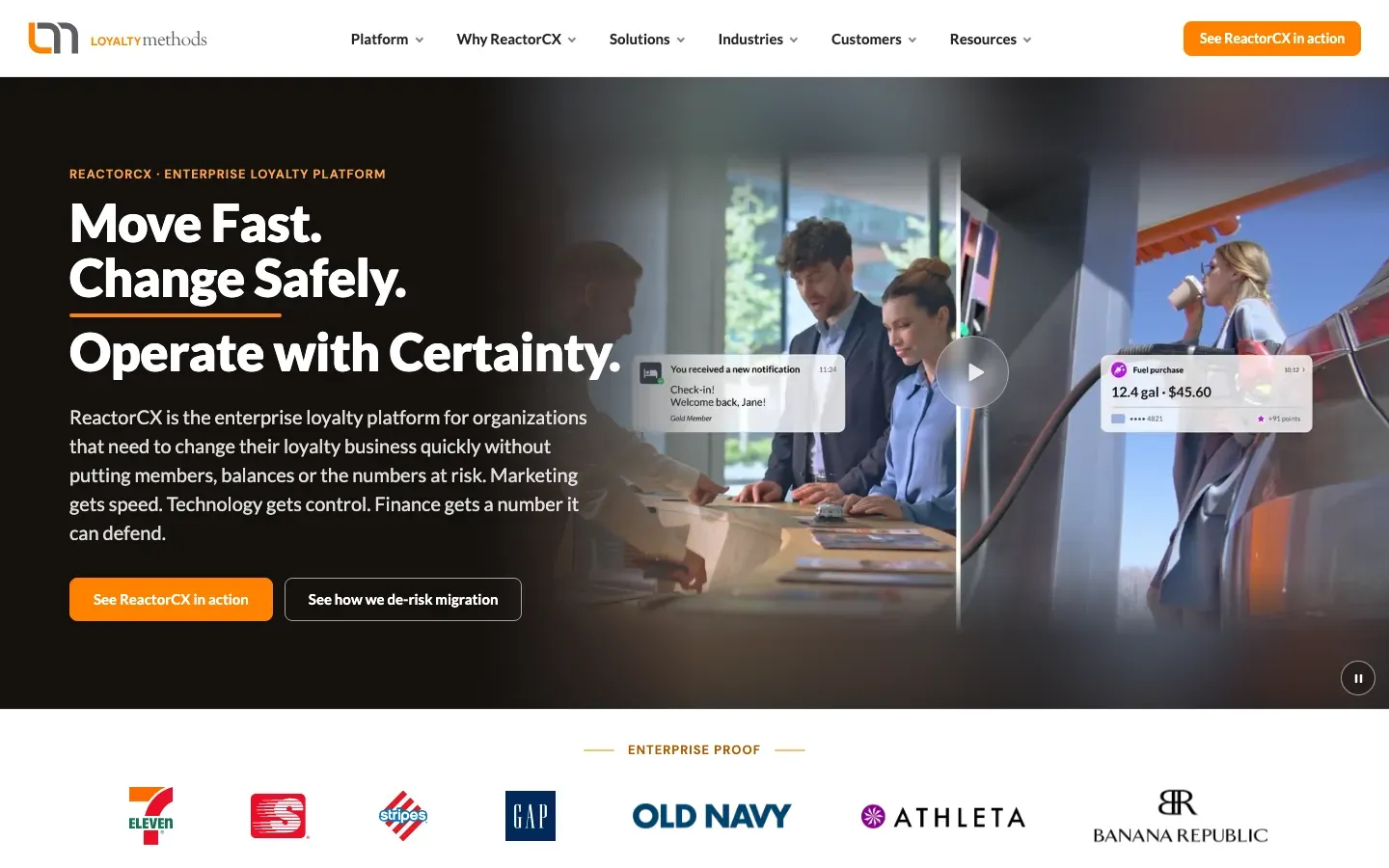
ReactorCX is Loyalty Methods' headless, API-first loyalty engine. It keeps one balance and one tier for each guest at every front desk, outlet, and casino floor in your group, without your properties replacing the software they already run.
Your marketers set earning rules and offers in the admin console, and your engineers extend the same engine in code. Every rule, earn rate, and tier threshold is reachable through the same APIs your systems already use. Your own apps and front-desk screens show the member experience, and your customer data platform and email provider stay in place.
Every system sends its activity to that engine through real-time APIs, event streams, or scheduled batch feeds. A room charge and a slot session update the same member account, and ReactorCX applies your earning and tier rules as each one arrives. When a transaction needs an immediate answer, it responds at the desk or register while staff are still serving the guest.
When several promotions qualify on the same hotel bill, ReactorCX evaluates every valid combination and applies the one your policy picks: guest-first, business-first, or protecting a partner's funded offer.
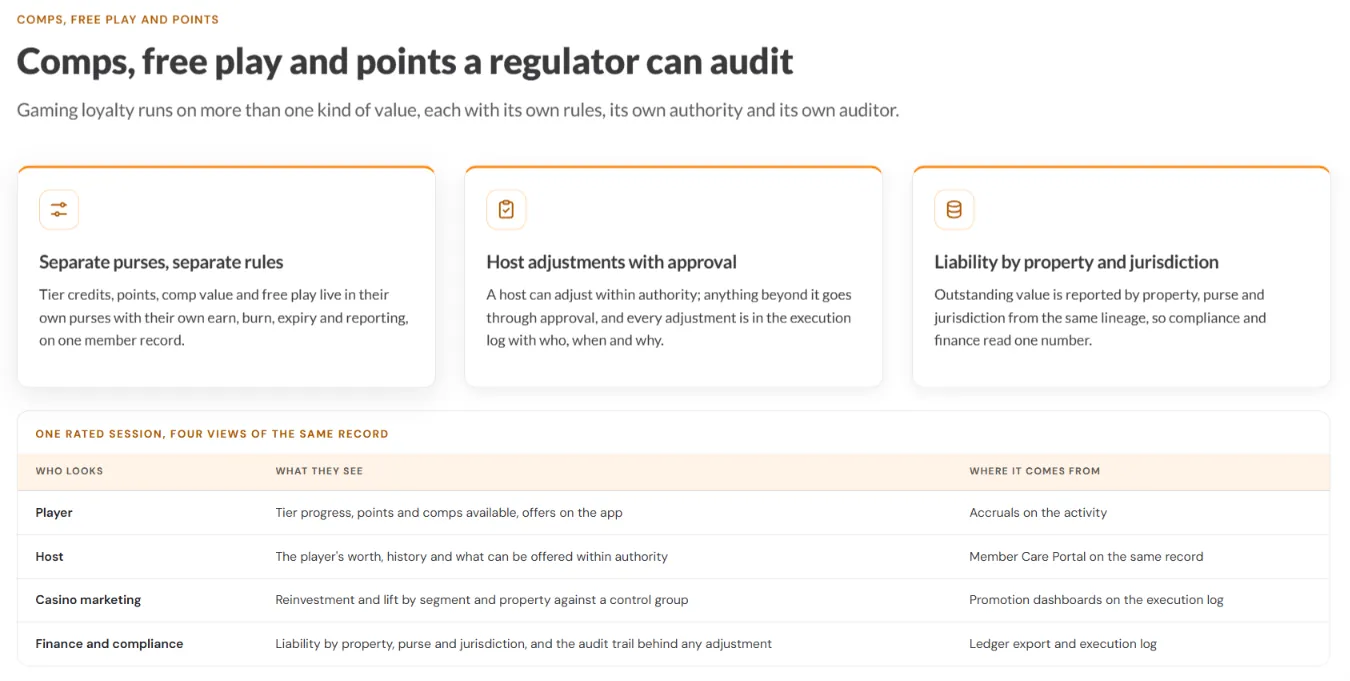
Casino rewards run on that engine too. Comps, free play, and slot dollars each run as their own purse with their own rules alongside points, and the rewards catalog ranks what each player sees using configurable signals, including propensity scores from your own models.
Each member holds one wallet while finance tracks earning and redemption by venue, outlet, partner, and channel. ReactorCX allocates funding and reimbursement across those venues and partners, and it reports reward liability and breakage with transaction-level exports for reconciliation. The real-time core loyalty engine logs every rule execution, so when a guest disputes a balance, your team sees which rule produced it.
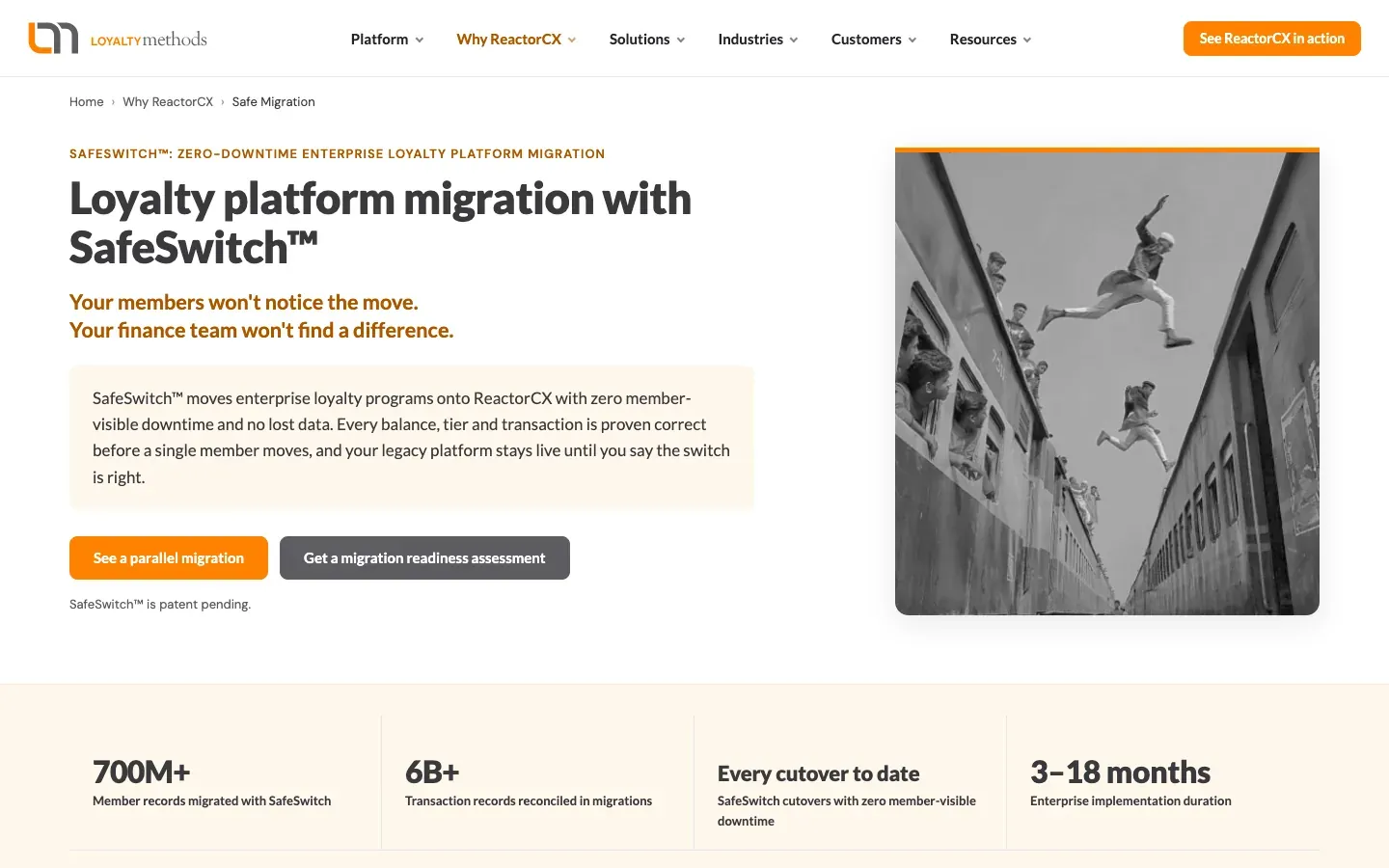
If you're replacing an existing platform, ThreadSync™ runs configuration, integrations, and data migration as parallel specialist threads that reconcile at shared checkpoints. SafeSwitch™ then moves the program through four gates, starting with a shadow run and reconciliation against the live program. Loyalty Methods keeps the old platform synchronized and the rollback path ready until ReactorCX is confirmed stable in production, and members keep using the existing program the whole time.
When your properties don't share systems and finance needs to track the program by venue, ReactorCX gives you one program without replacing those systems. MGM Rewards, which runs on ReactorCX, won Best Earning and Redemption Ability at the 2025 Frequent Traveler Awards. ReactorCX isn't built to be your member app or your email platform, though. You'd keep separate tools for those and connect them.
ReactorCX Key Features
- Extensible data model: The member record carries balances, tiers, segments, preferences, and any custom attributes your program defines, and new fields reach rules, APIs, and reporting without a platform change.
- Property, outlet, and gaming integrations: ReactorCX connects to PMSs, F&B and retail POS, kiosks, and casino management systems through real-time APIs, event streams, or batch feeds, so each property keeps the systems it runs.
- Member Care Portal: Front desk, host, and contact-center staff find a member by phone or loyalty ID and adjust a balance within the limits set for their role.
- Gamification on the same engine: Trip challenges reward a stay, a dinner, and a spa visit on one trip, each mechanic with a control group.
- Bring-your-own-model AI: A program manager asks ReactorCX AI, running on your own language model, for a promotion and approves the draft it returns.
- Enterprise security posture: ReactorCX holds SOC 2 Type II and ISO/IEC 27001:2022 and runs across three availability zones, with an optional secondary region for disaster recovery.
ReactorCX Pricing
Loyalty Methods prices ReactorCX per engagement, with implementation included. Each quote is scoped to:
- Program scope: The properties, venues, and currencies the program covers
- Transaction volume: The activity the engine processes
- Integration scope: The property, point-of-sale, and gaming systems ReactorCX connects to
- Migration scope: Whether a live program is moving off another platform
What Customers Are Saying
"You guys [Loyalty Methods] understanding our problem at the outset, what we're trying to solve for, and then really putting the tools in the hands of our teams … to make sure that we're hitting that moment and we're getting it right."
Kevin Meiners, Head of Loyalty and Payments, Gap Inc.
"LM's focus on innovation, agility, and successful, seamless delivery has made a massive difference in our efforts."
Lucy Donaldson, Head of Loyalty, Martech and Consumer Ecosystems, Western Union
2. Cendyn + Loyalty Juggernaut GRAVTY: Best for Loyalty on the Same Guest Profile as CRM Segmentation and Messaging
Cendyn + Loyalty Juggernaut GRAVTY gives your marketers a guest's stays, spa and restaurant spending, and loyalty status in one record when they build a segment or a campaign. Cendyn CRM brings PMS and booking-engine records together in that profile, and GRAVTY, the loyalty engine behind it, runs the earning and redemption rules on it.
Loyalty managers set earning and redemption conditions in GRAVTY's visual rule builder, including offers aimed at particular guest segments. They change those conditions without code as a promotion develops.
The program reaches outlet and booking systems through named connectors. Its POS connectors for Infrasys, Micros, Toshiba, and Oracle Simphony check balances and post earning and redemption in real time, and a Cendyn CRS connector lets guests use points when they reserve a stay.
The PMS connectors don't all do the same job, though. The Protel connector handles account inquiries and points redemption, while the IDS connector covers real-time balance inquiries and redemption with points or vouchers. With a mix of PMSs across your hotels, what front-desk staff can do for a member will differ from one property to the next. Check each connector's functions against the workflows you want at every hotel.
If your group already runs Cendyn CRM, or is moving to it, the loyalty rules, tiers, and rewards work on the guest data your campaigns already use. But if you'd rather keep the CRM you have and add a standalone loyalty engine beside it, this pairing gives you less, because the shared profile is what it's built around.
Cendyn + GRAVTY Key Features
- Behavior-based tiering with automated upgrades, badges, and challenges
- Experiential redemptions across spa, dining, events, and curated experiences
- Enrollment from the website, the mobile app, check-in, Wi-Fi, or a QR code
- Member portal delivered on the web and through a loyalty app
- Central campaign controls and portfolio-wide benchmarking, with each property keeping its own flexibility
Cendyn + GRAVTY Pricing
Neither vendor publishes a price, and there's no trial or free tier. Cendyn sells three loyalty packages:
- Loyalty Essentials: Member recognition, discounted member rates, manual awards, and a web member portal
- Loyalty Professional: Adds guest-activity tiers, rules based on nights or whole reservations, and point redemption through the booking engine
- Loyalty Enterprise powered by LJI GRAVTY: Adds two-way integrations, unlimited tiers, points, redemptions, and rule configurations, AI personalization with a predictive retention score, and enterprise BI on program and member activity
- Contract: Bought together with Cendyn CRM in one agreement, with a 36-month minimum term for both subscriptions and no termination for convenience
- Implementation: Billed separately, starting at CRM go-live and running about 12 weeks
3. Oracle OPERA Cloud Loyalty: Best for Loyalty Inside an Existing OPERA Cloud Property Stack
Oracle OPERA Cloud Loyalty runs tiers, points, and awards for every OPERA Cloud property in your group from one central guest database. Administrators set the rules and handle membership claims inside OPERA Cloud, and the system keeps points spent on rewards apart from points that count toward a tier.
Its match-and-merge rules decide which duplicate guest records combine automatically and which go to a person for review, so a guest who books across several of your properties ends up with one record. Preferences can be set per property or for the whole group, and a member gets the same recognition at a hotel they've never visited.
OPERA Cloud Central puts the program in the same chain-level login as distribution, sales, and the contact center, so an agent taking a reservation sees the member's profile and past stays on the same screen. Membership data moves through the OHIP REST APIs your group already uses for reservations.
Tier history doesn't come across when you move an established program onto the module. The Toolbox import loads past membership transactions and stay records from a CSV file, including the points earned from nights, revenue, and stays, but not the tier history behind each member's status. If your members already hold status, you'll need to agree with Oracle how it carries over before launch.
OPERA Cloud Loyalty makes the most sense when OPERA Cloud is already the system of record across your properties and you want consistent recognition without adding a vendor. But it's less suited to a program that has to reach beyond OPERA. Links to a casino player tracking system or an outside CRM run through outbound integrations your team configures to Oracle's REST specification.
Oracle OPERA Cloud Loyalty Key Features
- Automatic point and tier calculation, with upgrades, downgrades, and renewals on a calendar or rolling period
- Bonus point rules for direct bookings, targeted by booking channel, rate, and date range
- Award redemption that lets members spend accrued points on rooms, hotel bills, room upgrades, packages, or experiences
- Membership claims for missed stays, with configurable claim types and staff adjustment limits
- Corporate and travel agent reporting on the stay activity and revenue each company generates
Oracle OPERA Cloud Loyalty Pricing
Oracle doesn't publish pricing for OPERA Cloud Loyalty. The module is sold as an add-on subscription to OPERA Cloud Foundation, and its price comes as part of an OPERA Cloud quote.
Oracle OPERA Cloud Loyalty Reviews and Ratings
- G2: 4.2/5 (65 reviews, includes the OPERA Cloud PMS suite)
- Capterra: 3.6/5 (68 reviews, includes the OPERA Cloud PMS suite)
- Hotel Tech Report: 4.6/5 (761 reviews, includes the OPERA Cloud PMS suite)
4. Agilysys Loyalty & Promotions: Best for Casino Resort Loyalty Built Into Agilysys PMS and POS
Agilysys Loyalty & Promotions connects your resort's rewards program to Agilysys PMS and InfoGenesis POS. Guests earn and redeem as those systems process each transaction, and balances update in real time. The module also connects to Agilysys Book and Analyze for booking and performance reporting.
Staff work the program from the PMS arrival screen, where they pull up a member's status and post an earning or a redemption without opening a second application. You configure earning rules, redemption thresholds, expiration policies, and tier benefits. If you run several properties, central controls keep the program rules consistent while each property keeps its own promotions and brand settings.
If you want membership administration and broader hotel reporting, you'll need more than Loyalty & Promotions. Agilysys Membership handles recurring dues and member self-service, and Analyze supplies the broader reporting tools. Your team implements and manages those products alongside the loyalty module, so one program means running several connected products.
If you run a casino or tribal gaming resort and want to reward hotel stays and spending across its amenities, Agilysys does that from the PMS and POS your staff already work in. It's most relevant if you use Agilysys PMS and InfoGenesis or plan to adopt them.
Agilysys Loyalty & Promotions Key Features
- Item-specific, outlet-specific, and post-type promotions supporting BOGO offers, conditional discounts, and timed incentives
- Promotion targeting built from guest profile and transaction data, including guest behavior
- Membership entitlements, stored credits, and loyalty points applied in a single guest transaction
- Executive dashboards covering redemption rates, campaign performance, wallet share, and lifetime value
- Menus, item prices, promotions, and outlet settings managed for every outlet from one cloud-hosted operator portal
Agilysys Loyalty & Promotions Pricing
Agilysys doesn't publish pricing, a trial, or contract terms for Loyalty & Promotions. Its hospitality team quotes each deployment individually.
5. Talon.One: Best for Building Loyalty Rules Into a Composable, API-First Hospitality Stack
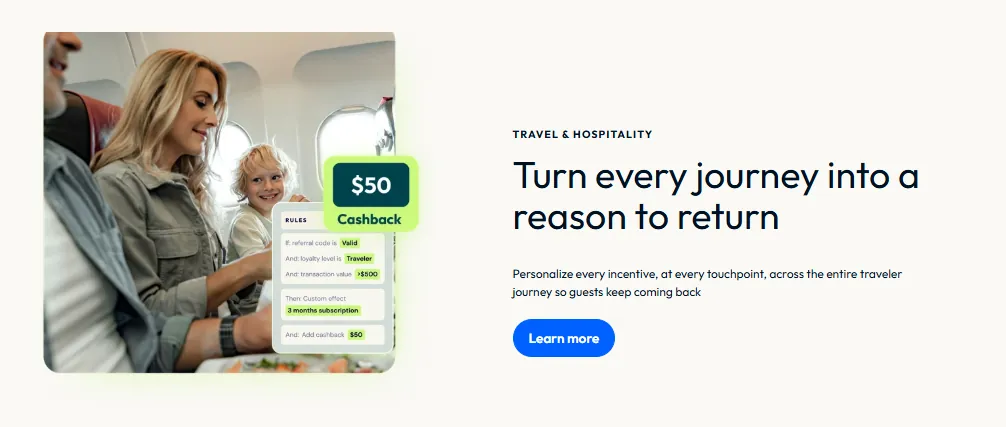
Talon.One applies the loyalty rules your team writes to bookings and on-property purchases, while your own hotel systems show guests the results. Developers connect those systems through more than 170 API endpoints, and the engine runs on Google Cloud with a choice of hosting regions.
Its session endpoint takes reservation data, including booking changes and cancellations, and custom attributes such as stay length and check-in status can drive your reward rules. For example, you could give bonus points for longer stays and hold them in a pending balance that your integration activates only after checkout, so canceled bookings and no-shows never produce spendable points.
Subledgers keep a separate point balance for each property within one program. If you want guests to redeem only where they earned, you set that restriction without building a program for every hotel. Each subledger tracks current and pending balances, plus a tentative balance during an active transaction.
Your loyalty team will still need developers for some changes after launch. Marketers change rules in the no-code Rule Builder, but your website or app controls how guests see and use rewards, and your hotel systems supply the booking data the rules depend on. A reward that needs new booking details or a new redemption option means developers update those systems first. Plan that work into each new reward.
If you have in-house engineers and want to assemble the guest experience yourself across booking, mobile, and outlet systems, Talon.One gives them the rules engine to build on. But with a thin development team, each system it has to reach, casino player tracking included, becomes integration work to schedule before launch.
Talon.One Key Features
- Point currencies and tiers that promote a member automatically when their active balance crosses a threshold
- Nestable campaign groups that stack offers, apply only the first, or apply the highest discount
- Loyalty cards for point-of-sale use, shareable across a household and replaceable with the balance intact
- A loyalty dashboard reporting active points, spent points, and member counts, filterable by subledger and time frame
- Incentives triggered only where models trained on your own data predict an incremental conversion
Talon.One Pricing
Talon.One doesn't publish prices for its three plans. Each is quoted individually and priced on data volume, and a free developer trial environment is available for testing.
- Starter: An individual pricing scheme covering at least 500,000 coupons, with the full promotion suite, onboarding and support, all third-party integrations, a staging environment and SDK library, and audit logs with user roles and access levels
- Professional: Adds expert technical support, webhook integrations, a dedicated customer success manager, a dedicated database server, and support for campaign setup and user training
- Enterprise: Adds enterprise-grade scalability for security, individual user onboarding, instant troubleshooting and response, unlimited users and webhooks, and customized SLAs
Talon.One Reviews and Ratings
- G2: 4.5/5 (63 reviews)
- Capterra: 4.8/5 (16 reviews)
- TrustRadius: 6.7/10 (7 reviews)
6. Antavo: Best for Configuring Complex Hotel Member Journeys Without an Engineering Queue
Antavo gives your hotel's loyalty team a no-code interface for managing earning rules and tier policies. Your developers or an implementation partner connect its Google Cloud-hosted engine to your booking and POS systems through APIs and available integrations. Once those connections supply the data, your team handles routine program changes in the admin interface.
The Tiers module runs point-based, spend-based, and invitation-only status with unlimited levels and five expiration types, including an anniversary date read from a guest attribute. Four expiration methods set which tier a guest keeps afterward, and one setting protects a member from downgrade until the next expiration date, so your status rules don't have to follow a calendar-year reset.
Your team builds bonus-point campaigns in the drag-and-drop Workflows editor and triggers them on member events or scheduled dates. Hard point limits stop awards that would exceed a campaign's budget or a member's allowance. Every run writes a log of each step the rule passed through and why a step failed, and your team traces a misfiring campaign from that log.
Antavo locks a tier structure's type when you activate it. If you later switch from points-based to spend-based qualification, you'll need to create a new tier structure, although you can still adjust the other settings in the existing one. Changing how guests qualify for status after launch means setting the structure up again.
Antavo pays off when your loyalty team has a dedicated program owner with time to learn a deep set of controls. But hotel customers run the same modules Antavo sells to brands in every other vertical, and your team designs the hotel-specific parts of the program itself.
Antavo Key Features
- One or several custom currencies running at once, with earn values and expiration set per action
- Self-service imports that load your existing members and their past transactions as immutable records
- Pre-built connectors for Twilio Segment, Braze, Klaviyo, Bloomreach, and Shopify, with webhooks for real-time data flow
- Apple Wallet and Google Wallet passes from a visual editor, plus receipt scanning for unconnected outlets
- Prize wheels, milestone challenges, and family or group point pooling
Antavo Pricing
Antavo doesn't publish prices or a free trial for its three plans, and billing is based on customer activity.
- Start: For brands that want a quick, simple launch on a setup that can grow with the program
- Grow: For brands outgrowing tactical loyalty apps that want richer campaigns and member experiences
- Enterprise: For brands running loyalty at scale across markets, channels, or brands
Antavo Reviews and Ratings
- G2: 4.2/5 (7 reviews)
- Capterra: 4.4/5 (19 reviews)
- TrustRadius: 8.6/10 (8 reviews)
7. Capillary: Best for Nesting Stay, Dining, and Paid-Membership Programs Inside One Loyalty Framework
Capillary Technologies keeps your hotel group's stay program, restaurant program, and paid membership running separately while the guest stays one member across all three. It's a cloud loyalty specialist, and its hospitality line runs on a Multi-Loyalty Program (MLP) framework that nests those programs over one customer database. On the hotel side, it integrates with Sabre's SynXis suite, including its central reservations system and booking engine.
The MLP framework maps each program to a brand, region, or card series, and each program keeps its own rules. Your dine-in program, for example, has its own tiers and points-to-currency ratio, while a default program at the organization level evaluates every activity underneath it, so the stay program sees a guest's restaurant points. Stay rewards can also differ between owned and franchise properties.
By default, points are redeemed from one program at a time. With group redemption enabled, guests can use points from several programs toward one reward, and Capillary uses the points closest to expiration first unless you set a priority order. For returns, it applies the rules of the program that recorded the original purchase, even when another outlet processes the return.
The MLP structure is fixed once you choose it. You pick brand-based, region-based, or card-series programs and can't mix them, and the MLP type can't change after setup. Each transaction also triggers only the default program and one other. If you want a stay to count toward both a brand program and a regional one, you'll need to design around that limit.
Capillary makes sense when your brands need their own earning rules and you want guests to redeem across them. It's built for programs with clear boundaries, and the structure works against you if several overlapping programs have to reward the same stay.
Capillary Key Features
- Gamified challenges toward stay milestones, with AI-picked destination and package suggestions on each guest's preferred channel
- Card-series programs that attach tiers, balances, and earning rules to a loyalty card
- Multi-country programs that convert a local-currency bill to the base currency before awarding points
- An AI assistant that builds the audience and launches a campaign from a written brief
- Benefits and earning extended past the guest to corporate bookers, travel agents, and ecosystem partners
Capillary Pricing
Capillary doesn't publish a rate card for its loyalty platform or a hospitality price. It scopes and quotes each deployment individually.
Capillary Reviews and Ratings
8. Kobie: Best for Bundling Loyalty Strategy, Program Design, and Platform Under One Engagement
Kobie offers loyalty software alongside services that help your hotel group design and run its program. Its composable platform, Kobie Alchemy Loyalty Cloud, connects to the CDP, CRM, and content management system you already run, and five service suites come with it.
The Strategy & Intelligence suite covers program design and partnership strategy, along with AI-enabled financial modeling of program costs and partner arrangements. The provider that designs your first launch or a redesign also supplies the technology behind it.
To help your team put the program into practice, Kobie's Operational Readiness & Management services cover CRM activation, guest communications across channels, governance, and change management, with lifecycle messaging playbooks for individual markets.
Marketers configure promotions and manage tiers in the no-code Loyalty Experience Engine. The Performance & Growth suite's Loyalty Health Monitor tracks 22 business metrics and 17 customer-value drivers, giving your team a basis for reviewing results.
Kobie is a good match when you want outside loyalty expertise as well as software, with program design and ongoing support coming from the same provider. If your group already has its own loyalty strategists and only needs the software, much of an engagement built around those services would go unused.
Kobie Key Features
- Liability ledger that tracks cost and attribution for every point from earn to burn
- Reward storefronts spanning gift cards, merchandise, travel, perks, your own inventory, and auctions
- Member profiles that combine transactional, behavioral, and zero-party data behind one resolved member ID
- Tier 1 and Tier 2 member care for resolving loyalty issues
- A research-based score of member sentiment used as an input to program design
Kobie Pricing
Kobie doesn't publish rates or plan tiers. Its quotes cover the software and whichever services you take.
Kobie Reviews and Ratings
- G2: 4.8/5 (10 reviews)
9. Salesforce Loyalty Management: Best for Extending an Existing Salesforce Customer 360 Investment Into Hotel Loyalty
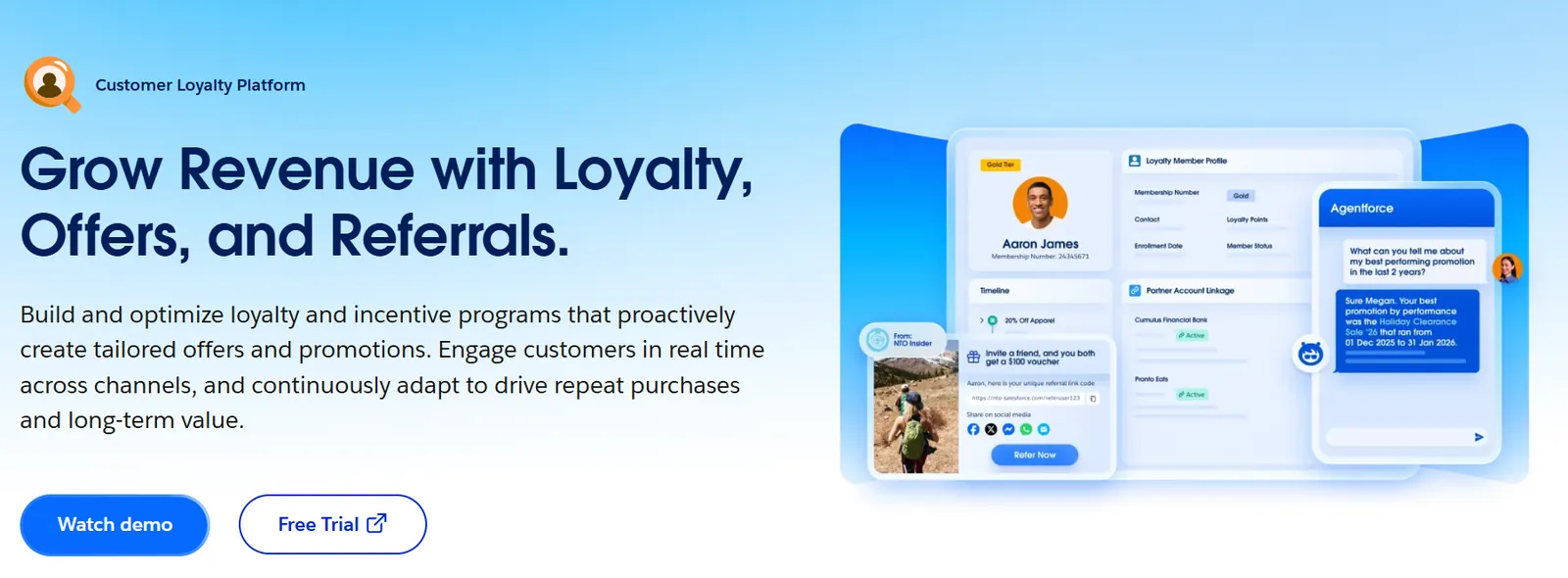
Salesforce Loyalty Management connects your hotel loyalty program to the customer records and service workflows you run on Salesforce. Each member is a loyalty record linked to a Contact for an individual or an Account for a corporate member.
In the loyalty service console, guest service agents see member details and past interactions on one page, open a case from the member profile, and check tier, balance, and voucher history without leaving it. Identity verification flows confirm the member before any adjustment.
Finance gets a formula for loyalty liability. The formula multiplies member point balances by the cost per point, then adds issued vouchers multiplied by the cost per voucher. The Liability Forecast dashboard projects liability for the coming months and shows how accruals, redemptions, expirations, and vouchers move it.
Your developers connect Loyalty Management to reservation and point-of-sale systems through business APIs and invocable actions for enrollment, point credits and debits, voucher issuance, and tier changes. Point accruals run in real time or in scheduled batches, and redemptions run in real time.
Connecting those APIs to your property systems is your project, though. Your developers or an implementation partner map the data, configure the earning and redemption workflows, and test them across your systems. MuleSoft is one route for that work, and Salesforce's POS API package works without it.
Salesforce is for you if you want loyalty and guest service on the same platform, whether you already use Salesforce or plan to adopt it, and Salesforce expertise on your team shortens the setup. If you need a simple rewards program with little implementation work, you won't get the most from a platform built for configuration at this depth.
Salesforce Loyalty Management Key Features
- Qualifying and non-qualifying currencies, so tiers run off one balance and redemption off the other
- Point-and-click rules designer and promotion wizard for accrual, redemption, tier upgrade, and expiration rules
- Promotion simulation that shows how rules apply to member transactions before a promotion goes live
- Partner administration for onboarding program partners, running joint promotions, and managing shared currencies
- A member portal template where members check tier, point balance, benefits, and recent transactions
Salesforce Loyalty Management Pricing
Loyalty Management comes in three tiers, priced per org per month and billed annually (no monthly payment option). A free trial is available, and CRM Analytics for Loyalty Management is licensed separately ($165 per user per month).
- Starter: $20,000 per org per month, one loyalty program, currency and tier management, the promotion wizard, receipt scanning, liability forecasting, the POS, POS+, and GDS+ integration kits, 1 million loyalty events per year, and 50,000 API calls per day
- Growth: $35,000 per org per month, adds the loyalty rules designer, simulation, promotion calendar, escrow points, member badges, engagement attributes, full benefit management, and simple partner administration, with 15 million loyalty events per year and 100,000 API calls per day
- Advanced: $45,000 per org per month, adds multiple loyalty programs, clubs, contact center for loyalty, advanced partner administration, 50 million loyalty events per year, and 500,000 API calls per day
Salesforce Loyalty Management Reviews and Ratings
- Gartner Peer Insights: 4.4/5 (14 reviews)
10. dailypoint: Best for Guest, Corporate-Booker, and Staff Loyalty on One Hotel-Native Profile
dailypoint builds one profile per person from the guest data across your hotel systems, starting from your PMS, and runs its loyalty programs on that profile. You can launch a branded member portal where guests enroll and manage rewards, or use the open API to build loyalty into your own website or app.
That profile can hold more than one relationship. A corporate travel manager booking 50 room nights a year is rarely rewarded by a guest program. In dailypoint, one profile holds that person's guest role and corporate-booker role without duplicating data, and points transfer between roles or programs. The B2B track rewards agencies and travel managers for the volume they send, and the HR track delivers staff rates and outlet discounts through the same POS and booking engine.
To recognize someone as both a guest and a booker, dailypoint has to match their records across your systems. Its Data Laundry service runs roughly 350 automated cleansing and enrichment steps, merges duplicate profiles in real time, and sends corrected data back to supported PMSs through two-way interfaces with more than 30 PMS providers.
Those PMS interfaces don't all carry the same functions. A two-way link for guest profiles doesn't necessarily cover live points updates and redemption, so if your properties run different PMSs, you'll need to confirm those workflows for each interface. Where one falls short, the affected hotel needs extra integration work or a different process, and the program runs less consistently across your group.
dailypoint is built for rewarding corporate bookers or employees alongside guests on one guest record, and its data cleansing helps where duplicate records get in the way of recognizing members. If you need identical earning and redemption at every property across different PMSs, make interface coverage the deciding factor.
dailypoint Key Features
- Physical and digital member cards, scanned at the point of sale so discounts and benefits apply automatically
- Connections to external loyalty currencies including Payback and Miles & More, plus airline and car rental programs
- A voucher engine tied to POS systems and the guest profile for timed, segment-specific offers
- Digital gift cards and wallet passes delivered to a guest's phone and redeemable against the same profile
- Interest and segment scoring built from behavior across stays, website visits, and email
dailypoint Pricing
dailypoint doesn't publish plan pricing, packages, or trial terms, and it prices each deployment individually.
dailypoint Reviews and Ratings
- Hotel Tech Report: 4.4/5 (226 reviews, rated in the Hotel CRM and Email Marketing category)
What Type of Hotel Loyalty Platform Do You Need?
The 10 platforms above fall into four architectures. The architecture decides where the loyalty logic runs and which of your systems it can reach. Place your own stack against the four types before you compare vendors.
Hospitality-Suite Loyalty Platforms
A suite module runs loyalty inside the PMS or hospitality platform your properties already use, so booking, front desk, POS, and member data share one ecosystem from the first day. Nothing has to be integrated before a guest can earn on a stay, and front-desk staff see tier and balance in the screen they already work in.
Choosing a suite's loyalty module also ties your program more closely to its hotel operations software. Existing connectors or APIs may let you include another vendor's PMS or gaming system, but those connections still need to support your earning and redemption workflows. If you later change the PMS, your team may need to rebuild connections or reconsider the loyalty module. Consider this dependency if you expect your properties to use different hotel systems over time.
Dedicated Enterprise Loyalty Engines
A dedicated engine runs the whole program in one system that connects to the rest of your stack, so you define the program once and every system reports into it. This is what an enterprise loyalty platform is in practice. It's built for groups whose properties already run different PMSs, with gaming, F&B, and retail each keeping their own records.
Connecting every system takes integration work up front, and you're buying a separate platform instead of switching on a feature of one you already pay for. In exchange, the program no longer depends on any one PMS, so a property that changes systems reconnects one integration instead of rebuilding the program.
API-First and Composable Loyalty Platforms
An API-first loyalty platform lets your developers or an implementation partner connect loyalty functions to your booking site or guest app. In a composable setup, you combine that engine with other tools you choose. The engine applies reward rules to incoming activity, while your site or app displays the results and lets guests use their rewards. This approach suits groups that want control over how members earn and redeem within their own booking experience.
Your team or implementation partner must maintain those connections and any custom features in your site or app. A no-code rule builder can let marketers adjust campaigns using data and actions the integration already supports. A new reward that needs additional booking data or a new redemption screen may require development work. You'll need ongoing technical support for those changes, so include that work in your budget and campaign schedule.
CRM/Data-Led Loyalty Platforms
A CRM-led platform builds loyalty as an extension of a CRM or customer data platform the group already owns. Member data, segmentation, and guest messaging live in the same system as sales and marketing, and the loyalty team inherits the segmentation it already trusts. Loyalty then runs within what the CRM's data model and program logic support.
The trade-off is that you also commit to the CRM or customer data platform that supports those loyalty tools. If you plan to keep a different CRM, your team may need to synchronize guest records between them. Related marketing or service features may also require additional licenses. Check those dependencies alongside each product's transaction capacity and liability reporting before deciding whether it fits your group.
How to Choose the Best Hotel Loyalty Program Software
Once you know which architecture fits your properties, compare the platforms inside it in the order an enterprise loyalty platform evaluation follows, from the program you want to the guest experience you can test.
1. Hotel Loyalty Program Model
Choose the reward model before you compare vendors, and match it to how your guests book and spend. Points and tiers can recognize repeat stays or qualifying spending across the property. For guests who book infrequently, member rates and immediate perks offer value on the current stay, while cashback provides a monetary reward for eligible spending. You can also include status benefits and experiences, such as late checkout or a chef's table, if your properties can deliver them consistently.
If you plan to combine different reward types, ask each vendor to show how they work on the same member account. For example, can a guest book at a member rate and still earn points on the stay? Confirm any restrictions on combining rewards before you commit.
2. Evaluate Your Existing Hotel Tech Stack
The systems your group already depends on change which platform makes sense, and a group that has just standardized on one PMS evaluates differently from one that runs three. List what loyalty will have to live alongside:
- A specific PMS, and how many instances of it
- POS systems in restaurants, bars, and retail
- A CRM or CDP
- The booking engine and distribution channels
- Marketing automation
- Gaming and player-tracking systems
- Mobile apps and kiosks
- Payment infrastructure
- Spa, golf, retail, or activity systems
- The existing loyalty platform and its member history
A suite's loyalty module may reduce integration work when its existing connections cover the systems you plan to keep. If your properties use several vendors, check each connection individually. Include planned software changes in that assessment, since a platform that fits today's setup may require more work after a PMS replacement.
3. Map the Systems Loyalty Needs to Connect With
For each system on that list, decide whether it needs to send loyalty data, receive it, or both, and whether the exchange has to happen in real time. Earning at one outlet and redeeming at another the same evening needs both of them on a live connection to the same balance. A monthly statement feed to the data warehouse needs a nightly sync and nothing more.
Ask each vendor to name its connectors for your PMS, POS, and gaming systems, and to say which of them run in real time. A named, maintained connector and an API you build against are both called integration, and they carry very different implementation timelines.
4. Calculate the Economics of Each Reward
Compare what guests value about a reward with its cost to your property. A free night carries the cost of servicing the room and may displace a paid booking when demand is high. An upgrade can cost less when the higher room category would otherwise go unsold, but it may still add service costs. Finance also needs to track outstanding reward obligations. For major hotel programs, CBRE reported liability of $17.85 per member in 2024, equivalent to 11.3% of average daily rate. Ask vendors how their reports support your finance team's liability calculations and trace balance changes to individual transactions.
To judge whether those rewards justify their cost, you also need to measure the business they generate. CBRE found that loyalty members accounted for 52.8% of occupied rooms in the programs it analyzed in 2024. That share shows how much business involves members, but it doesn't reveal how many stays would have happened without incentives.
To assess your own loyalty program ROI, ask whether you can analyze reward costs alongside booking revenue, using occupancy and room rates for context. Confirm whether the platform provides that analysis or connects to your analytics tools. Test offers with randomly assigned groups of eligible guests who receive or don't receive them, and compare results to estimate additional profit after reward costs. Include other program expenses when calculating overall ROI.
5. Test the Guest Experience
Before you sign, ask each vendor to demonstrate the full journey on your own scenario rather than on a demo account. A guest joins, books, earns on the stay and at an outlet, checks status on the app, redeems at a different property, and returns. Watch for the places where the journey stalls, whether a balance that updates minutes late, a redemption a front-desk agent has to phone another department to confirm, or a kiosk that shows a different tier from the app.
Each of those gaps turns into a workaround your staff run by hand, and a platform that answers every integration question on paper but stalls in this test will stall the same way in production.
ReactorCX: Replace an Outgrown Loyalty Platform Without Pausing Your Program
Fragmented systems, legacy infrastructure, and the risk of a migration going wrong keep hotel groups on loyalty platforms they outgrew years ago, because every year of accumulated accounts makes the switch look larger.
If your properties run systems from different vendors, the platform you choose has to work across them without replacing them. And if your members shouldn't notice the migration, it has to prove itself against your live program before anyone moves. ReactorCX is built for both, and Loyalty Methods runs it alongside your current platform until the two agree.
Bring your system list, planned earning rules, reward currencies, and a guest journey you want to support. If you're replacing an existing program, also share the requirements your finance and IT teams need the migration to meet. Request a demo to see how ReactorCX would run your program across your hotel and gaming systems.