
Epsilon's loyalty platform starts with knowing exactly who each member is. Its COREid service ties a member's online and in-store activity to one verified person. Epsilon then adds outside data, such as demographics, buying habits, and lifestyle, so every offer you send is tailored to the member receiving it.
As a marketing-first platform, Epsilon focuses mostly on what happens before the sale. But loyalty also happens at the register, where a fuel-and-convenience member might bring a cents-per-gallon reward, a double-points coffee promotion, and a tier bonus to one transaction, where the system has a fraction of a second to decide which apply. If it accepts all three when your rules allow only one, each of those sales gives away two rewards you never planned to pay for. With each mishandled transaction, that cost slowly drains partner offers and cuts into your margins.
The points members haven't redeemed raise the same kind of problem for finance. They count as a liability until they're spent or expire, and your finance team has to show where that number came from, transaction by transaction and brand by brand.
Both of those jobs start after the offer goes out, and they're why teams whose programs run at the register look at Epsilon alternatives. This guide covers eight of them, from engines that resolve offers at the register and let your own team change the rules to suites that treat loyalty as one module among many.
Top Epsilon Loyalty alternatives at a glance
| Platform | Best for |
|---|---|
| 1. Loyalty Methods (ReactorCX) | Real-time loyalty on every sale, inside your own stack |
| 2. Capillary Technologies | Program design from a dedicated loyalty consultancy |
| 3. Salesforce Loyalty Management | Running loyalty from your Salesforce records |
| 4. Comarch | Regulated, cross-border, and coalition programs that need hosting control |
| 5. Oracle CrowdTwist | Rewarding non-purchase engagement inside an Oracle CX stack |
| 6. SAP Emarsys | Tier-and-points programs running inside your marketing suite |
| 7. Annex Cloud | Referrals and reviews through the same engine as purchases |
| 8. Antavo | Changing program rules and journeys without an engineering ticket |
1. Loyalty Methods (ReactorCX): Best for real-time loyalty on every sale, inside your own stack
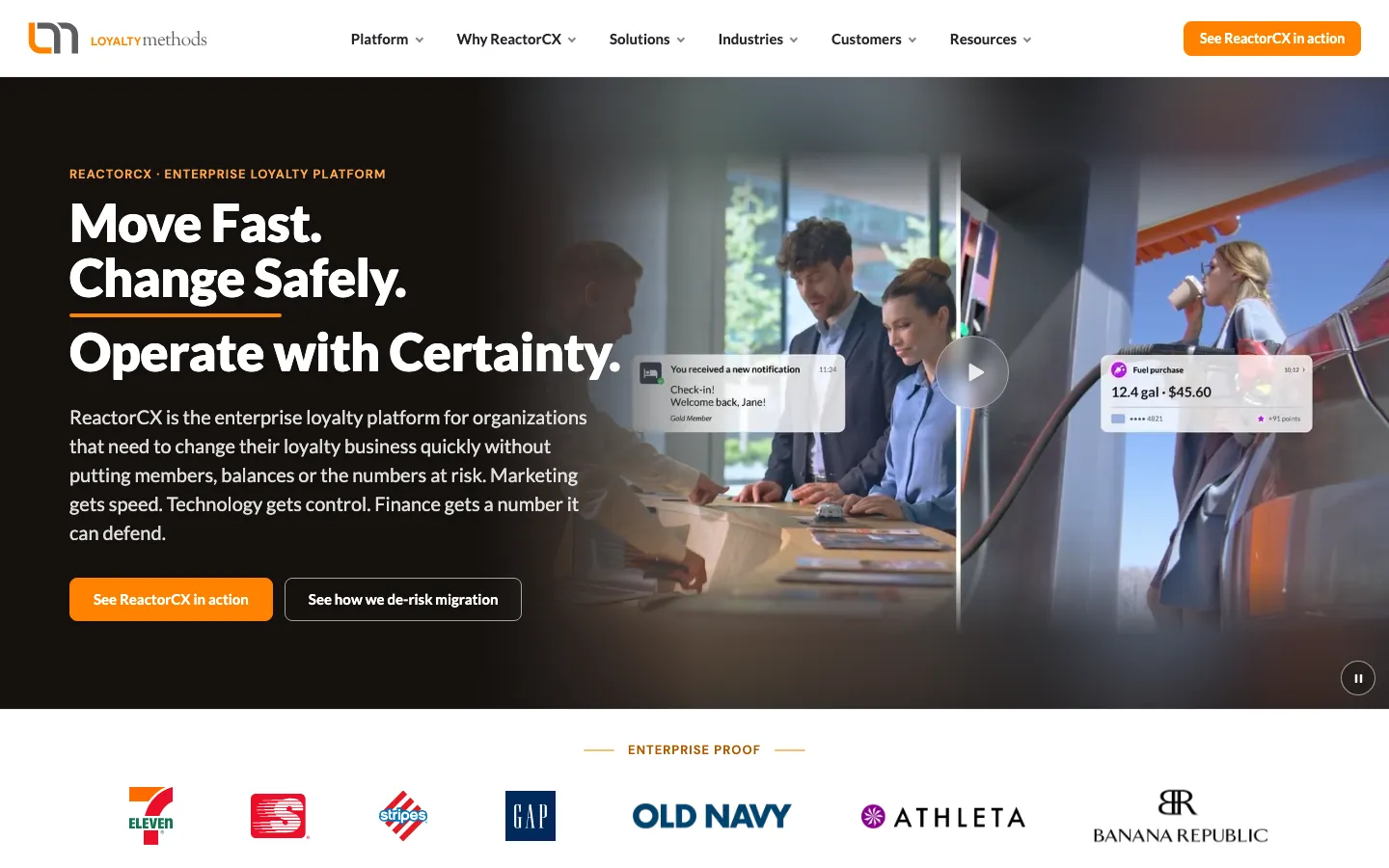
ReactorCX works out a member's balance, tier, and eligible offers in the same subsecond call, so your program makes its decisions while the customer is still at the register. One real-time engine runs the whole program as a headless, API-first backend inside your stack. It owns who a member is and what they've earned, while your apps and point-of-sale systems provide the member experience on top of it.
The same call decides which of your offers apply. ReactorCX evaluates every valid combination on the basket and returns the best allocation in under a second, optimized for the policy you set: customer-first, business-first, or vendor-protected. Earning and discounting resolve together, so the register applies the discount you intended and there's nothing to correct in an overnight batch.
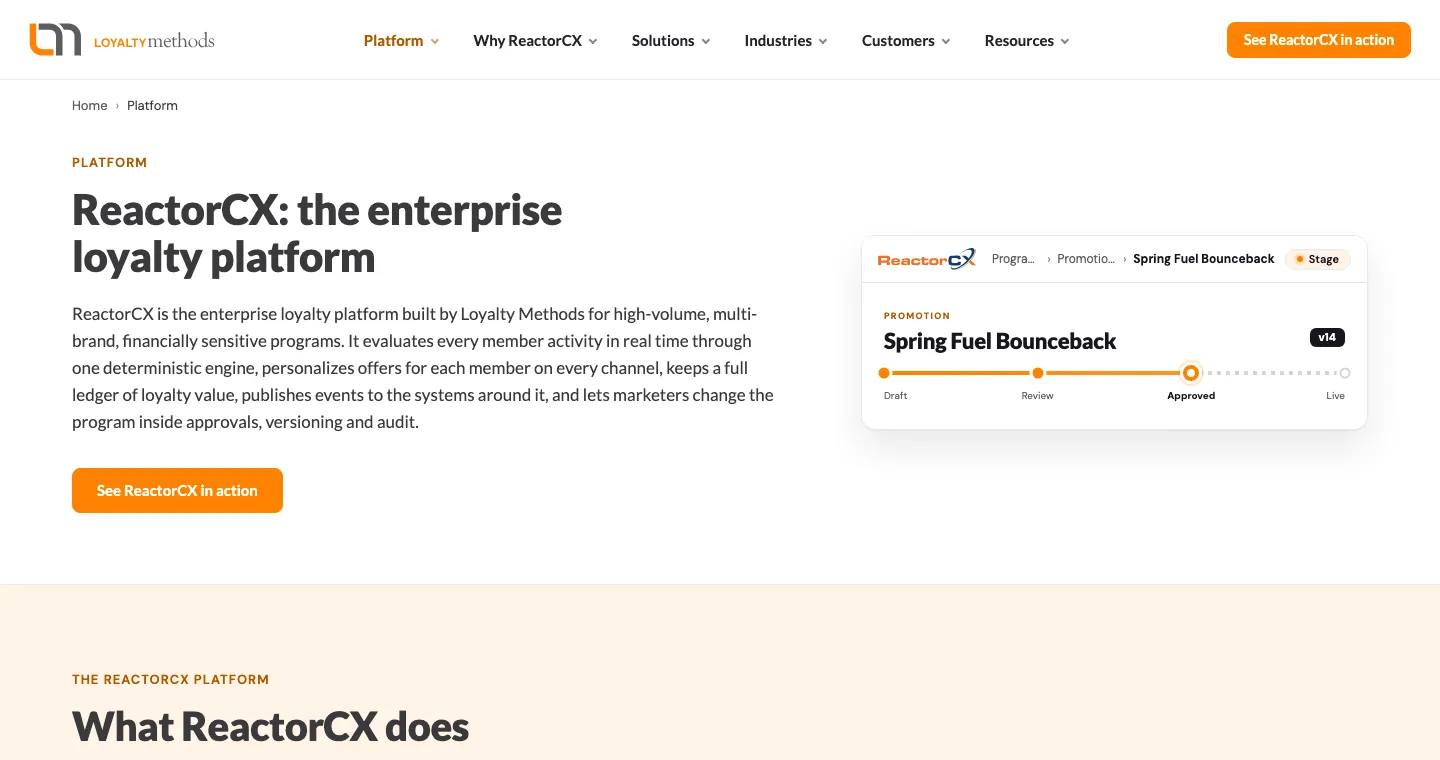
Every point that call awards is recorded against the activity that earned it. The engine preserves accrual and redemption lineage on every balance, lets you set the order points are spent in, and tags each redemption to a partner, location, or promotion. When finance asks for the outstanding-points liability, your controller can trace each figure back to its source.
Across several brands, a shopper keeps one member profile and one account while each banner's P&L still gets its own share. A mixed basket splits at the line item, and a return reverses against the brand that earned it.
Your team owns all of those rules. Every rule, earn rate, tier threshold, and reward definition is structured and reachable through the same APIs your systems already use. Your marketers change an offer or the arbitration policy from the admin console without waiting on a release, and engineers extend the same programmable core in code when the engine needs something the standard configuration doesn't cover.
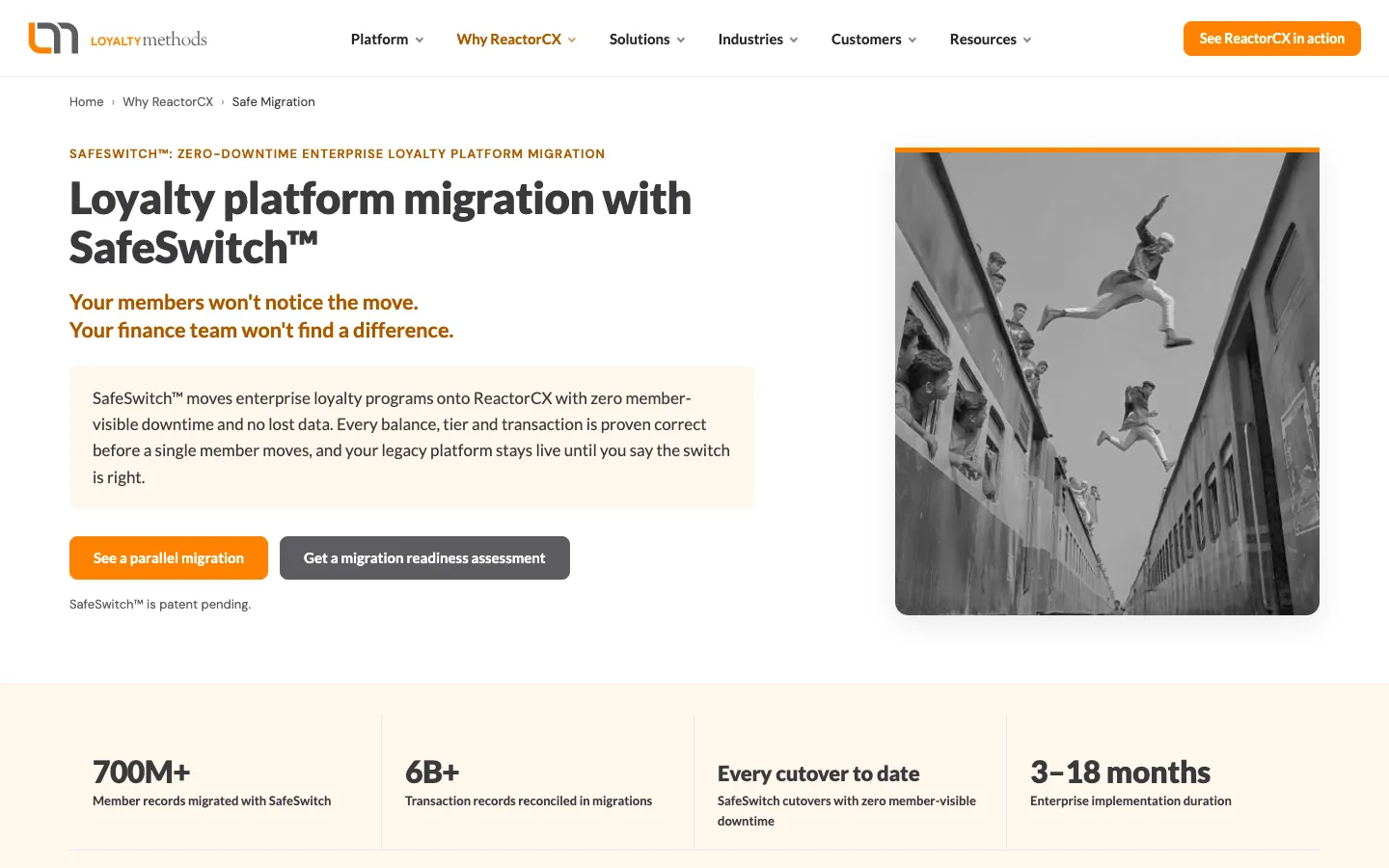
Your current program can also move onto that engine without going offline. SafeSwitch™ runs ReactorCX alongside your existing platform on live production traffic, reconciles every member’s balance and tier status account by account, and moves traffic only once both systems return the same answers. The legacy platform stays live with rollback armed until the new one is confirmed correct, so members keep their balances and your service team never reconciles accounts by hand.
If loyalty is part of the infrastructure your business runs on, and you want to retain full control over how your program functions, ReactorCX is a strong fit. But businesses running a simple points program will only use a small part of it.
Loyalty Methods' best features
- Extensible data model: The member record takes any custom attribute you define, and the activity schema adds new fields and event types without a platform change.
- Real-time offer arbitration: Overlapping offers are evaluated and allocated in the same call that resolves earn, under the policy you choose.
- Liability lineage: Every balance keeps its accrual and redemption history, and granular records export to your finance systems for journaling.
- Offer budget caps: A promotion deactivates on its own once it reaches its spending limit.
- Forecourt discounts: The discount library handles cents-per-gallon rollbacks at the pump alongside BOGO and mix-and-match offers.
- Member Care Portal: Service staff see the full member record and credit a missing transaction from one screen.
Loyalty Methods' pricing
Loyalty Methods doesn’t publish plans or tiers. Pricing depends on transaction volume, the number of brands and programs per instance, integration scope, and migration scope. Implementation is included in the engagement.
What are people saying about Loyalty Methods
“Loyalty Methods has been a crucial partner, providing a flexible platform and bringing an experienced team that has partnered well with BP to deliver on our initiatives with excellence and dedication.”
Tarang Sethia, Chief Product Officer and General Manager, Digital Products, Mobility and Convenience Americas, BP
“They are experts in their space and provide excellent solutions, creativity and out of the box thinking.”
Steve Kinch, Innovation Leader, 7-Eleven
2. Capillary Technologies: Best for program design from a dedicated loyalty consultancy
Capillary Technologies designs your loyalty program and runs the platform behind it. It acquired Brierley+Partners in 2023, so a dedicated loyalty-strategy consultancy comes with the software. While Epsilon's tiers include help configuring a program, Capillary brings a practice that designs one.
That design work starts from what your current program is currently accomplishing. Brierley's Program Health Assessment scores the program against industry benchmarks, and a cost-benefit analysis shows whether it earns back what it costs in incremental revenue. The Brierley Loyalty Quotient, a short member survey, also measures how much of your members' loyalty comes from the rewards and how much from attachment to the brand.
With those results in hand, you know whether a redesign should change the earn rates and rewards or the experience around them.
On the software side, Loyalty+ lets you run one default program across your brands, with brand or country programs under it on a single customer database. A purchase at one of your stores runs through both that store's program and the default one, so a member can earn with one brand and redeem with another.
Live offers are less flexible, though. Once a cart promotion goes live, the per-customer limit and the overall redemption count can't be updated. If your team adjusts limits while an offer runs, you'll need to get them right before launch.
Capillary works when you're building a new program or reworking an existing one and want the same company advising on it and running it. If your program's design already works and you only need a new platform, Brierley has less to add.
Capillary Technologies' best features
- Includes Brierley+Partners consulting, from program health assessments to churn and lifetime-value modeling.
- Runs tiered, experiential, gamified, and coalition programs from one configurable platform.
- Applies points and discounts at checkout, online and in store.
- Measures loyalty's direct revenue impact with a proprietary ROI methodology.
- Holds ISO 27001 and PCI DSS certification, with a four-hour recovery time objective.
Capillary Technologies' pricing
Capillary doesn't publish a self-serve rate card. Every engagement is a negotiated enterprise contract.
Capillary Technologies ratings
G2: 4.8/5 (6 reviews)
3. Salesforce Loyalty Management: Best for running loyalty from your Salesforce records
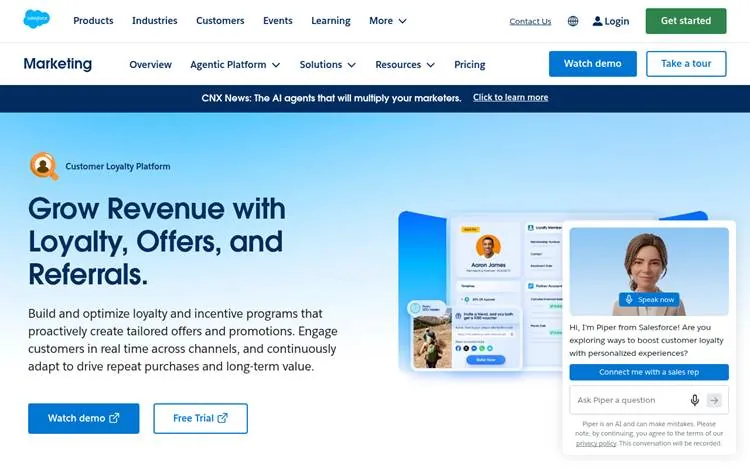
If your service, commerce, and marketing teams already work in Salesforce, a separate loyalty system means another integration to build and another storage to manage for customer data. Loyalty Management is built on the Salesforce Platform, so the program runs in the same org and reads from the same customer record. A tier upgrade or an expiring reward can kick off a journey in real time, without anything moving between systems first.
Where Epsilon enriches member records with its own identity graph, Loyalty Management works from the Data 360 record you already hold. Loyalty activity joins the behavioral and transaction data already there, so the segments you reward and the offers you target draw on the same customer data your sales and service teams see.
Finance sees what those rewards cost without leaving Salesforce. Liability Forecasting multiplies the points balance by what a point costs you, then adds issued vouchers multiplied by what each voucher costs, so your finance team gets an outstanding-points figure they can test against their own assumptions.
But when several of those offers apply to the same basket, Salesforce doesn't decide between them. Your team builds that step, typically by checking which promotions a member qualifies for and then applying the one your rules choose, or with an integration partner who can build it for you.
If Salesforce is already where your teams sell to and serve customers, Loyalty Management extends that system instead of adding another platform beside it. If many of your offers overlap, you'll need that extra build before launch.
Salesforce Loyalty Management's best features
- Forecasts points liability from the cost per point and per voucher you set.
- Supports points, tiered, cashback, punch-card, and hybrid programs.
- Tests promotions in Simulation before they go live.
- Flags suspicious member activity with Intelligent Fraud Management.
- Uses Agentforce to recommend the next best offer for each member.
Salesforce Loyalty Management's pricing
Loyalty Management is billed annually, with no monthly option, and pricing is per org. A multi-brand enterprise needs the Advanced tier, since Starter and Growth are each capped at a single program. Add-ons stack on top of the license.
- Starter: $20,000/org/month billed annually, covering one loyalty program, 1 million loyalty events per year, one Tableau CRM license, and 50K API calls per day
- Growth: $35,000/org/month billed annually, still a single program, with 15 million loyalty events per year, three Tableau CRM licenses, and 100K API calls per day
- Advanced: $45,000/org/month billed annually, adding multi-program support, 50 million loyalty events per year, five Tableau CRM licenses, and 500K API calls per day
- Add-ons: Extra Tableau CRM for Loyalty Management at $165/user/month, Referral Marketing at $12,500/org/month, and Premier Success at 30% of net license fees
Salesforce Loyalty Management ratings
Gartner Peer Insights: 4.4/5 (14 reviews)
4. Comarch: Best for regulated, cross-border, and coalition programs that need hosting control

Comarch lets you decide where your member data physically runs. You can run the program as a managed service from Comarch's own 16 data centers, install it in your own Azure, AWS, or Google Cloud account, or put it on your own hardware, alone or split with the cloud.
If in-country hosting laws apply to your program, as they often do for banks, airlines, and cross-border programs, you can keep member data on your own servers in the country the law requires.
Comarch is also built for coalition programs, where members earn points at one partner and spend them at another. Partner billing works out who owes whom in co-branded and multi-partner programs, and settlement reports break the balance down by partner, so each partner's share is calculated in the platform. Expiration and liability reports in the same analytics module show what the program still owes as points expire.
Beyond the platform, Comarch's team can run much of the program for you. Implementation starts at about three months for a standard program, and after launch the team can configure campaigns, tiers, and accrual rules, monitor for fraud, and take on ongoing changes as an outsourced service. That spares you from staffing a loyalty team, though the people changing your program then work for Comarch.
When regulators, partners, or the countries you operate in dictate how a program has to run, Comarch’s hosting control makes it stand out. A single-brand program in one country with no hosting restrictions has less reason to choose it.
Comarch's best features
- Supports multi-level tiers and flexible point-accrual rules across brands, countries, and currencies.
- Runs a DIAMETRICS health check, where Comarch's consultants review your program across five areas and recommend changes.
- Models churn, customer lifetime value, and campaign uplift in CLM Business Intelligence.
- Segments members with RFM analysis of how recently, how often, and how much they buy.
- Detects fraud with AI and machine-learning models.
Comarch's pricing
Comarch doesn't publish a rate card for its enterprise platform. Each quote is scoped to the modules you select, the program's scale, and integration complexity. Comarch Loyalty Cloud, a separately sold growth-stage tier, is billed per active member or per transaction.
Comarch ratings
G2: 4.2/5 (10 reviews)
5. Oracle CrowdTwist: Best for rewarding non-purchase engagement inside an Oracle CX stack
Oracle CrowdTwist rewards what members do between purchases and puts that behavioral data where your Oracle marketing and commerce teams already work. Members earn for surveys, sweepstakes, and challenges, and each action adds to a first-party profile that combines engagement, social activity, and spend. That's a different starting point from Epsilon, which builds profiles from identity data.
CrowdTwist sends that activity to the rest of your Oracle stack. Responsys gets it in real time, so you can message a member right after they finish a challenge or reach a new tier. Unity takes in profiles, activities, and redemptions as they happen, and the segments your team builds there come back to CrowdTwist on a schedule. On your own site, members see their point balance, tier, and open surveys in widgets you embed on the page.
However, each CrowdTwist instance runs only one loyalty program. If your brands can share one set of tier rules and one points economy, a single instance covers them all. But a brand that needs different tier rules, a different points economy, a separate country program, or data residency in its own region needs a separate instance, set up and run on its own. That adds up.
If your team judges loyalty by engagement as well as spend, and your campaigns already go out through Responsys, you can add CrowdTwist without changing how those campaigns run. Without Oracle's marketing tools in your stack, you lose the connection that sets it apart.
Oracle CrowdTwist's best features
- Rewards members for connecting their social accounts.
- Segments members in real time on profile and custom attributes.
- Offers rewards across gift cards, sweepstakes, and donations.
- Allows members to earn partner points alongside your own.
- Lets members pool points within a household.
Oracle CrowdTwist's pricing
Oracle doesn't publish a list price for CrowdTwist. The base service is priced per 1,000 active members for each program instance, add-ons are priced separately, and every instance requires setup, configuration, and program management services.
Oracle CrowdTwist ratings
G2: 4.8/5 (2 reviews)
6. SAP Emarsys: Best for tier-and-points programs running inside your marketing suite
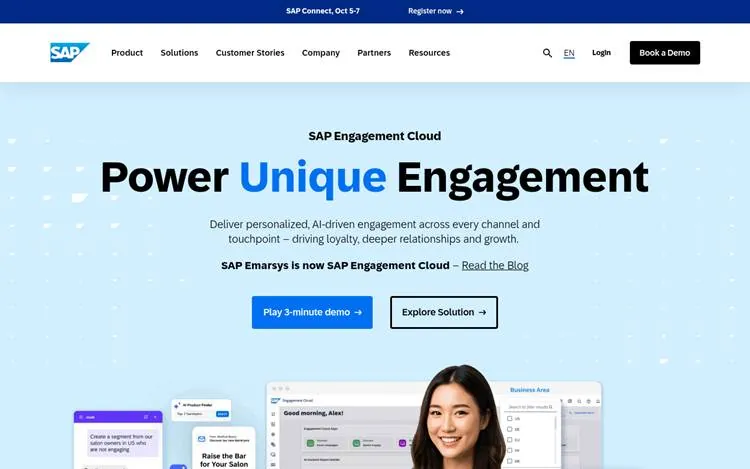
SAP Emarsys puts your loyalty program in the same software your campaign team already sends from. The suite, sold as SAP Engagement Cloud since February 2026, runs loyalty as a module, so the congratulations email goes out the moment a member reaches Gold and there's no separate loyalty system to connect.
Member profiles come from your own customer records and the suite's built-in customer data platform, with no outside identity graph like Epsilon's behind them.
Your team doesn't build those messages from scratch. Emarsys ships pre-built tactics with triggers, segments, and personalization already configured for the journeys most programs need, including member onboarding, tier upgrades, and expiring-points reminders.
Members take the same program into your stores in their phone's wallet. They save a loyalty card to Apple Wallet or Google Wallet without downloading an app, and the card identifies them at the counter, so they can redeem rewards in the store as well as online.
But the native module primarily covers the core of a tier-and-points program. Referral programs and enterprise-scale loyalty management come from partner platforms that plug into Emarsys, which puts a second system back into your stack. However, if tiers, points, and campaigns are all your program needs, this module alone is enough.
When your marketing team already works in SAP and loyalty's main job is bringing customers back, Emarsys adds a program to the suite they know. Teams whose campaigns run elsewhere would be taking on a whole marketing suite to get one loyalty module.
SAP Emarsys' best features
- Nudges members who are close to the next tier, based on their trailing spend.
- Rewards members for filling in more of their profile over time.
- Reaches members by email, SMS, push, and WhatsApp from the same campaigns.
- Shows loyalty offers on your website and in digital ads.
- Sets tier qualification rules and points expiry for the program.
SAP Emarsys' pricing
SAP doesn't publish a price for Engagement Cloud and quotes it on request. It sells the suite in blocks of 100,000 contacts on auto-renewing contracts, and the cost scales with the size of your contact database and the channels you activate.
SAP Emarsys ratings
G2: 4.2/5 (645 reviews)
7. Annex Cloud: Best for referrals and reviews through the same engine as purchases
Annex Cloud rewards referrals, reviews, and social engagement through the same loyalty engine that rewards purchases, so a member earns from a referred friend or a posted review the way they earn from a basket. Epsilon's program centers on personalizing offers to each member, while Annex Cloud concentrates on widening what members can earn for.
The engagement tools go further than points. Leaderboards rank members by purchases, milestones, or points, and action series reward a member for completing a set sequence of actions you define. You can show a tier to push members toward the next level, or hide it so the upgrade arrives as a surprise.
Across brands and regions, you start each program from a reusable template, keep the elements they share, and customize earn rules and tiers per market. For example, if you sell in North America, EMEA, and Asia-Pacific, you don't rebuild the program three times. The multi-language and multi-currency templates run on one shared instance, and a multi-instance option keeps regions apart where data residency requires it.
As part of those flexible instances, your marketers can change offers and program rules in the platform without filing a ticket. More than 125 pre-built integrations, including Adobe, Shopify, Klaviyo, and Segment, connect it to the systems your program already draws from.
With Annex Cloud, support starts with your own team. It expects your trained staff to handle first-line issues, like a discount that won't apply or points a member says vanished, and to escalate only what they can't fix, with steps that reproduce the fault. Annex Cloud's 24/7 support team takes those escalations. If you don't already run a support desk for your loyalty program, you'll need to set one up.
Annex Cloud makes the most sense when your customers already recommend and review your products and you want that activity to count toward their rewards. A purchase-only points program won't need the referral and review side of the suite.
Annex Cloud's best features
- Runs referrals through its Refer-a-Friend module.
- Collects ratings, reviews, and user-generated content in the same suite as the loyalty program.
- Awards badges as members reach milestones.
- Holds SOC 2 Type 2 and ISO 27001 certification, with role-based access control and audit logs.
- Supports GDPR and CCPA compliance for member data.
Annex Cloud's pricing
Annex Cloud doesn't publish pricing, and every engagement is quoted individually.
Annex Cloud ratings
Capterra: 4.2/5 (39 reviews)
8. Antavo: Best for changing program rules and journeys without an engineering ticket
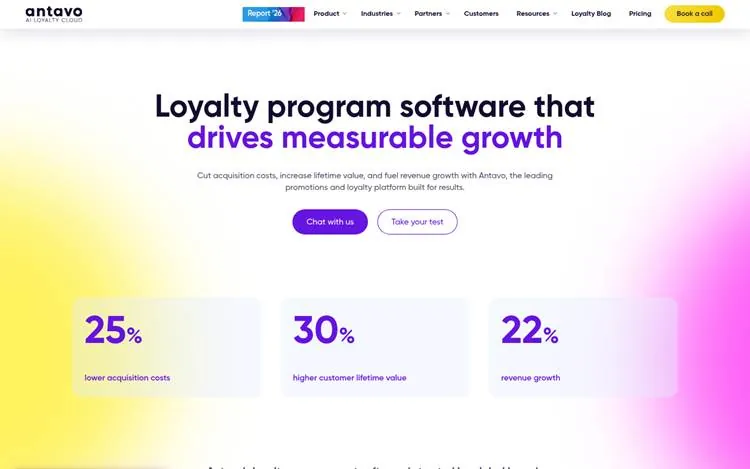
Antavo puts program configuration in your marketing team's hands. The Workflows editor is drag-and-drop and needs no code, so your team builds and changes earn rules, campaigns, and journeys without filing an engineering ticket.
A workflow starts on a date or when a member does something, then acts on it, such as assigning a reward, sending a message, or moving the member into a segment. A seasonal campaign, for example, can start on a set date, cap the points each member earns, and be saved as a blueprint to run again next year. After a workflow runs, you can trace the path each member took through it.
Workflow results don't stay inside Antavo. Its APIs and webhooks send loyalty updates to your CRM and ecommerce platform in real time, so your online store can show members their balance as it changes. Because the platform is headless, your developers build the member-facing screens on those same APIs and decide how each one looks.
Across markets, Antavo handles multiple currencies and languages, and a new market can launch in days. But each loyalty program runs in its own workspace with its own member database. So if your brands run separate programs, a shopper who belongs to two of them has two accounts and two balances. Brands that share one program, or rarely share customers, won't run into it.
Antavo suits a loyalty team that wants to run its own rules, campaigns, and journeys, market by market. Your marketers get the controls, and your developers decide what members see.
Antavo's best features
- Adds gamification such as missions, badges, prize wheels, and scratch cards.
- Offers spend-based, point-based, and invitation-only tiers.
- Runs custom currencies such as points, credits, and stamps in its Points Economy module.
- Issues Apple Wallet and Google Wallet loyalty cards with no app download.
- Scans receipts to credit purchases made outside your own channels.
Antavo's pricing
Antavo doesn't publish prices for its three plans, and there's no free trial.
- Start: for ecommerce brands that want a quick, simple program
- Grow: for brands outgrowing tactical loyalty apps
- Enterprise: for complex programs running across markets, channels, or brands
Antavo ratings
G2: 4.2/5 (7 reviews)
Loyalty Methods: The Best Epsilon Alternative for the Operational Side of Loyalty
Epsilon is a strong choice when loyalty is mainly a way to know your members and market to them well. Its identity data and personalization are built for that, and many marketing-focused programs get what they need out of it.
ReactorCX puts loyalty at the register instead. Every discount and every point is settled inside your own stack while the customer is still paying, and the balance finance reports trace back to the purchases and activity behind it.
Your team's job becomes deciding the rules. Your marketers change them without waiting on a release, your engineers extend them in code when the program needs more, and moving your current program over is part of the engagement rather than a project you run alone.
When you're ready to see how that would work for your program, book a call with us. We'll go through your member counts, your brands, and what your team would be running day to day.